QUESTION IMAGE
Question
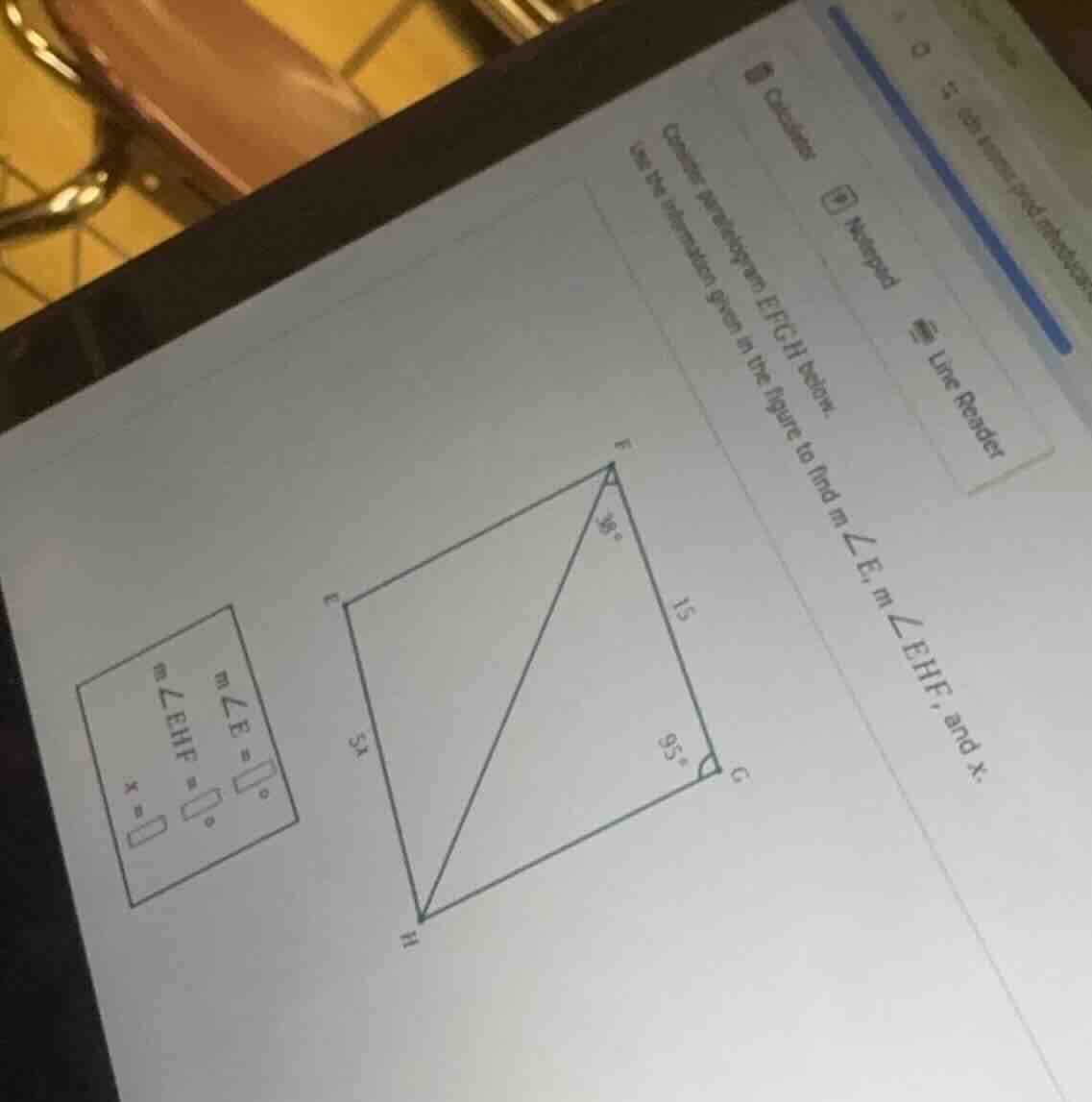
consider parallelogram efgh below. use the information given in the figure to find ( mangle e ), ( mangle ehf ), and ( x ).
in the parallelogram efgh, side ( fg = 15 ), ( angle g = 95^circ ), ( angle feh = 36^circ ) (marked at e), side ( eh = 5x ), and theres a triangle inside. also, a box with ( mangle e = square^circ ), ( mangle ehf = square^circ ), ( x = square ).
Step1: Find \( m\angle E \)
In a parallelogram, consecutive angles are supplementary. So \( m\angle E + m\angle G = 180^\circ \). Given \( m\angle G = 95^\circ \), then \( m\angle E = 180^\circ - 95^\circ = 85^\circ \).
Step2: Find \( m\angle EHF \)
In triangle \( EHF \), we know one angle is \( 36^\circ \) (at \( E \)) and we found \( \angle E = 85^\circ \), but wait, actually, in parallelogram \( EFGH \), \( EF \parallel GH \) and \( EH \) is a transversal? Wait, no, let's correct. Wait, in parallelogram \( EFGH \), \( EF = GH \) and \( EH = FG \). Also, the triangle: wait, the angle at \( E \) in the parallelogram is \( 85^\circ \), and the angle given at \( E \) in the triangle is \( 36^\circ \)? Wait, no, maybe the triangle is isoceles? Wait, no, let's re-express. Wait, in parallelogram \( EFGH \), opposite angles are equal, consecutive angles are supplementary. So \( m\angle E + m\angle G = 180^\circ \), so \( m\angle E = 180 - 95 = 85^\circ \). Then, in triangle \( EHF \), we have \( \angle HEF = 36^\circ \) (given at \( E \) in the triangle), and we need to find \( \angle EHF \). Wait, but in the parallelogram, \( EH = FG = 15 \)? Wait, no, \( FG = 15 \), \( EH = 5x \)? Wait, no, \( EH \) and \( FG \) are opposite sides, so \( EH = FG = 15 \)? Wait, no, the side \( FG \) is 15, and \( EH \) is \( 5x \)? Wait, no, opposite sides of a parallelogram are equal, so \( EH = FG \) and \( EF = GH \). So \( EH = FG = 15 \), so \( 5x = 15 \), so \( x = 3 \). Wait, that's a simpler step. Let's do that first.
Step3: Find \( x \)
In parallelogram \( EFGH \), opposite sides are equal. So \( EH = FG \). Given \( EH = 5x \) and \( FG = 15 \), so \( 5x = 15 \). Solving for \( x \), divide both sides by 5: \( x = \frac{15}{5} = 3 \).
Step4: Find \( m\angle EHF \)
Now, in triangle \( EHF \), we know \( \angle HEF = 36^\circ \), and \( \angle HFE = \angle E = 85^\circ \)? Wait, no, \( \angle E \) in the parallelogram is \( 85^\circ \), which is \( \angle HEF + \angle FEH \)? Wait, no, the angle at \( E \) in the parallelogram is \( \angle HEF \)? Wait, maybe the triangle is formed by the diagonal \( HF \). So in parallelogram \( EFGH \), \( EF \parallel GH \), \( EH \parallel FG \). The diagonal \( HF \) splits the parallelogram into two triangles. Now, in triangle \( EHF \), we have angles: let's see, the angle at \( E \) in the triangle is \( 36^\circ \), and we need to find \( \angle EHF \). Wait, but we know that in the parallelogram, \( \angle E = 85^\circ \), which is the angle at vertex \( E \) of the parallelogram, so that angle is composed of \( \angle HEF = 36^\circ \) and another angle? Wait, no, maybe the given angle at \( E \) in the triangle is \( 36^\circ \), and the angle of the parallelogram at \( E \) is \( 85^\circ \), so the other angle in the triangle at \( E \) is \( 85^\circ - 36^\circ \)? No, that doesn't make sense. Wait, maybe the triangle is isoceles? Wait, no, let's use the fact that in triangle \( EHF \), the sum of angles is \( 180^\circ \). Wait, we know \( \angle HEF = 36^\circ \), and we need to find \( \angle EHF \). But we also know that in the parallelogram, \( EH = FG = 15 \), and \( EF \) is a side. Wait, maybe I made a mistake earlier. Let's re-express:
In parallelogram \( EFGH \):
- Opposite sides: \( EH = FG = 15 \), so \( 5x = 15 \implies x = 3 \).
- Consecutive angles: \( m\angle E + m\angle G = 180^\circ \), so \( m\angle E = 180 - 95 = 85^\circ \).
- Now, in triangle \( EHF \), we have \( \angle HEF = 36^\circ \), \( \angle HFE = \angle E - 36^\circ \)? Wait, no, the angle at \( E \) in…

Snap & solve any problem in the app
Get step-by-step solutions on Sovi AI
Photo-based solutions with guided steps
Explore more problems and detailed explanations
\( m\angle E = \boxed{85^\circ} \), \( m\angle EHF = \boxed{59^\circ} \), \( x = \boxed{3} \)