QUESTION IMAGE
Question
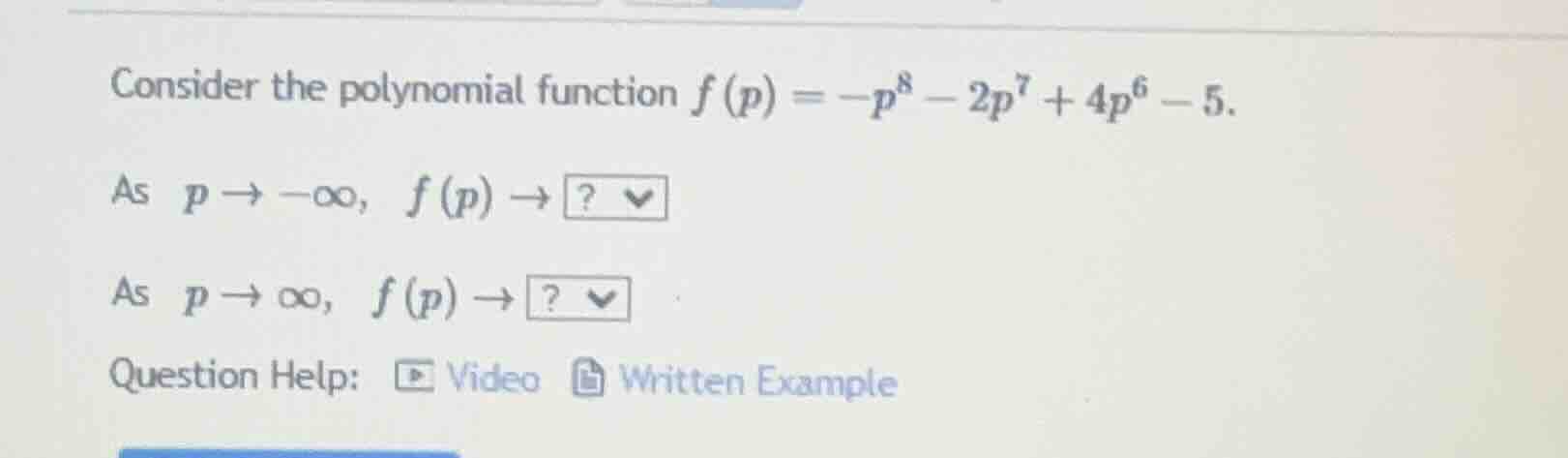
consider the polynomial function $f(p) = -p^8 - 2p^7 + 4p^6 - 5$. as $p \to -\infty$, $f(p) \to$? as $p \to \infty$, $f(p) \to$? question help: video written example
Step1: Identify Leading Term
The leading term of the polynomial \( f(p) = -p^8 - 2p^7 + 4p^6 - 5 \) is \( -p^8 \), since it has the highest degree (degree 8).
Step2: Analyze End Behavior for \( p \to -\infty \)
For a polynomial, the end behavior is determined by the leading term. The leading term is \( -p^8 \). When \( p \to -\infty \), \( p^8 \) (since the exponent is even) will be a large positive number. Multiplying by -1 gives \( -p^8 \to -\infty \)? Wait, no: Wait, \( p^8 \) when \( p \) is negative: \( (-a)^8 = a^8 \) (positive, since 8 is even). So \( -p^8 = - (positive) \), so as \( p \to -\infty \), \( p^8 \to \infty \), so \( -p^8 \to -\infty \)? Wait, no, wait: Wait, \( p \to -\infty \), so let's take \( p = -N \) where \( N \to \infty \). Then \( p^8 = (-N)^8 = N^8 \), so \( -p^8 = -N^8 \), which goes to \( -\infty \) as \( N \to \infty \)? Wait, no, that can't be. Wait, no, wait: Wait, the leading term is \( -p^8 \). So when \( p \) is large in magnitude (positive or negative), the leading term dominates. Let's check the degree and the leading coefficient. The degree is 8 (even), leading coefficient is -1 (negative). For even degree polynomials:
- If leading coefficient is positive: as \( p \to \pm\infty \), \( f(p) \to \infty \)
- If leading coefficient is negative: as \( p \to \pm\infty \), \( f(p) \to -\infty \)
Wait, that's the key. For even degree, the ends go in the same direction. Since the leading coefficient is negative, both as \( p \to \infty \) and \( p \to -\infty \), \( f(p) \to -\infty \)? Wait, let's verify with \( p \to -\infty \):
Take \( p = -1000 \), then \( p^8 = (-1000)^8 = 1000^8 \) (positive), so \( -p^8 = -1000^8 \) (very negative). So as \( p \to -\infty \), \( f(p) \to -\infty \).
Step3: Analyze End Behavior for \( p \to \infty \)
Similarly, when \( p \to \infty \), \( p^8 \to \infty \), so \( -p^8 \to -\infty \) (since leading coefficient is -1 and degree is even). So both ends go to \( -\infty \).
Wait, let's confirm the rule: For a polynomial \( a_n p^n + \dots + a_0 \):
- If \( n \) is even:
- If \( a_n > 0 \), as \( p \to \pm\infty \), \( f(p) \to \infty \)
- If \( a_n < 0 \), as \( p \to \pm\infty \), \( f(p) \to -\infty \)
- If \( n \) is odd:
- If \( a_n > 0 \), as \( p \to \infty \), \( f(p) \to \infty \); as \( p \to -\infty \), \( f(p) \to -\infty \)
- If \( a_n < 0 \), as \( p \to \infty \), \( f(p) \to -\infty \); as \( p \to -\infty \), \( f(p) \to \infty \)
In our case, \( n = 8 \) (even), \( a_n = -1 \) (negative). So both as \( p \to \infty \) and \( p \to -\infty \), \( f(p) \to -\infty \).

Snap & solve any problem in the app
Get step-by-step solutions on Sovi AI
Photo-based solutions with guided steps
Explore more problems and detailed explanations
As \( p \to -\infty \), \( f(p) \to \boldsymbol{-\infty} \)
As \( p \to \infty \), \( f(p) \to \boldsymbol{-\infty} \)