QUESTION IMAGE
Question
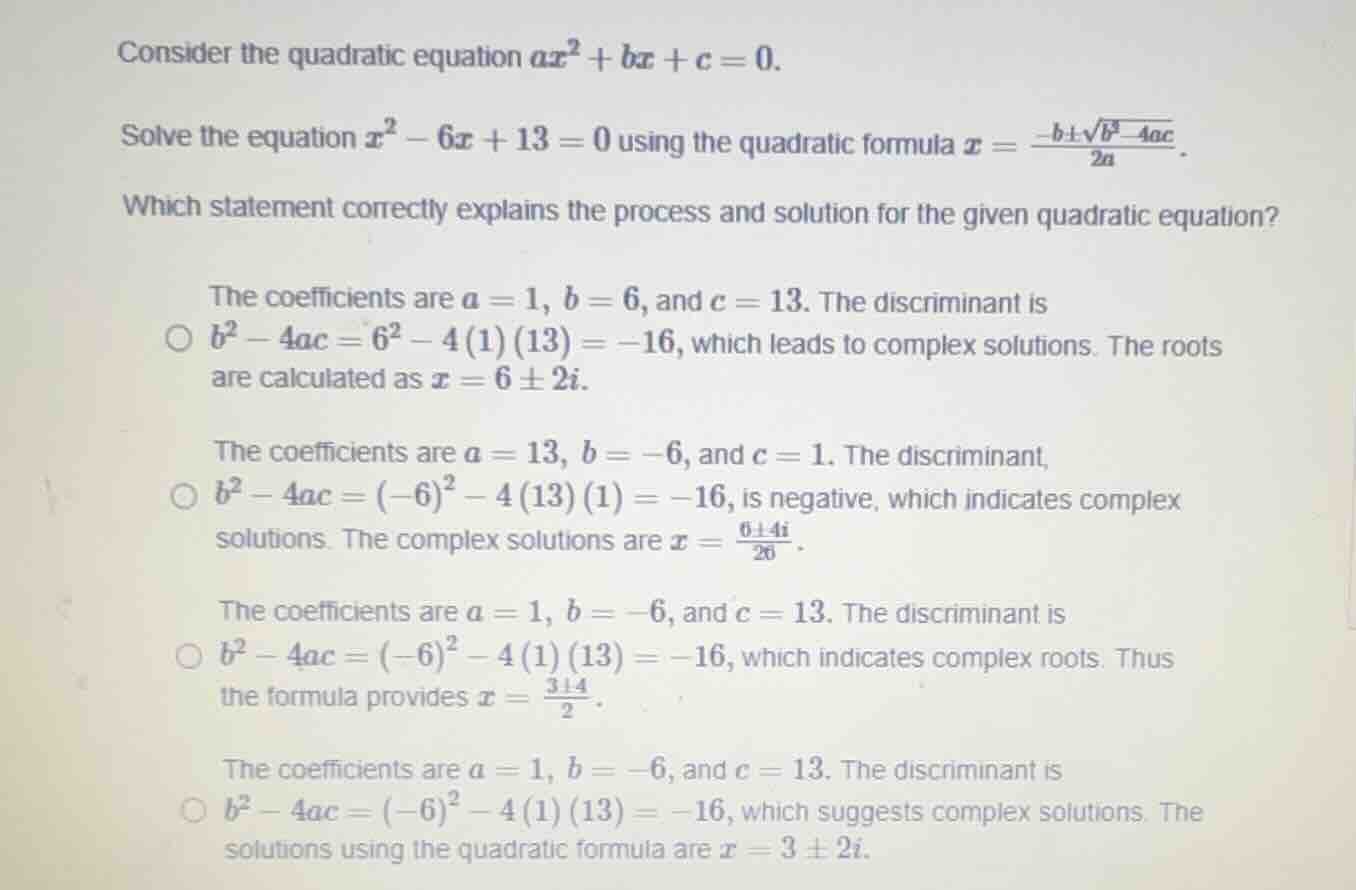
consider the quadratic equation ( ax^2 + bx + c = 0 ).
solve the equation ( x^2 - 6x + 13 = 0 ) using the quadratic formula ( x = \frac{-b pm sqrt{b^2 - 4ac}}{2a} ).
which statement correctly explains the process and solution for the given quadratic equation?
the coefficients are ( a = 1 ), ( b = 6 ), and ( c = 13 ). the discriminant is
( b^2 - 4ac = 6^2 - 4(1)(13) = -16 ), which leads to complex solutions. the roots
are calculated as ( x = 6 pm 2i ).
the coefficients are ( a = 13 ), ( b = -6 ), and ( c = 1 ). the discriminant,
( b^2 - 4ac = (-6)^2 - 4(13)(1) = -16 ), is negative, which indicates complex
solutions. the complex solutions are ( x = \frac{6 pm 4i}{26} ).
the coefficients are ( a = 1 ), ( b = -6 ), and ( c = 13 ). the discriminant is
( b^2 - 4ac = (-6)^2 - 4(1)(13) = -16 ), which indicates complex roots. thus
the formula provides ( x = \frac{3 pm 4}{2} ).
the coefficients are ( a = 1 ), ( b = -6 ), and ( c = 13 ). the discriminant is
( b^2 - 4ac = (-6)^2 - 4(1)(13) = -16 ), which suggests complex solutions. the
solutions using the quadratic formula are ( x = 3 pm 2i ).
Step1: Identify coefficients
For $x^2 - 6x + 13 = 0$, compare to $ax^2+bx+c=0$:
$a=1$, $b=-6$, $c=13$
Step2: Calculate discriminant
Use $\Delta = b^2-4ac$:
$\Delta = (-6)^2 - 4(1)(13) = 36 - 52 = -16$
Step3: Apply quadratic formula
Substitute into $x=\frac{-b\pm\sqrt{b^2-4ac}}{2a}$:
$x=\frac{-(-6)\pm\sqrt{-16}}{2(1)} = \frac{6\pm4i}{2} = 3\pm2i$
Step4: Match correct option
Verify each choice against the above steps.

Snap & solve any problem in the app
Get step-by-step solutions on Sovi AI
Photo-based solutions with guided steps
Explore more problems and detailed explanations
The coefficients are $a = 1$, $b = -6$, and $c = 13$. The discriminant is $b^2 - 4ac = (-6)^2 - 4(1)(13) = -16$, which suggests complex solutions. The solutions using the quadratic formula are $x = 3 \pm 2i$.