QUESTION IMAGE
Question
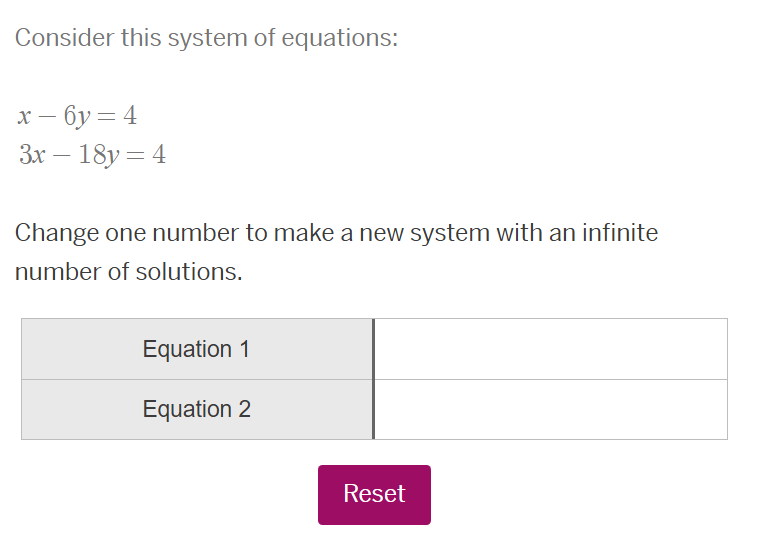
consider this system of equations:
x - 6y = 4
3x - 18y = 4
change one number to make a new system with an infinite
number of solutions.
equation 1
equation 2
reset
Step1: Recall infinite solutions condition
A system \(
\) has infinite solutions if \( \frac{a_1}{a_2}=\frac{b_1}{b_2}=\frac{c_1}{c_2} \).
Step2: Analyze given equations
Given \( x - 6y = 4 \) (Equation 1) and \( 3x - 18y = 4 \) (Equation 2).
For \( x - 6y = 4 \) and \( 3x - 18y = c_2 \), \( \frac{1}{3}=\frac{-6}{-18}=\frac{4}{c_2} \). Solve \( \frac{4}{c_2}=\frac{1}{3} \Rightarrow c_2 = 12 \).
Or, for \( ax - 6y = 4 \) and \( 3x - 18y = 4 \), \( \frac{a}{3}=\frac{-6}{-18}=\frac{4}{4} \). But \( \frac{-6}{-18}=\frac{1}{3} \), \( \frac{4}{4}=1 \), so this path is invalid.
So, change the constant term in Equation 2 from 4 to 12. New Equation 2: \( 3x - 18y = 12 \).

Snap & solve any problem in the app
Get step-by-step solutions on Sovi AI
Photo-based solutions with guided steps
Explore more problems and detailed explanations
Equation 1: \( x - 6y = 4 \)
Equation 2: \( 3x - 18y = 12 \) (or other valid changes, e.g., change Equation 1's constant to \( \frac{4}{3} \), but changing Equation 2's constant to 12 is simpler)