QUESTION IMAGE
Question
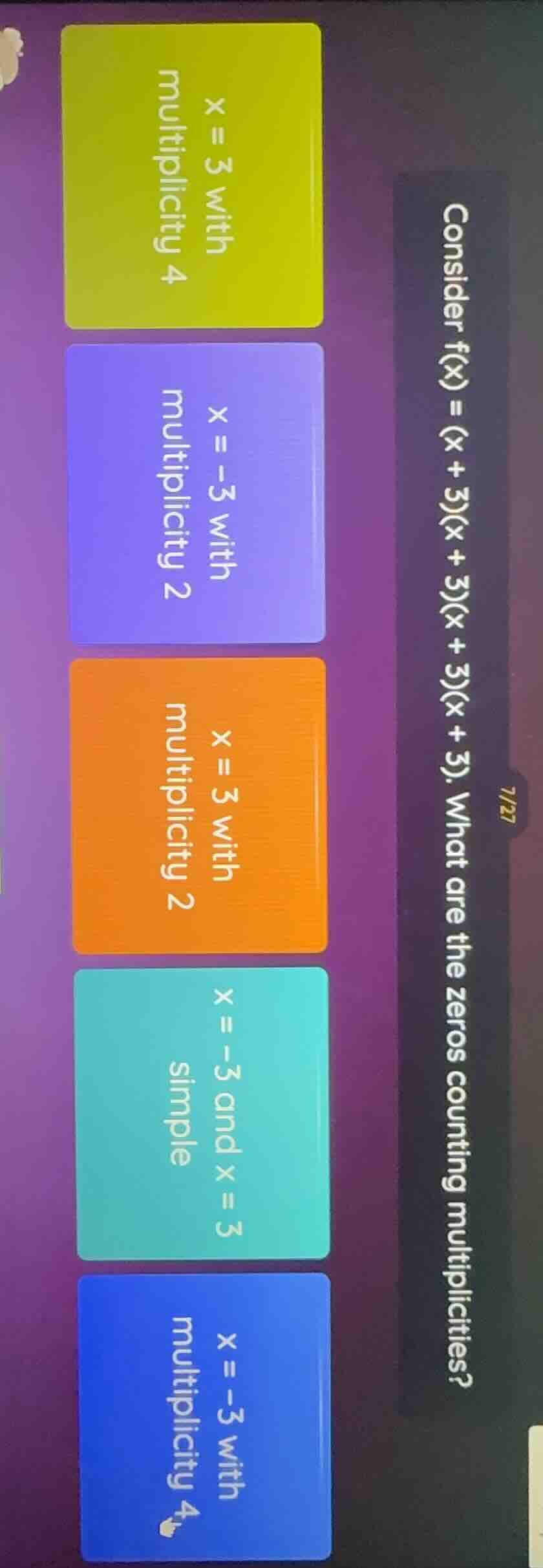
consider f(x) = (x + 3)(x + 3)(x + 3)(x + 3). what are the zeros counting multiplicities?
options:
x = 3 with multiplicity 4
x = -3 with multiplicity 2
x = 3 with multiplicity 2
x = -3 and x = 3 simple
x = -3 with multiplicity 4
Step1: Analyze the function
The function is \( f(x)=(x + 3)(x)(x + 3)(x + 3) \). Let's rewrite it to identify the factors and their multiplicities. First, group the like factors: \( f(x)=x\times(x + 3)^3 \)? Wait, no, wait. Wait, the original function is \( (x + 3)(x)(x + 3)(x + 3) \). Let's count the number of times each factor appears. The factor \( (x + 3) \) appears 3 times? Wait, no, let's list the factors: first \( (x + 3) \), then \( x \), then \( (x + 3) \), then \( (x + 3) \). Wait, no, the user wrote \( f(x)=(x + 3)(x)(x + 3)(x + 3) \). Wait, maybe a typo? Wait, no, let's check again. Wait, the problem says \( f(x)=(x + 3)(x)(x + 3)(x + 3) \). So the factors are: \( (x + 3) \) appears 3 times? Wait, no, \( (x + 3) \) is multiplied three times? Wait, no, \( (x + 3) \times (x + 3) \times (x + 3) \) is three times, and then \( x \) once. Wait, but the options have \( x=-3 \) with multiplicity 4? Wait, maybe the function is \( (x + 3)(x + 3)(x + 3)(x + 3) \)? No, the user wrote \( (x + 3)(x)(x + 3)(x + 3) \). Wait, maybe I misread. Wait, let's re-express the function: \( f(x)=x\times(x + 3)^3 \)? No, \( (x + 3) \) is multiplied three times? Wait, \( (x + 3) \times (x + 3) \times (x + 3) \) is three factors, plus \( x \) is one factor. Wait, but the options include \( x=-3 \) with multiplicity 4. Wait, maybe the function is \( (x + 3)(x + 3)(x + 3)(x + 3) \), but the user wrote \( (x + 3)(x)(x + 3)(x + 3) \). Wait, maybe that's a mistake. Alternatively, maybe the function is \( (x + 3)^4 \)? No, the user's function is \( (x + 3)(x)(x + 3)(x + 3) \). Wait, let's count the exponents. Let's expand the factors:
The factor \( (x + 3) \) appears in the first term, third term, and fourth term. So that's three times? Wait, first term: \( (x + 3) \), third term: \( (x + 3) \), fourth term: \( (x + 3) \). So that's three \( (x + 3) \) factors, and one \( x \) factor. But the options have \( x=-3 \) with multiplicity 4. Wait, maybe the function is \( (x + 3)(x + 3)(x + 3)(x + 3) \), i.e., \( (x + 3)^4 \), but the user included an extra \( x \) by mistake. Alternatively, maybe the function is \( (x + 3)(x)(x + 3)(x + 3) \), but then the multiplicity of \( x=-3 \) is 3, and \( x=0 \) is 1. But the options don't have that. Wait, the options are:
- \( x=3 \) with multiplicity 4
- \( x=-3 \) with multiplicity 2
- \( x=3 \) with multiplicity 2
- \( x=-3 \) and \( x=3 \) simple
- \( x=-3 \) with multiplicity 4
Wait, maybe the function is \( (x + 3)^4 \), i.e., \( (x + 3)(x + 3)(x + 3)(x + 3) \), so the zero is \( x=-3 \) (since \( x + 3 = 0 \) implies \( x=-3 \)) and the multiplicity is the number of times the factor \( (x + 3) \) appears, which is 4. So that would correspond to the last option: \( x=-3 \) with multiplicity 4.
Step2: Confirm the zero and multiplicity
To find the zero of a function \( f(x) \), we set \( f(x)=0 \). For \( f(x)=(x + 3)(x)(x + 3)(x + 3) \), if we consider that maybe there was a typo and the \( x \) is actually \( (x + 3) \), then \( f(x)=(x + 3)^4 \). Then, setting \( (x + 3)^4 = 0 \), we get \( x=-3 \) as the zero, and the multiplicity is 4 (since the factor \( (x + 3) \) is raised to the 4th power, or appears 4 times in the factorization).

Snap & solve any problem in the app
Get step-by-step solutions on Sovi AI
Photo-based solutions with guided steps
Explore more problems and detailed explanations
x = -3 with multiplicity 4 (the blue option)