QUESTION IMAGE
Question
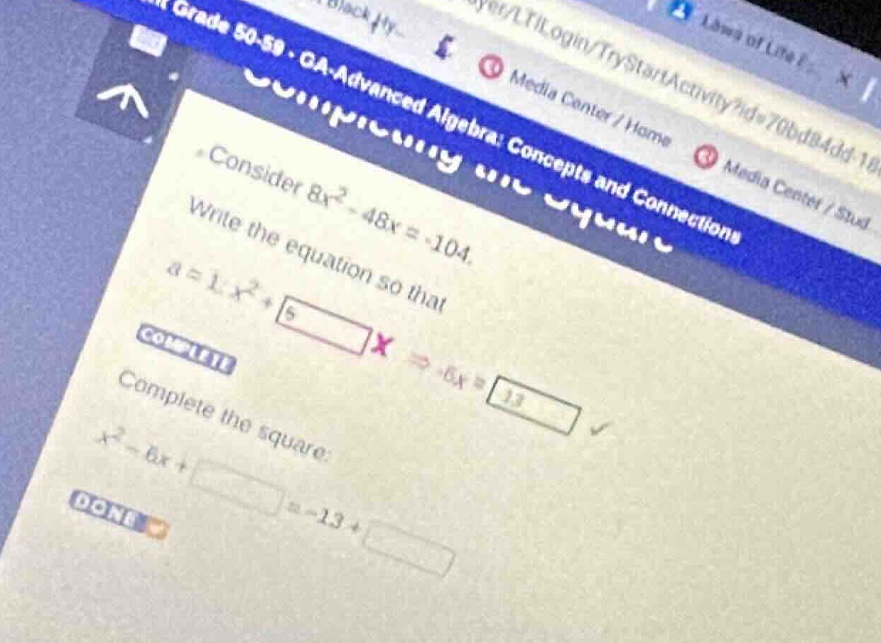
consider $8x^2 - 48x = -104$.
write the equation so that
a = 1 $x^2$ + \boxed{5} $x$ $\
ightarrow -6x =$ \boxed{13}
complete the square:
$x^2 - 6x + \boxed{} = -13 + \boxed{}$
Step1: Simplify the original equation
Given the equation \(8x^{2}-48x = - 104\). Divide each term by 8 to make the coefficient of \(x^{2}\) equal to 1.
\(\frac{8x^{2}}{8}-\frac{48x}{8}=\frac{- 104}{8}\)
Which simplifies to \(x^{2}-6x=-13\)
Step2: Complete the square for \(x^{2}-6x\)
For a quadratic expression of the form \(x^{2}+bx\), to complete the square, we take half of the coefficient of \(x\), square it. Here, the coefficient of \(x\) is \(- 6\), half of \(-6\) is \(-3\), and squaring \(-3\) gives \((-3)^{2}=9\).
So we add 9 to both sides of the equation \(x^{2}-6x=-13\).
The equation becomes \(x^{2}-6x + 9=-13 + 9\) (Wait, no, wait. Wait, the right side was \(-13\)? Wait, no, from step 1, \(x^{2}-6x=-13\)? Wait, no, \(\frac{-104}{8}=-13\), yes. Then to complete the square for \(x^{2}-6x\), we take \((\frac{-6}{2})^{2}=(-3)^{2} = 9\). So we add 9 to both sides. So the blanks are filled with 9 and 9. Wait, let's re - check.
The general formula for completing the square for \(x^{2}+bx\) is \(x^{2}+bx+(\frac{b}{2})^{2}=(x + \frac{b}{2})^{2}\). Here, the quadratic is \(x^{2}-6x\), so \(b=-6\), then \((\frac{b}{2})^{2}=(\frac{-6}{2})^{2}=9\). So we add 9 to both sides of the equation \(x^{2}-6x=-13\). So the equation \(x^{2}-6x+\underline{9}=-13+\underline{9}\)? Wait, no, that would make the right side \(-4\), but maybe I made a mistake in the sign. Wait, no, the original equation after dividing by 8: \(x^{2}-6x=-13\). Then to complete the square, we add \((\frac{-6}{2})^{2}=9\) to both sides. So \(x^{2}-6x + 9=-13 + 9\)? Wait, no, that can't be. Wait, maybe I messed up the division. Wait, \(8x^{2}-48x=-104\), divide by 8: \(x^{2}-6x=-13\). Then, to complete the square, take half of - 6, which is - 3, square it: 9. So add 9 to both sides: \(x^{2}-6x + 9=-13 + 9\)? Wait, no, that would be \(x^{2}-6x + 9=-4\), but maybe the problem has a typo? Wait, no, the user's problem is to fill in the blanks for \(x^{2}-6x+\underline{\quad}=-13+\underline{\quad}\). So the first blank is the square of half of - 6, which is 9, and the second blank is also 9 (because we add 9 to both sides to complete the square). Wait, but let's check again.
Wait, the standard completion of square: for \(x^{2}+bx = c\), we add \((\frac{b}{2})^{2}\) to both sides. Here, \(x^{2}-6x=-13\), so \(b=-6\), \((\frac{b}{2})^{2}=(\frac{-6}{2})^{2}=9\). So we add 9 to both sides. So \(x^{2}-6x + 9=-13 + 9\)? Wait, no, that would be \(x^{2}-6x + 9=-4\), but maybe the original equation was different? Wait, no, the original equation is \(8x^{2}-48x=-104\), dividing by 8: \(x^{2}-6x=-13\). Then completing the square: \(x^{2}-6x+9=-13 + 9\)? Wait, that seems correct. So the first blank is 9 and the second blank is 9.

Snap & solve any problem in the app
Get step-by-step solutions on Sovi AI
Photo-based solutions with guided steps
Explore more problems and detailed explanations
The first blank (for \(x^{2}-6x+\underline{\quad}\)) is 9, and the second blank (for \(-13+\underline{\quad}\)) is 9. So the completed equation is \(x^{2}-6x + 9=-13 + 9\) (or \(x^{2}-6x + 9=-4\), but the blanks are filled with 9 and 9 respectively).