QUESTION IMAGE
Question
construct and interpret two-way frequency tables
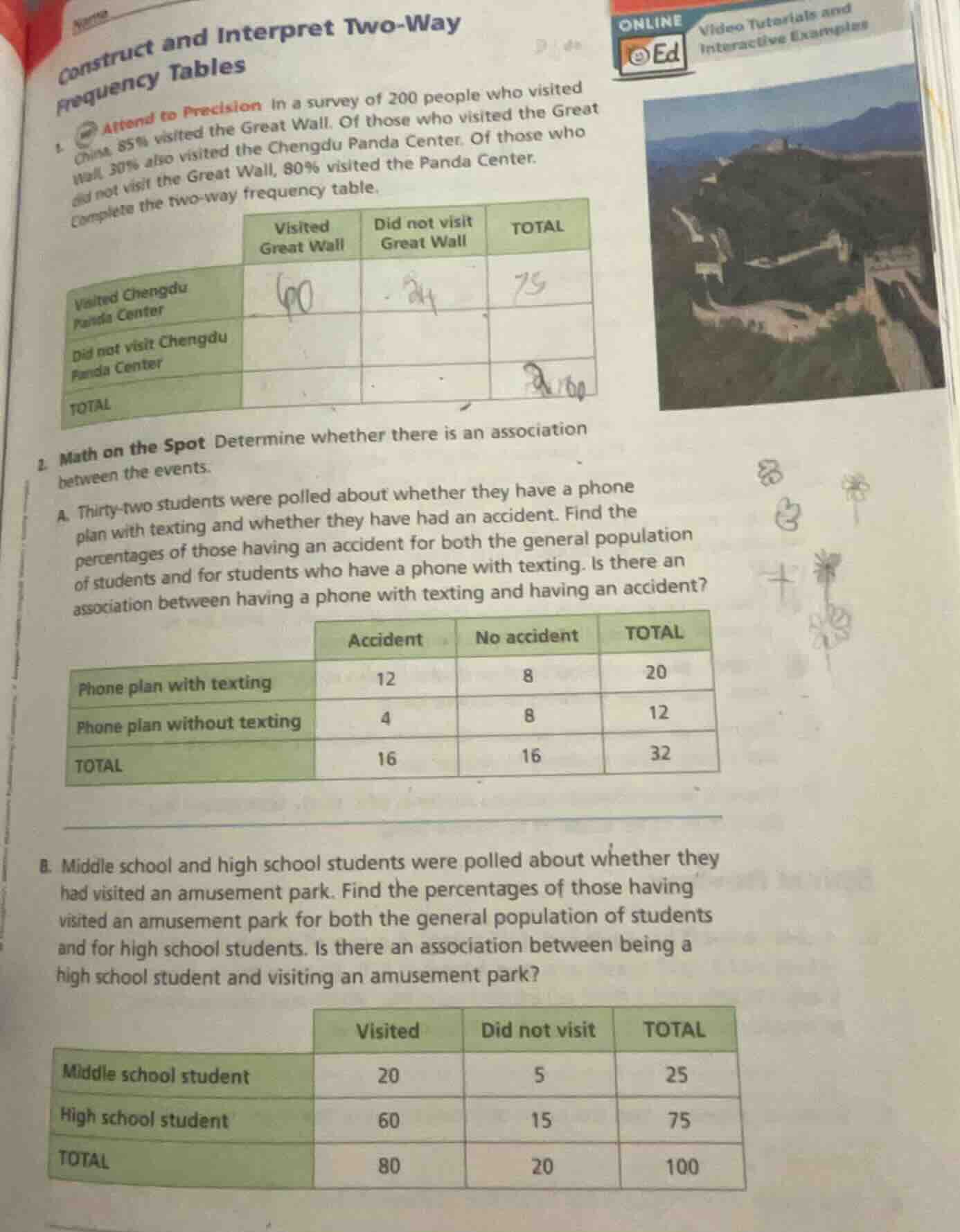
- attend to precision in a survey of 200 people who visited china, 85% visited the great wall. of those who visited the great wall, 30% also visited the chengdu panda center. of those who did not visit the great wall, 80% visited the panda center.
complete the two-way frequency table.
| visited great wall | did not visit great wall | total | --- | --- | --- | --- | visited chengdu panda center | did not visit chengdu panda center | total | 200 | 2. math on the spot determine whether there is an association between the events. |
a. thirty-two students were polled about whether they have a phone plan with texting and whether they have had an accident. find the percentages of those having an accident for both the general population of students and for students who have a phone with texting. is there an association between having a phone with texting and having an accident?
| accident | no accident | total | --- | --- | --- | --- | phone plan with texting | 12 | 8 | 20 | phone plan without texting | 4 | 8 | 12 | total | 16 | 16 | 32 | b. middle school and high school students were polled about whether they had visited an amusement park. find the percentages of those having visited an amusement park for both the general population of students and for high school students. is there an association between being a high school student and visiting an amusement park? | |||||
| visited | did not visit | total | --- | --- | --- | --- | middle school student | 20 | 5 | 25 | high school student | 60 | 15 | 75 | total | 80 | 20 | 100 |
---
Problem 1: Complete the two-way table
Step1: Calculate Great Wall visitors
Total people = 200. 85% visited Great Wall:
$200 \times 0.85 = 170$
People who did not visit Great Wall:
$200 - 170 = 30$
Step2: Panda Center visitors (Great Wall group)
30% of 170 visited Panda Center:
$170 \times 0.30 = 51$
Great Wall visitors who did not visit Panda Center:
$170 - 51 = 119$
Step3: Panda Center visitors (non-Great Wall group)
80% of 30 visited Panda Center:
$30 \times 0.80 = 24$
Non-Great Wall visitors who did not visit Panda Center:
$30 - 24 = 6$
Step4: Calculate row totals
Total Panda Center visitors:
$51 + 24 = 75$
Total non-Panda Center visitors:
$119 + 6 = 125$
---
Problem 2A: Analyze association for texting/accidents
Step1: General accident percentage
Total accidents = 16, total students = 32:
$\frac{16}{32} \times 100 = 50\%$
Step2: Texting plan accident percentage
Accidents with texting = 12, texting students = 20:
$\frac{12}{20} \times 100 = 60\%$
Step3: Compare percentages
60% ≠ 50%, so association exists.
---
Problem 2B: Analyze association for school/amusement park
Step1: General visited percentage
Total visited = 80, total students = 100:
$\frac{80}{100} \times 100 = 80\%$
Step2: High school visited percentage
High school visited = 60, high school students = 75:
$\frac{60}{75} \times 100 = 80\%$
Step3: Compare percentages
80% = 80%, so no association exists.

Snap & solve any problem in the app
Get step-by-step solutions on Sovi AI
Photo-based solutions with guided steps
Explore more problems and detailed explanations
---
Completed Two-Way Table (Problem 1):
| Visited Great Wall | Did not visit Great Wall | TOTAL | |
|---|---|---|---|
| Did not visit Chengdu Panda Center | 119 | 6 | 125 |
| TOTAL | 170 | 30 | 200 |
---
Problem 2A:
- General student accident rate: 50%
- Students with texting plan accident rate: 60%
- Answer: Yes, there is an association between having a phone plan with texting and having an accident, as the accident rate is higher for students with a texting plan.
---
Problem 2B:
- General student amusement park visit rate: 80%
- High school student amusement park visit rate: 80%
- Answer: No, there is no association between being a high school student and visiting an amusement park, as the visit rate matches the general student population.