QUESTION IMAGE
Question
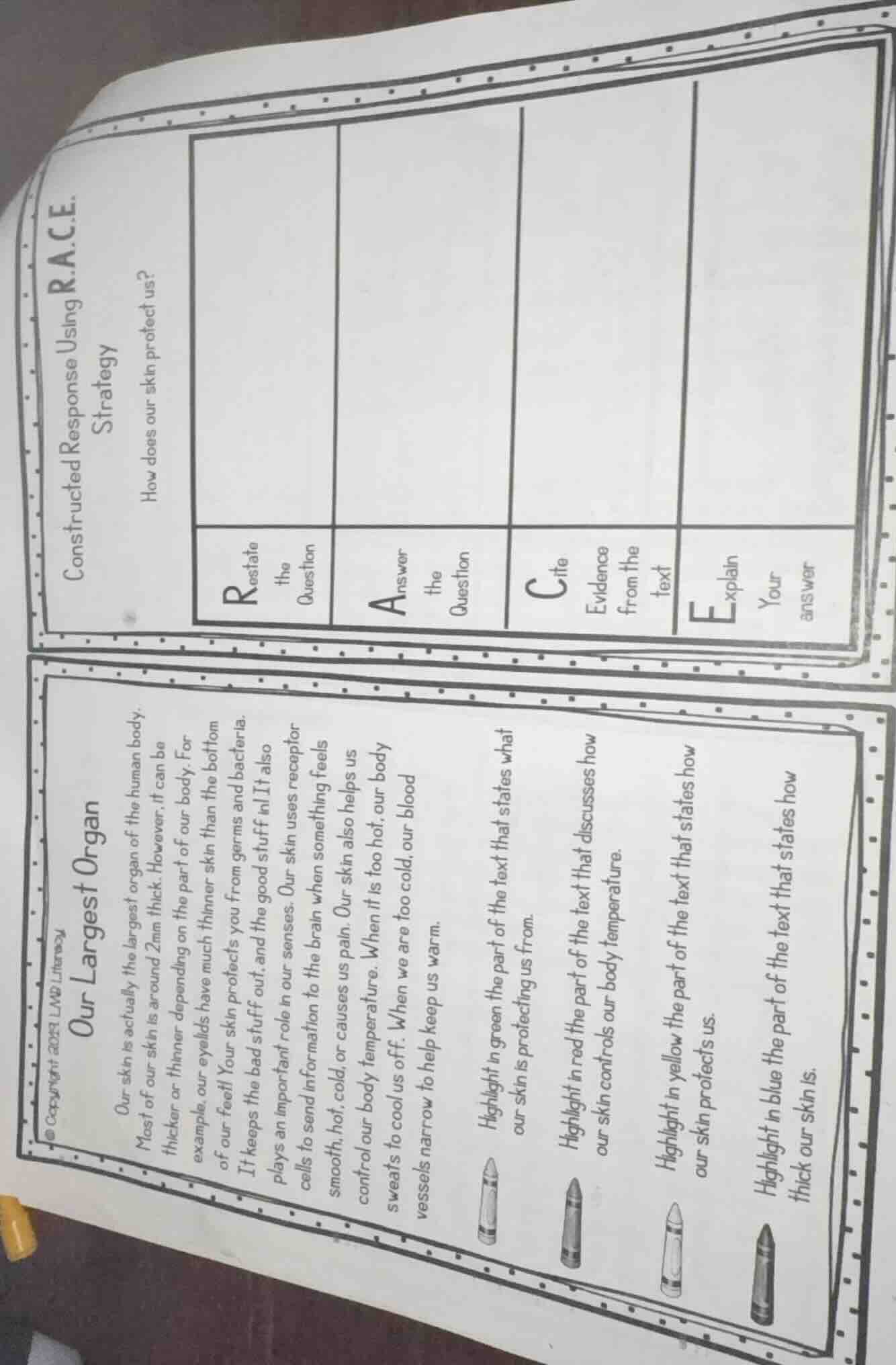
constructed response using r.a.c.e. strategy how does our skin protect us? r estate the question a nswer the question c ite evidence from the text e xplain your answer our largest organ our skin is actually the largest organ of the human body. most of our skin is around 2mm thick. however, it can be thicker or thinner depending on the part of our body. for example, our eyelids have much thinner skin than the bottom of our feet! your skin protects you from germs and bacteria. it keeps the bad stuff out, and the good stuff in! it also plays an important role in our senses. our skin uses receptor cells to send information to the brain when something feels smooth, hot, cold, or causes us pain. our skin also helps us control our body temperature. when it is too hot, our body sweats to cool us off. when we are too cold, our blood vessels narrow to help keep us warm. highlight in green the part of the text that states what our skin is protecting us from. highlight in red the part of the text that discusses how our skin controls our body temperature. highlight in yellow the part of the text that states how our skin protects us. highlight in blue the part of the text that states how thick our skin is.
This response follows the R.A.C.E. strategy: first restating the core question, then summarizing the skin's protective functions, citing direct evidence from the provided text for each function, and finally connecting the evidence to explain how each mechanism actively protects the body. The highlighted text segments align with the specific protective roles identified in the answer.

Snap & solve any problem in the app
Get step-by-step solutions on Sovi AI
Photo-based solutions with guided steps
Explore more problems and detailed explanations
R (Restate the Question):
How does the skin protect the human body?
A (Answer the Question):
Our skin protects us by blocking harmful germs/bacteria, sensing stimuli to avoid harm, and regulating body temperature to maintain safe internal conditions.
C (Cite Evidence from the Text):
- (Green highlight text): "Your skin protects you from germs and bacteria. It keeps the bad stuff out, and the good stuff in!"
- (Red highlight text): "When it is too hot, our body sweats to cool us off. When we are too cold, our blood vessels narrow to help keep us warm."
- (Yellow highlight text): "Our skin uses receptor cells to send information to the brain when something feels smooth, hot, cold, or causes us pain."
- (Blue highlight text): "Most of our skin is around 2mm thick. However, it can be thicker or thinner depending on the part of our body. For example, our eyelids have much thinner skin than the bottom of our feet!"
E (Explain Your Answer):
The skin acts as a physical barrier (supported by its thickness variation and germ-blocking function) to keep out harmful pathogens while retaining beneficial substances. Its sensory receptors alert us to potentially damaging stimuli like extreme temperatures or pain, letting us avoid harm. Additionally, its temperature regulation system (sweating and blood vessel adjustment) maintains a stable internal environment, which is critical for overall health and protection from temperature-related harm.