QUESTION IMAGE
Question
content check
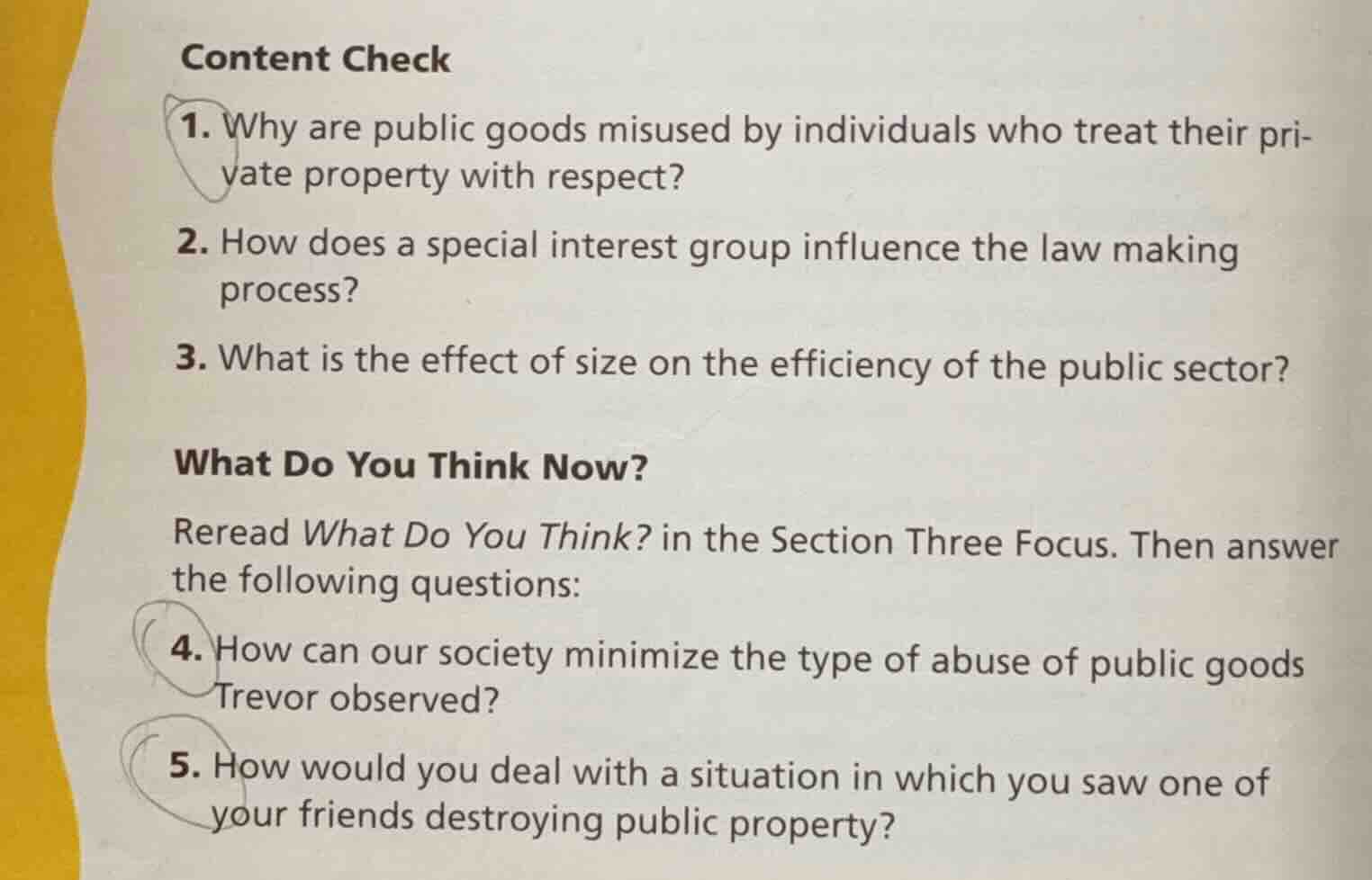
- why are public goods misused by individuals who treat their private property with respect?
- how does a special interest group influence the law making process?
- what is the effect of size on the efficiency of the public sector?
what do you think now?
reread what do you think? in the section three focus. then answer the following questions:
- how can our society minimize the type of abuse of public goods trevor observed?
- how would you deal with a situation in which you saw one of your friends destroying public property?
Brief Explanations
- Public goods are non-excludable and non-rivalrous, so individuals do not bear the full cost of their misuse, unlike with their own private property where they bear all costs and benefits.
- Special interest groups influence lawmaking through lobbying, campaign contributions, providing policy expertise, mobilizing grassroots support, and advocating for policies that benefit their specific group.
- Smaller public sectors may be more efficient due to less bureaucracy, but larger public sectors can achieve economies of scale and provide more comprehensive public goods; efficiency depends on proper oversight and alignment of services with demand.
- Society can minimize public goods abuse through enforcing clear rules and penalties, increasing public awareness and education about shared resources, implementing user fees for some quasi-public goods, and establishing community stewardship programs.
- First, intervene directly to stop the friend's actions. Then, explain why destroying public property harms the community. Encourage the friend to take responsibility, such as reporting the incident or helping repair the damage, and remind them of potential legal consequences.

Snap & solve any problem in the app
Get step-by-step solutions on Sovi AI
Photo-based solutions with guided steps
Explore more problems and detailed explanations
- Public goods are non-excludable/non-rivalrous, so individuals do not face the full cost of misuse, unlike private property where they bear all associated costs and benefits.
- Special interest groups influence lawmaking via lobbying, campaign donations, providing policy research, mobilizing member support, and direct advocacy to legislators for group-aligned policies.
- Smaller public sectors may have less bureaucratic waste, while larger ones can leverage economies of scale; efficiency hinges on oversight, service alignment with community needs, and avoiding unnecessary bloat.
- Society can minimize this abuse by enforcing penalties for misuse, running public education campaigns, using user fees for applicable goods, and creating community-led stewardship initiatives.
- I would immediately stop my friend, explain the harm to the community, encourage them to take accountability (e.g., helping repair or report the issue), and remind them of potential legal repercussions.