QUESTION IMAGE
Question
content review
multiple choice
choose the letter of the answer that best completes each statement.
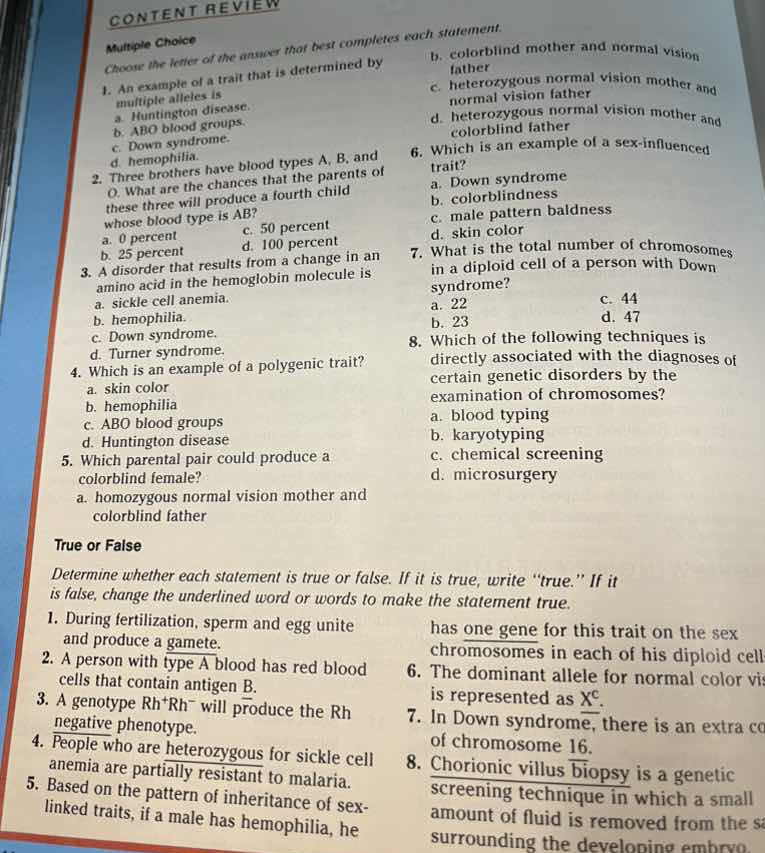
- an example of a trait that is determined by multiple alleles is
a. huntington disease.
b. abo blood groups.
c. down syndrome.
d. hemophilia.
- three brothers have blood types a, b, and o. what are the chances that the parents of these three will produce a fourth child whose blood type is ab?
a. 0 percent
b. 25 percent
c. 50 percent
d. 100 percent
- a disorder that results from a change in an amino acid in the hemoglobin molecule is
a. sickle cell anemia.
b. hemophilia.
c. down syndrome.
d. turner syndrome.
- which is an example of a polygenic trait?
a. skin color
b. hemophilia
c. abo blood groups
d. huntington disease
- which parental pair could produce a colorblind female?
a. homozygous normal vision mother and colorblind father
b. colorblind mother and normal vision father
c. heterozygous normal vision mother and normal vision father
d. heterozygous normal vision mother and colorblind father
- which is an example of a sex - influenced trait?
a. down syndrome
b. colorblindness
c. male pattern baldness
d. skin color
- what is the total number of chromosomes in a diploid cell of a person with down syndrome?
a. 22
b. 23
c. 44
d. 47
- which of the following techniques is directly associated with the diagnoses of certain genetic disorders by the examination of chromosomes?
a. blood typing
b. karyotyping
c. chemical screening
d. microsurgery
true or false
determine whether each statement is true or false. if it is true, write \true.\ if it is false, change the underlined word or words to make the statement true.
- during fertilization, sperm and egg unite and produce a gamete.
- a person with type a blood has red blood cells that contain antigen b.
- a genotype rh⁻rh⁻ will produce the rh negative phenotype.
- people who are heterozygous for sickle cell anemia are partially resistant to malaria.
- based on the pattern of inheritance of sex - linked traits, if a male has hemophilia, he has one gene for this trait on the sex chromosomes in each of his diploid cell.
- the dominant allele for normal color vis is represented as x^c.
- in down syndrome, there is an extra co of chromosome 16.
- chorionic villus biopsy is a genetic screening technique in which a small amount of fluid is removed from the s surrounding the developing embryo.
Multiple Choice
Step1: Match trait to allele type
ABO blood groups are determined by 3 alleles ($I^A$, $I^B$, $i$), fitting multiple alleles.
Step2: Infer parental genotypes
3 sons have A, B, O blood. Parents must be $I^A i$ and $I^B i$. Probability of $I^A I^B$ (AB) is $\frac{1}{4}=25\%$.
Step3: Identify hemoglobin mutation disorder
Sickle cell anemia arises from a single amino acid change in hemoglobin.
Step4: Define polygenic trait
Skin color is controlled by multiple genes, a polygenic trait.
Step5: Determine colorblind female parental pair
Colorblindness is X-linked recessive. A colorblind female ($X^cX^c$) needs $X^c$ from both parents: carrier mother ($X^CX^c$) and colorblind father ($X^cY$).
Step6: Identify sex-influenced trait
Male pattern baldness is expressed differently based on biological sex, a sex-influenced trait.
Step7: Calculate Down syndrome chromosome count
Diploid cells have 46 chromosomes; Down syndrome adds 1, so $46+1=47$.
Step8: Match chromosome exam technique
Karyotyping directly examines chromosome structure/number for genetic disorders.
- Fertilization forms a zygote, not a gamete.
- Type A blood has antigen A, not B, on red blood cells.
- $Rh^+Rh^-$ has a dominant $Rh^+$ allele, so the phenotype is Rh positive.
- Heterozygotes for sickle cell anemia have partial malaria resistance, which is a true statement.
- Males have one X chromosome; if they have hemophilia, they have one allele on their single X.
- The dominant normal vision allele is represented as $X^C$, not $X^c$.
- Down syndrome is caused by an extra copy of chromosome 21, not 16.
- Chorionic villus biopsy samples placental tissue, while amniocentesis removes fluid.

Snap & solve any problem in the app
Get step-by-step solutions on Sovi AI
Photo-based solutions with guided steps
Explore more problems and detailed explanations
- b. ABO blood groups
- b. 25 percent
- a. sickle cell anemia
- a. skin color
- d. heterozygous normal vision mother and colorblind father
- c. male pattern baldness
- d. 47
- b. karyotyping
---