QUESTION IMAGE
Question
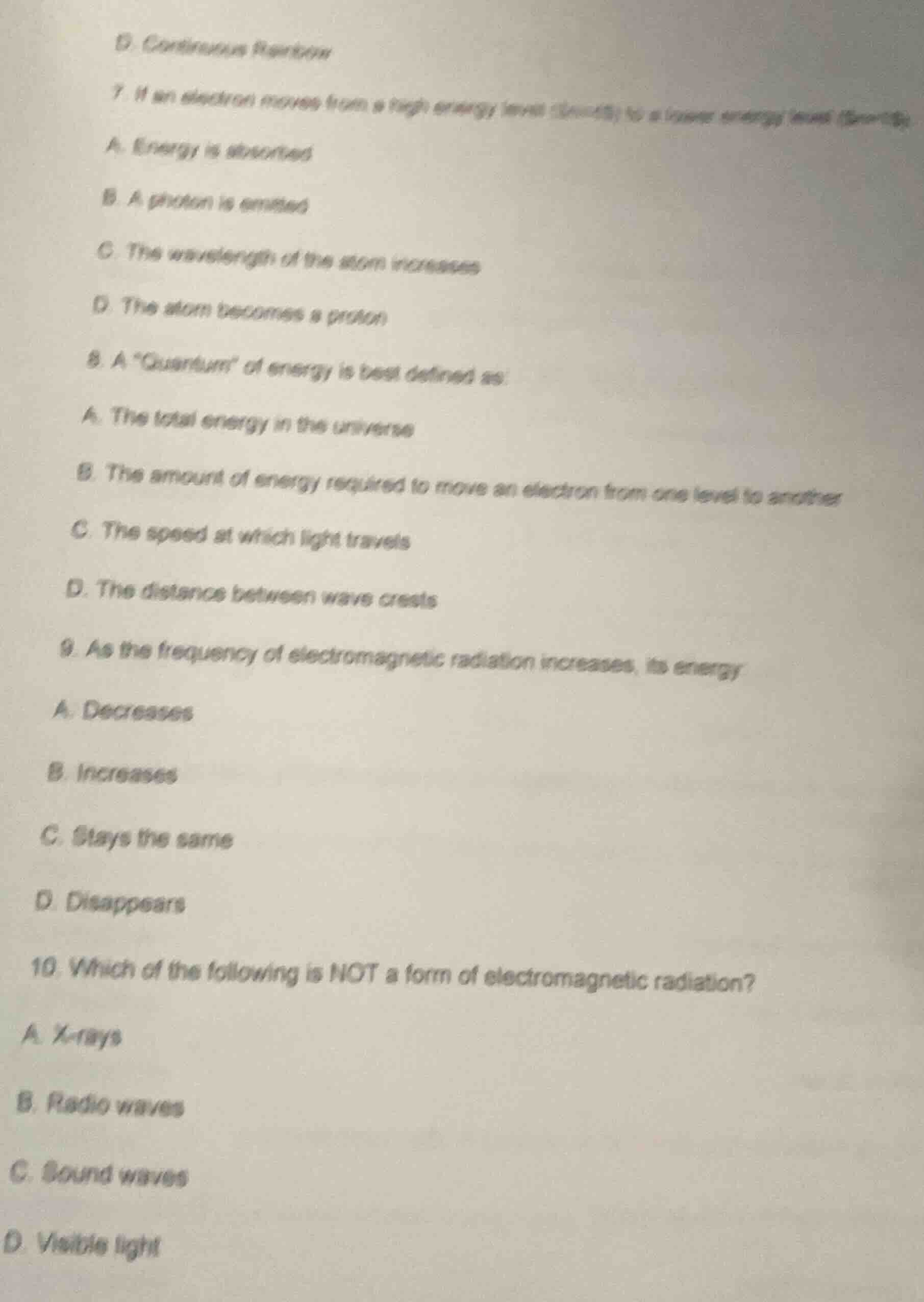
d. continuous rainbow
- if an electron moves from a high energy level (shell) to a lower energy level (shell)
a. energy is absorbed
b. a photon is emitted
c. the wavelength of the atom increases
d. the atom becomes a proton
- a \quantum\ of energy is best defined as:
a. the total energy in the universe
b. the amount of energy required to move an electron from one level to another
c. the speed at which light travels
d. the distance between wave crests
- as the frequency of electromagnetic radiation increases, its energy
a. decreases
b. increases
c. stays the same
d. disappears
- which of the following is not a form of electromagnetic radiation?
a. x - rays
b. radio waves
c. sound waves
d. visible light
Brief Explanations
- When an electron moves from a higher to lower energy level, the excess energy is released as a photon; energy is absorbed when moving to a higher level, atoms do not become protons, and the atom's wavelength is not relevant here.
- A quantum is a discrete packet of energy, specifically the amount needed to move an electron between energy levels; the other options describe universal energy, light speed, and wavelength respectively.
- The energy of electromagnetic radiation follows $E=h
u$, where $E$ is energy, $h$ is Planck's constant, and $
u$ is frequency. Energy and frequency have a direct proportional relationship.
- Electromagnetic radiation does not require a medium to travel. Sound waves are mechanical waves that need a medium, while X-rays, radio waves, and visible light are all electromagnetic radiation.

Snap & solve any problem in the app
Get step-by-step solutions on Sovi AI
Photo-based solutions with guided steps
Explore more problems and detailed explanations
- B. A photon is emitted
- B. The amount of energy required to move an electron from one level to another
- B. Increases
- C. Sound waves