QUESTION IMAGE
Question
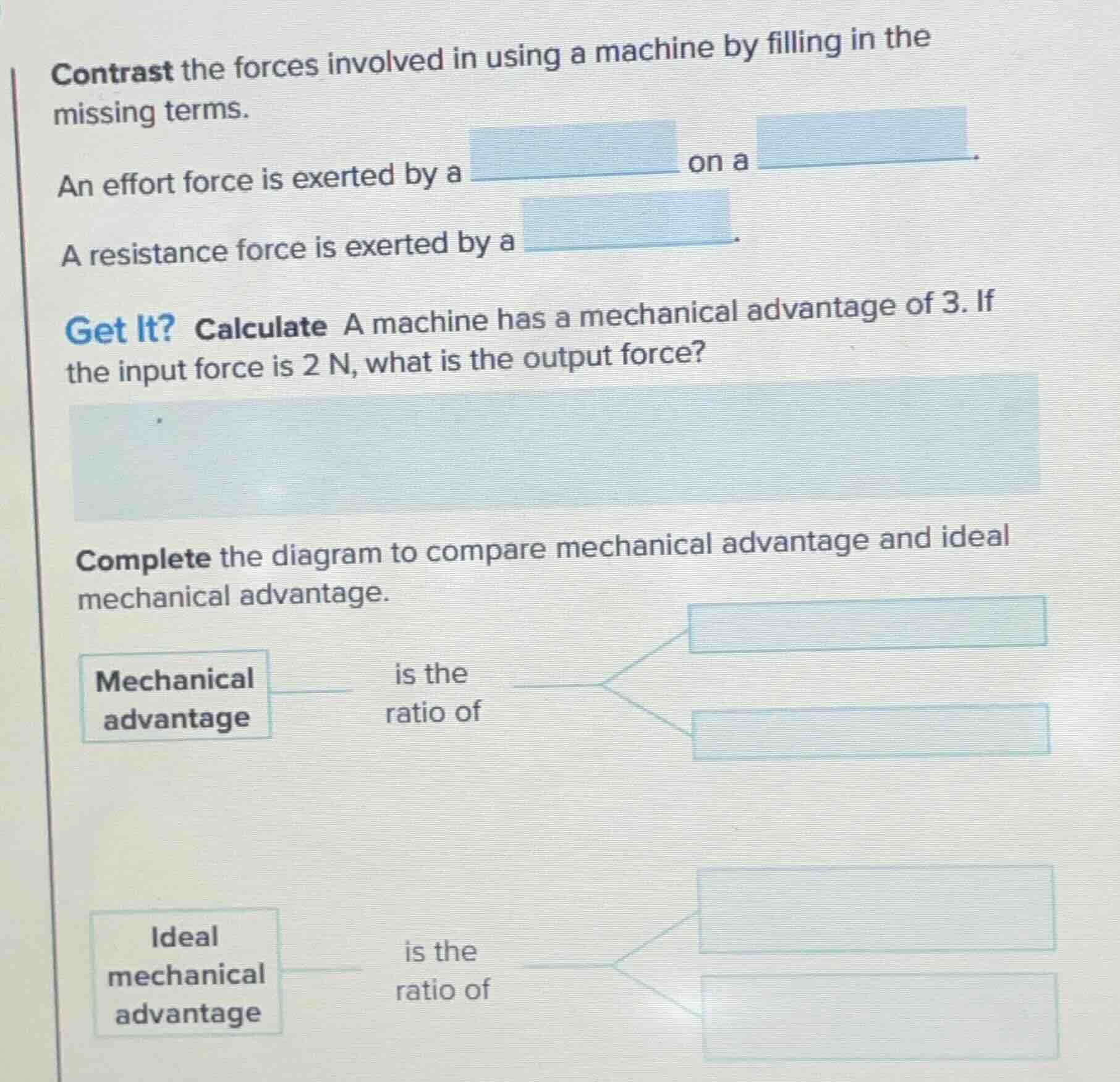
contrast the forces involved in using a machine by filling in the missing terms. an effort force is exerted by a ____________ on a ________. a resistance force is exerted by a ________. get it? calculate a machine has a mechanical advantage of 3. if the input force is 2 n, what is the output force? complete the diagram to compare mechanical advantage and ideal mechanical advantage. mechanical advantage is the ratio of __________ ________. ideal mechanical advantage is the ratio of __________ __________.
Part 1: Filling in the missing terms about forces in machines
- For the effort force: In machine terminology, the effort force is the force applied by a person (or a source of input) on the machine's input component (like a lever's effort arm, or a pulley's rope pulled by the user). So the first blank for effort force's source is "person" (or "user", "operator"), and the second blank is "machine" (the input part of the machine).
- For the resistance force: The resistance force is the force that the machine has to overcome, which is exerted by the load (the object being moved, lifted, etc.). So the blank for resistance force's source is "load".
The formula for mechanical advantage (\(MA\)) is \(MA=\frac{F_{output}}{F_{input}}\), where \(F_{output}\) is the output force and \(F_{input}\) is the input force. We know that \(MA = 3\) and \(F_{input}=2\space N\). We need to solve for \(F_{output}\).
Step 1: Recall the mechanical advantage formula
The formula for mechanical advantage is \(MA=\frac{F_{output}}{F_{input}}\)
Step 2: Rearrange the formula to solve for \(F_{output}\)
Multiply both sides of the formula by \(F_{input}\) to get \(F_{output}=MA\times F_{input}\)
Step 3: Substitute the given values
We know that \(MA = 3\) and \(F_{input}=2\space N\). Substituting these values into the formula, we get \(F_{output}=3\times2\space N\)
Step 4: Calculate the result
\(3\times2 = 6\), so \(F_{output}=6\space N\)
- Mechanical Advantage (Actual MA): The actual mechanical advantage of a machine is the ratio of the output force (\(F_{output}\)) to the input force (\(F_{input}\)). This is because it takes into account the real - world factors like friction. So for mechanical advantage, it is the ratio of \(\boldsymbol{\text{output force}}\) to \(\boldsymbol{\text{input force}}\).
- Ideal Mechanical Advantage (IMA): The ideal mechanical advantage is the ratio of the input distance (\(d_{input}\)) to the output distance (\(d_{output}\)) (or alternatively, for some simple machines, it can also be thought of as the ratio of the resistance arm length to the effort arm length in levers, etc.). The ideal mechanical advantage assumes no friction, so it is based on the distances moved (or the lengths of the arms in levers). So for ideal mechanical advantage, it is the ratio of \(\boldsymbol{\text{input distance}}\) to \(\boldsymbol{\text{output distance}}\) (or for levers, \(\frac{\text{resistance arm length}}{\text{effort arm length}}\), but the distance - based ratio is more general for most machines like pulleys, inclined planes etc.).

Snap & solve any problem in the app
Get step-by-step solutions on Sovi AI
Photo-based solutions with guided steps
Explore more problems and detailed explanations
s for the force - related blanks:
- An effort force is exerted by a \(\boldsymbol{\text{person}}\) on a \(\boldsymbol{\text{machine}}\).
- A resistance force is exerted by a \(\boldsymbol{\text{load}}\).