QUESTION IMAGE
Question
convertible: y = 35x
what is the convertible’s speed? find the rate of change.
35 miles per hour
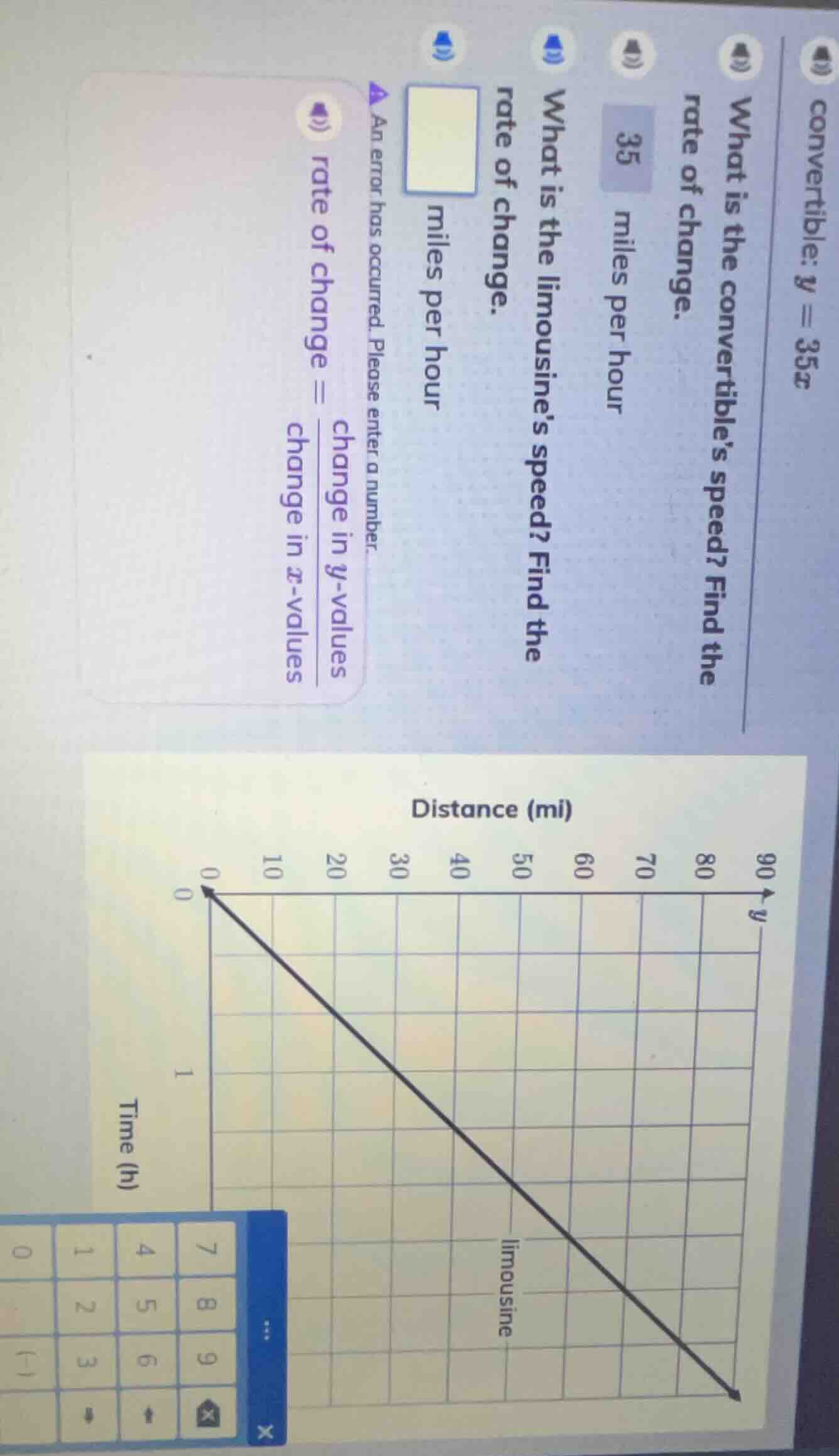
what is the limousine’s speed? find the rate of change.
an error has occurred. please enter a number. miles per hour
rate of change = (change in y - values)/(change in x - values)
(chart: x - axis time (h), y - axis distance (mi), line for limousine from (0,0) to some point)
Step1: Identify two points on the line
From the graph, the line passes through \((0, 0)\) and let's take another point, say when \(x = 2\) (time in hours), we can see from the grid that the distance \(y\) (miles) is \(90\)? Wait, no, wait. Wait, the x - axis is time (h) and y - axis is distance (mi). Wait, the line for limousine: let's pick two points. Let's take \((0,0)\) and \((2, 90)\)? Wait, no, maybe I misread. Wait, the grid: x (time) from 0,1,2,... and y (distance) from 0,10,20,... Wait, no, the x - axis is time (h) with ticks at 0,1,2,... and y - axis is distance (mi) with ticks at 0,10,20,30,40,50,60,70,80,90. Wait, the line for limousine: let's take two points. Let's take \((0,0)\) and \((2, 90)\)? No, that can't be. Wait, maybe the line goes through (0,0) and (1, 45)? Wait, no, the problem says rate of change is \(\frac{\text{change in }y}{\text{change in }x}\). Let's take two points on the limousine's line. Let's say when \(x = 0\), \(y = 0\); when \(x = 2\), \(y = 90\)? Wait, no, maybe the grid is such that each square is 1 unit in x and 10 units in y? Wait, no, the x - axis (time) has ticks at 0,1,2,... (each tick is 1 hour) and y - axis (distance) has ticks at 0,10,20,30,40,50,60,70,80,90 (each tick is 10 miles). Wait, the line for limousine: let's look at the graph. The line starts at (0,0) and goes to, say, (2, 90)? No, that seems too steep. Wait, maybe I made a mistake. Wait, the convertible has a rate of 35 mph, which is \(y = 35x\). For the limousine, let's take two points. Let's take (0,0) and (2, 90)? No, wait, maybe the line for limousine: when x = 1 (hour), y = 45? Wait, no, let's calculate the rate of change. Rate of change is \(\frac{\Delta y}{\Delta x}\). Let's take two points: (0, 0) and (2, 90). Then \(\Delta y=90 - 0 = 90\), \(\Delta x=2 - 0 = 2\), so rate of change is \(\frac{90}{2}=45\). Wait, that makes sense. So let's confirm. If we take (0,0) and (1, 45), then \(\Delta y = 45-0 = 45\), \(\Delta x=1 - 0 = 1\), so rate of change is \(\frac{45}{1}=45\). So the rate of change (speed) is 45 miles per hour.
Step2: Calculate the rate of change
Using the formula for rate of change (slope) \(m=\frac{y_2 - y_1}{x_2 - x_1}\). Let \( (x_1,y_1)=(0,0) \) and \( (x_2,y_2)=(2,90) \) (or any two points on the line). Then \( m=\frac{90 - 0}{2 - 0}=\frac{90}{2}=45 \). Or if we take \( (x_1,y_1)=(0,0) \) and \( (x_2,y_2)=(1,45) \), then \( m=\frac{45 - 0}{1 - 0}=45 \).

Snap & solve any problem in the app
Get step-by-step solutions on Sovi AI
Photo-based solutions with guided steps
Explore more problems and detailed explanations
45