QUESTION IMAGE
Question
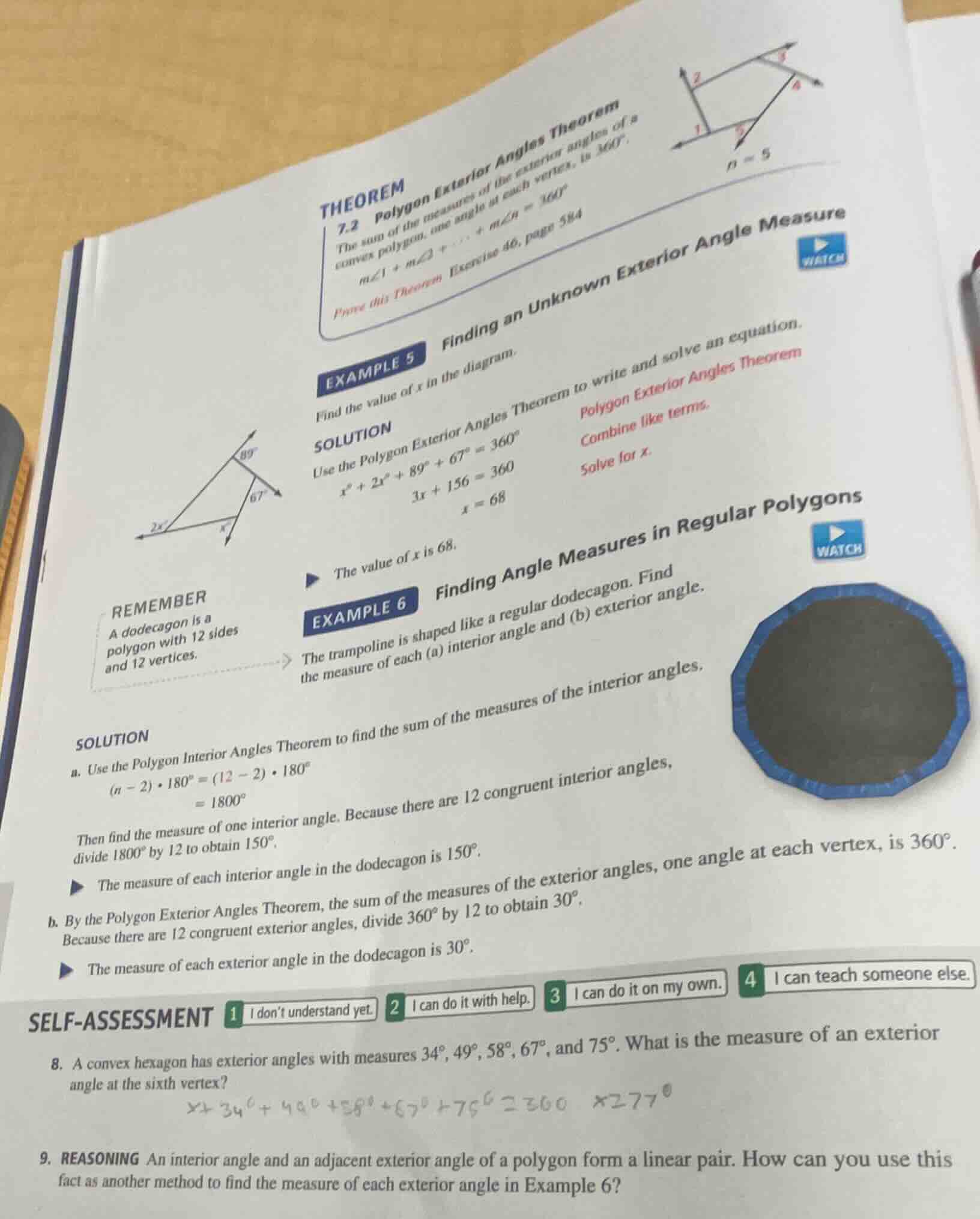
- a convex hexagon has exterior angles with measures 34°, 49°, 58°, 67°, and 75°. what is the measure of an exterior angle at the sixth vertex?
- reasoning an interior angle and an adjacent exterior angle of a polygon form a linear pair. how can you use this fact as another method to find the measure of each exterior angle in example 6?
Question 8
Step1: Recall the Polygon Exterior Angles Theorem
The sum of the exterior angles of a convex polygon is \( 360^\circ \). Let the measure of the sixth exterior angle be \( x \).
Step2: Sum the known exterior angles
First, calculate the sum of the given exterior angles: \( 34^\circ + 49^\circ + 58^\circ + 67^\circ + 75^\circ \).
\[
\]
Step3: Solve for \( x \)
Using the theorem, we have the equation \( x + 283^\circ = 360^\circ \). Subtract \( 283^\circ \) from both sides:
\[
x = 360^\circ - 283^\circ = 77^\circ
\]
In a polygon, an interior angle and its adjacent exterior angle form a linear pair, meaning they are supplementary (their sum is \( 180^\circ \)). In Example 6, we have a regular dodecagon with 12 sides. First, from the interior angle measure found ( \( 150^\circ \) ), we can find the adjacent exterior angle by subtracting the interior angle from \( 180^\circ \): \( 180^\circ - 150^\circ = 30^\circ \). This matches the exterior angle measure found using the Polygon Exterior Angles Theorem (dividing \( 360^\circ \) by 12). So, we can use the supplementary relationship between an interior angle and its adjacent exterior angle to find the exterior angle: if we know the interior angle, subtract it from \( 180^\circ \) to get the exterior angle.

Snap & solve any problem in the app
Get step-by-step solutions on Sovi AI
Photo-based solutions with guided steps
Explore more problems and detailed explanations
The measure of the exterior angle at the sixth vertex is \( 77^\circ \).