QUESTION IMAGE
Question
cooperative trees
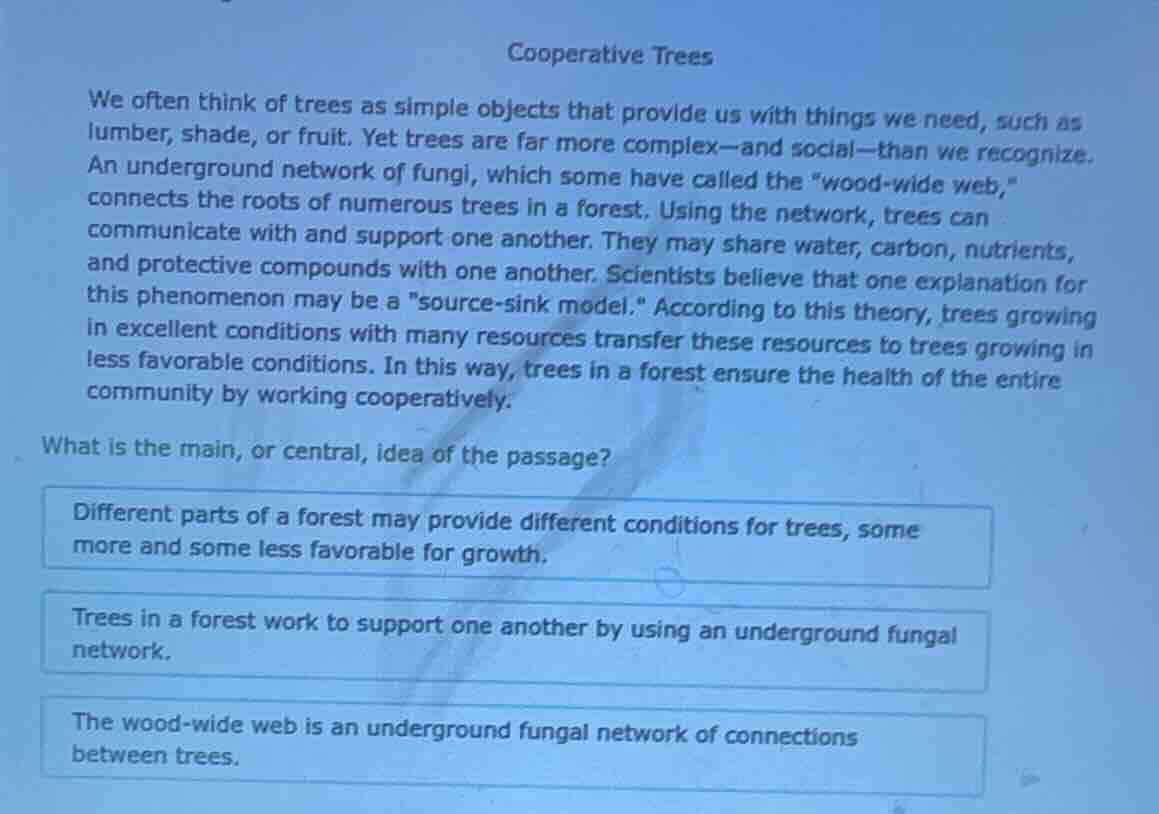
we often think of trees as simple objects that provide us with things we need, such as lumber, shade, or fruit. yet trees are far more complex—and social—than we recognize. an underground network of fungi, which some have called the \wood-wide web,\ connects the roots of numerous trees in a forest. using the network, trees can communicate with and support one another. they may share water, carbon, nutrients, and protective compounds with one another. scientists believe that one explanation for this phenomenon may be a \source-sink model.\ according to this theory, trees growing in excellent conditions with many resources transfer these resources to trees growing in less favorable conditions. in this way, trees in a forest ensure the health of the entire community by working cooperatively.
what is the main, or central, idea of the passage?
different parts of a forest may provide different conditions for trees, some more and some less favorable for growth.
trees in a forest work to support one another by using an underground fungal network.
the wood-wide web is an underground fungal network of connections between trees.
The passage first challenges the common view of trees as simple, then introduces the underground fungal "wood-wide web" that connects forest trees, explains how trees use this network to share resources and support each other, and frames this as a cooperative system for the forest's health. The other options only cover supporting details, not the overarching central idea.

Snap & solve any problem in the app
Get step-by-step solutions on Sovi AI
Photo-based solutions with guided steps
Explore more problems and detailed explanations
Trees in a forest work to support one another by using an underground fungal network.