QUESTION IMAGE
Question
coordinate plane
independent practice
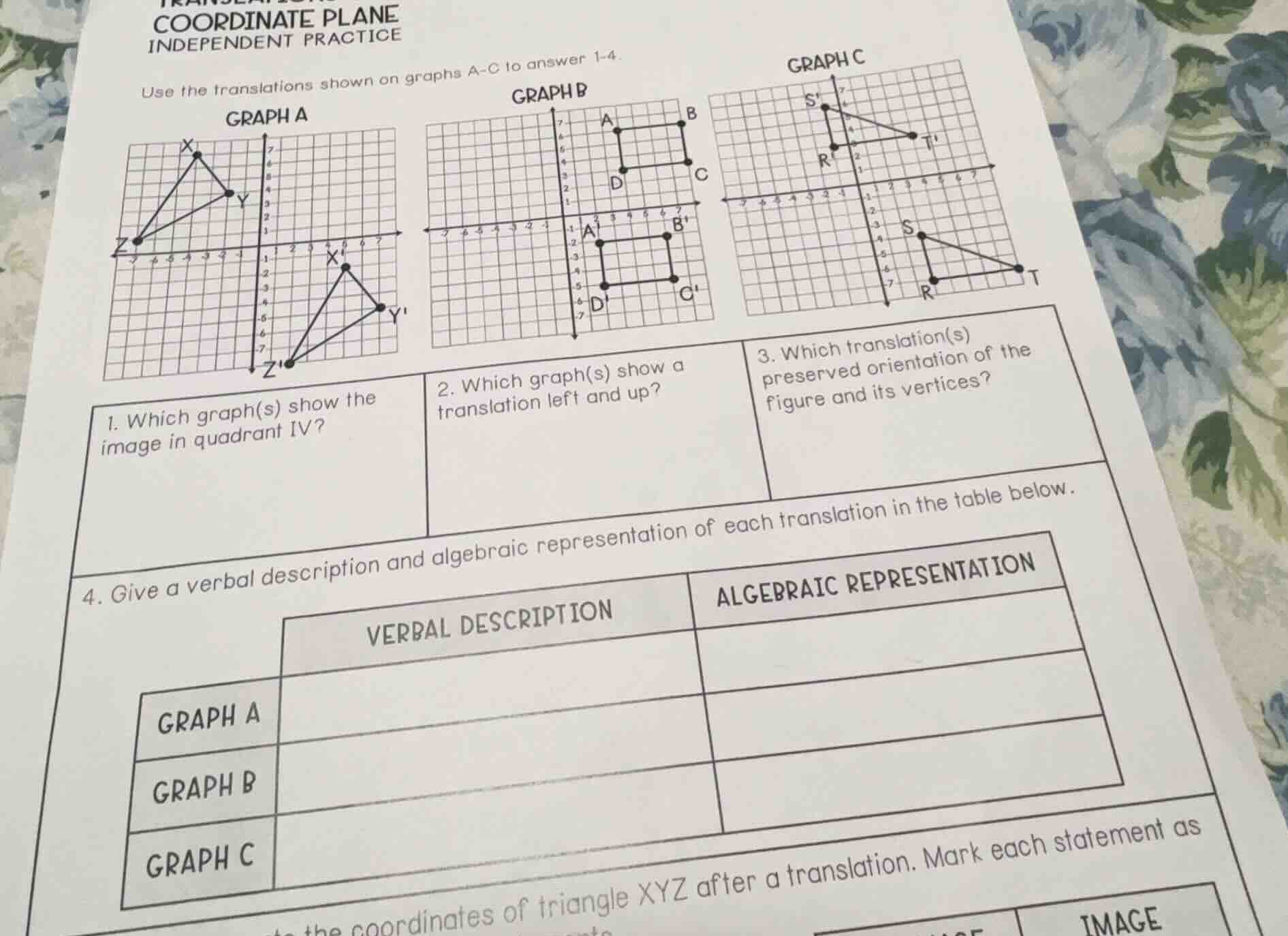
use the translations shown on graphs a - c to answer 1 - 4.
- which graph(s) show the image in quadrant iv?
- which graph(s) show a translation left and up?
- which translation(s) preserved orientation of the figure and its vertices?
- give a verbal description and algebraic representation of each translation in the table below.
| verbal description | algebraic representation | |
|---|---|---|
| graph b | ||
| graph c |
the coordinates of triangle xyz after a translation. mark each statement as
image
Question 1: Which graph(s) show the image in quadrant IV?
Quadrant IV is where \( x > 0 \) and \( y < 0 \). Looking at Graph A, the image \( X'Y'Z' \) has coordinates in quadrant IV (positive \( x \), negative \( y \)). Graphs B and C: Graph B's image is in quadrant III (negative \( x \), negative \( y \)) or below, and Graph C's image \( S'T'R' \) is in quadrant II (negative \( x \), positive \( y \)). So only Graph A.
Translation left means \( x \)-coordinate decreases (movement in negative \( x \)-direction), up means \( y \)-coordinate increases (positive \( y \)-direction). Graph B: The original figure is below (negative \( y \)) and moves up (positive \( y \)) and left? Wait, no—wait Graph B: Original \( A'B'C'D' \) is at lower \( y \), and \( ABCD \) is above and to the right? Wait no, looking at Graph B: The lower figure \( A'B'C'D' \) (quadrant IV? No, \( x \) positive, \( y \) negative) and the upper figure \( ABCD \) is to the right and up? Wait no, maybe I misread. Wait Graph C: Wait no, let's re-examine. Graph C: Original \( SRT \) is at \( y \) negative (quadrant IV? \( x \) positive, \( y \) negative), and \( S'R'T' \) is at \( y \) positive (quadrant II? \( x \) negative, \( y \) positive). Wait no, the question is left (negative \( x \)) and up (positive \( y \)). So moving from original to image: left (decrease \( x \)) and up (increase \( y \)). Graph C: Original \( S \) is at \( (2, -4) \)? Wait no, looking at Graph C: Original \( S \) is at \( (2, -4) \)? Wait no, the grid: each square is 1 unit. Let's take a vertex: \( S \) in Graph C (lower) is at \( (2, -4) \)? Wait \( S' \) is at \( (-2, 6) \)? Wait no, maybe better: left (x decreases) and up (y increases). Graph B: Wait no, Graph B's original is \( A'B'C'D' \) (lower, \( y \) negative) and \( ABCD \) is above (y positive) and to the right? No, maybe Graph B is down and right? Wait no, the question is left and up. Let's check Graph C: Original \( S \) is at \( (2, -5) \) (approx), \( S' \) is at \( (-2, 6) \): that's left (from \( x=2 \) to \( x=-2 \), decrease by 4) and up (from \( y=-5 \) to \( y=6 \), increase by 11). Wait Graph C: Yes, left (negative \( x \) movement) and up (positive \( y \) movement). Wait Graph B: Original \( A' \) is at \( (2, -3) \), \( A \) is at \( (4, 6) \): that's right (increase \( x \)) and up (increase \( y \)). Graph A: Original \( X \) is at \( (-4, 6) \), \( X' \) is at \( (4, -3) \): right (increase \( x \)) and down (decrease \( y \)). So Graph C: moving left (x decreases) and up (y increases). Wait maybe I made a mistake. Wait the original in Graph C: \( S \) is at \( (2, -4) \), \( S' \) is at \( (-2, 6) \): so \( x \) goes from 2 to -2 (left, -4), \( y \) goes from -4 to 6 (up, +10). So Graph C is left and up. Wait is there another? Graph B: original \( A' \) is at \( (2, -3) \), \( A \) is at \( (4, 6) \): right (x +2) and up (y +9). Graph A: \( X \) at \( (-4, 6) \), \( X' \) at \( (4, -3) \): right (x +8) and down (y -9). So only Graph C? Wait no, maybe Graph B? Wait no, the question is left (x decreases) and up (y increases). So Graph C: yes. Wait maybe I misread. Let me check again. Graph C: original triangle \( SRT \) is at lower right (quadrant IV: \( x>0, y<0 \)), and image \( S'T'R' \) is at upper left (quadrant II: \( x<0, y>0 \))—so moving left (x negative direction) and up (y positive direction). So Graph C shows translation left and up.
Translations (slides) preserve orientation (rotation, reflection change orientation; translation does not). All three graphs (A, B, C) are translations (no rotation, no reflection), so all translations preserve orientation. So Graphs A, B, and C.

Snap & solve any problem in the app
Get step-by-step solutions on Sovi AI
Photo-based solutions with guided steps
Explore more problems and detailed explanations
Graph A