QUESTION IMAGE
Question
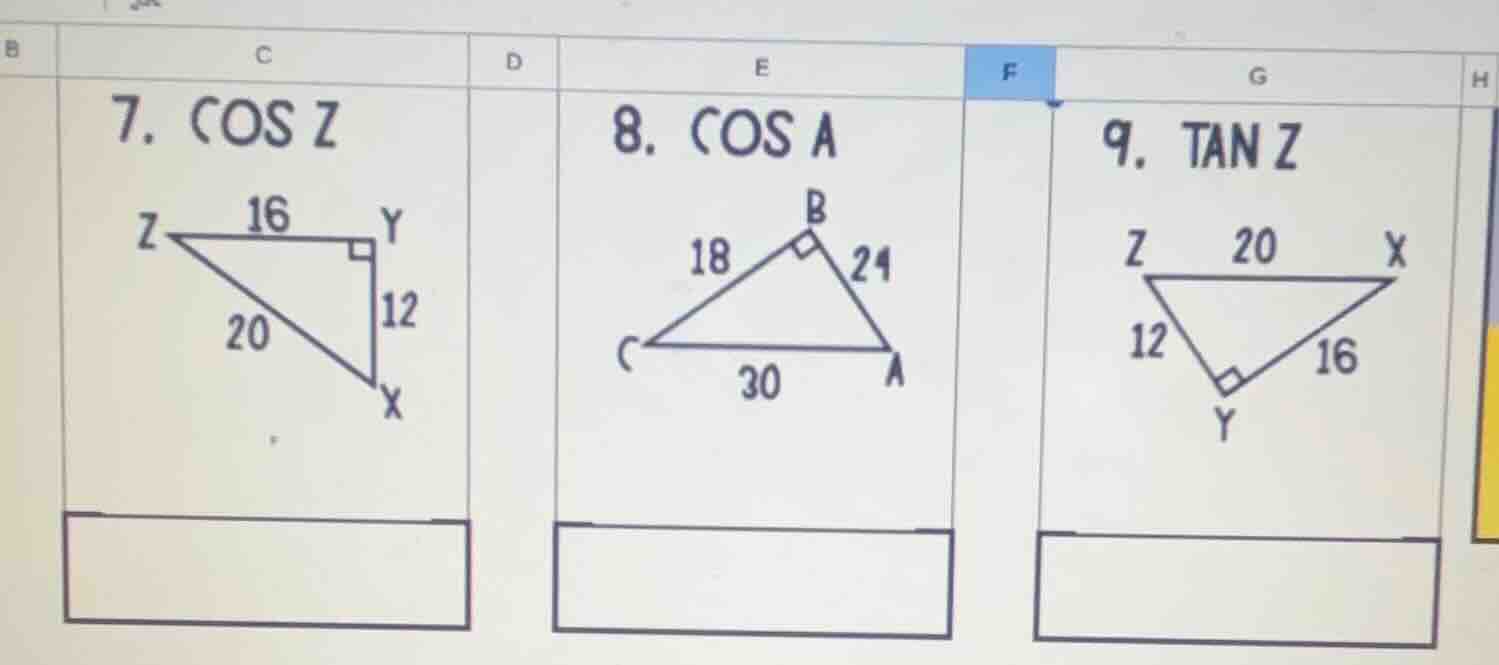
- cos z
z---16---y
|\\ |
| \\ |12
| \\20 |
x---y
- cos a
c---18---b
|\\ |
| \\ |24
| \\30 |
a---b
- tan z
z---20---x
|\\ |
| \\ |16
| \\12 |
y---x
Problem 7: $\boldsymbol{\cos Z}$
Step1: Recall cosine definition
In a right triangle, $\cos\theta = \frac{\text{adjacent}}{\text{hypotenuse}}$. For $\angle Z$, adjacent side is $ZY = 16$, hypotenuse is $ZX = 20$.
Step2: Calculate $\cos Z$
$\cos Z = \frac{ZY}{ZX} = \frac{16}{20} = \frac{4}{5}$
Problem 8: $\boldsymbol{\cos A}$
Step1: Recall cosine definition
In right $\triangle ABC$, $\cos A = \frac{\text{adjacent}}{\text{hypotenuse}}$. Adjacent to $\angle A$ is $AB = 24$, hypotenuse is $AC = 30$.
Step2: Calculate $\cos A$
$\cos A = \frac{AB}{AC} = \frac{24}{30} = \frac{4}{5}$
Problem 9: $\boldsymbol{\tan Z}$
Step1: Recall tangent definition
In right $\triangle XYZ$, $\tan\theta = \frac{\text{opposite}}{\text{adjacent}}$. For $\angle Z$, opposite side is $XY = 16$, adjacent side is $ZY = 12$? Wait, no: right angle at $Y$, so $\angle Y = 90^\circ$. So for $\angle Z$, opposite is $XY = 16$? Wait, no: sides: $ZY = 12$, $XY = 16$, $ZX = 20$ (by Pythagoras: $12^2 + 16^2 = 144 + 256 = 400 = 20^2$). So $\angle Y = 90^\circ$, so for $\angle Z$: adjacent is $ZY = 12$, opposite is $XY = 16$? Wait, no: $\tan Z = \frac{\text{opposite to } Z}{\text{adjacent to } Z}$. Opposite to $Z$ is $XY$ (since $XY$ is opposite $\angle Z$), adjacent is $ZY$. Wait, no: in $\triangle XYZ$, right-angled at $Y$, so:
- $\angle Z$: sides:
- Adjacent: $ZY = 12$
- Opposite: $XY = 16$
Wait, no: $\tan Z = \frac{\text{opposite}}{\text{adjacent}} = \frac{XY}{ZY}$? Wait, no: $\angle Z$ is at vertex $Z$, so the sides:
- Adjacent: $ZY$ (the side forming $\angle Z$ with hypotenuse)
- Opposite: $XY$ (the side opposite $\angle Z$)
Wait, actually, in right $\triangle XYZ$ (right at $Y$), the legs are $ZY = 12$ and $XY = 16$, hypotenuse $ZX = 20$. So for $\angle Z$:
- Adjacent side: $ZY = 12$
- Opposite side: $XY = 16$? Wait, no: $\angle Z$ is between $ZY$ and $ZX$. So the side opposite $\angle Z$ is $XY$, and adjacent is $ZY$. Wait, no: $\tan Z = \frac{\text{opposite}}{\text{adjacent}} = \frac{XY}{ZY}$? Wait, no, let's label:
- Vertex $Z$, $Y$, $X$: right at $Y$. So:
- $\angle Z$: sides:
- Adjacent: $ZY$ (length 12)
- Opposite: $XY$ (length 16)
Wait, no, that's incorrect. Wait, $\tan Z = \frac{\text{opposite to } Z}{\text{adjacent to } Z}$. The angle at $Z$: the sides:
- The side opposite $\angle Z$ is $XY$ (because $XY$ is opposite $\angle Z$: in triangle, side opposite $\angle Z$ is $XY$ (since $\angle Z$ is at $Z$, so the side not connected to $Z$ is $XY$). The side adjacent to $\angle Z$ is $ZY$ (the leg connected to $Z$ and the right angle $Y$). Wait, no: adjacent is the leg that is part of $\angle Z$ (other than hypotenuse). So $\tan Z = \frac{\text{opposite}}{\text{adjacent}} = \frac{XY}{ZY}$? Wait, $XY$ is length 16, $ZY$ is length 12? Wait, no: $ZY$ is 12, $XY$ is 16. Wait, no, in the diagram, $ZY = 12$, $XY = 16$, right angle at $Y$. So $\angle Z$: the sides:
- Adjacent: $ZY = 12$ (the leg adjacent to $\angle Z$)
- Opposite: $XY = 16$ (the leg opposite $\angle Z$)
Wait, but $\tan Z = \frac{\text{opposite}}{\text{adjacent}} = \frac{XY}{ZY} = \frac{16}{12} = \frac{4}{3}$? Wait, no, wait: maybe I mixed up. Wait, in right triangle, $\tan\theta = \frac{\text{opposite}}{\text{adjacent}}$. Let's re-express:
In $\triangle XYZ$, right at $Y$:
- $\angle Z$:
- Opposite side: $XY$ (since $XY$ is opposite $\angle Z$)
- Adjacent side: $ZY$ (since $ZY$ is adjacent to $\angle Z$)
Wait, but $ZY = 12$, $XY = 16$. Wait, no, maybe I got the sides wrong. Wait, the right angle is at $Y$, so $ZY$ and $XY$ are the legs, $ZX$ is the hypotenuse. So:
- For $\angle Z$:
- Adjacent: $ZY$ (length 12)
- Opposite: $XY$ (length 16)
Thus, $\tan Z = \frac{\text{opposite}}{\text{adjacent}} = \frac{XY}{ZY} = \frac{16}{12} = \frac{4}{3}$? Wait, no, wait: wait, $\angle Z$: the side adjacent is $ZY$, and the side opposite is $XY$? Wait, no, maybe I have the angle's adjacent and opposite reversed. Let's think again: in $\triangle XYZ$, right-angled at $Y$:
- $\angle Z$: the angle at $Z$ between $ZY$ and $ZX$. So the side adjacent to $\angle Z$ is $ZY$ (the leg), and the side opposite is $XY$ (the other leg). So yes, $\tan Z = \frac{XY}{ZY} = \frac{16}{12} = \frac{4}{3}$. Wait, but let's che…

Snap & solve any problem in the app
Get step-by-step solutions on Sovi AI
Photo-based solutions with guided steps
Explore more problems and detailed explanations
s:
- $\boldsymbol{\frac{4}{5}}$
- $\boldsymbol{\frac{4}{5}}$
- $\boldsymbol{\frac{4}{3}}$