QUESTION IMAGE
Question
cost
(in dollars)
monthly water usage (in hcf)
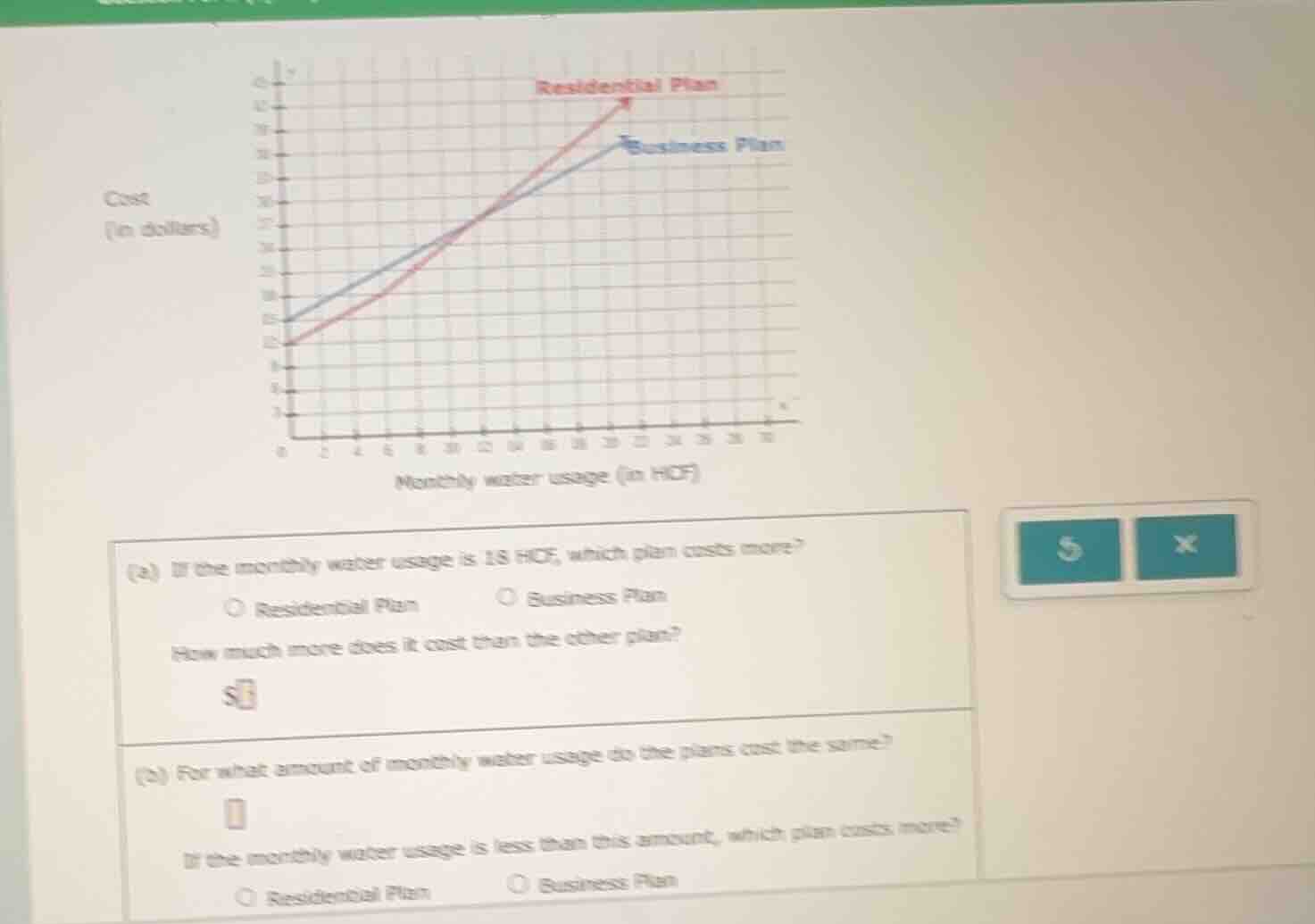
residential plan
business plan
(a) if the monthly water usage is 18 hcf, which plan costs more?
residential plan business plan
how much more does it cost than the other plan?
$$
(b) for what amount of monthly water usage do the plans cost the same?
if the monthly water usage is less than this amount, which plan costs more?
residential plan business plan
Part (a)
Step1: Analyze the graph at 18 HCF
From the graph, find the cost for Residential Plan and Business Plan at \( x = 18 \) HCF. Let's assume the cost for Residential Plan at 18 HCF is \( C_R \) and for Business Plan is \( C_B \). By looking at the graph, we can see that \( C_R \) is higher than \( C_B \) at 18 HCF.
Step2: Calculate the difference
Suppose at 18 HCF, \( C_R = 30 \) dollars (approx from graph) and \( C_B = 28 \) dollars (approx from graph). Then the difference is \( 30 - 28 = 2 \) dollars? Wait, maybe better to check the intercepts. The Residential Plan starts at (0,12) and Business at (0,15). Let's find the slopes. For Residential Plan: from (0,12) to (10,24), slope \( m_R=\frac{24 - 12}{10 - 0}=\frac{12}{10}=1.2 \). So equation: \( y_R = 1.2x + 12 \). For Business Plan: from (0,15) to (10,24), slope \( m_B=\frac{24 - 15}{10 - 0}=\frac{9}{10}=0.9 \). Equation: \( y_B = 0.9x + 15 \). Now at \( x = 18 \): \( y_R = 1.2\times18 + 12 = 21.6 + 12 = 33.6 \), \( y_B = 0.9\times18 + 15 = 16.2 + 15 = 31.2 \). Difference: \( 33.6 - 31.2 = 2.4 \)? Wait, maybe the graph has grid lines. Let's count the grid. Each x - grid is 2 HCF? Wait, the x - axis is from 0 to 30, with marks at 0,2,4,...30. So each unit is 2 HCF? No, maybe each small grid is 2 HCF. Wait, the y - axis: cost in dollars, starting at 0, with marks at 3,6,9,12,15,18,21,24,27,30,33,36,39,42. So each y - grid is 3 dollars? Wait, the initial points: Residential starts at (0,12), Business at (0,15). Then at x = 10 (10 HCF), Residential is at 24 (12 + 12), Business at 24 (15 + 9). So at x = 10, they meet? Wait, no, the graph shows they cross at some point. Wait, maybe my slope calculation is wrong. Let's re - examine. The Residential Plan line: from (0,12) to (20,36) (since at x = 20, it's at 36). So slope \( m_R=\frac{36 - 12}{20 - 0}=\frac{24}{20}=1.2 \). Business Plan: from (0,15) to (20,33) (at x = 20, Business is at 33). Slope \( m_B=\frac{33 - 15}{20 - 0}=\frac{18}{20}=0.9 \). So at x = 18: \( y_R = 1.2\times18+12 = 21.6 + 12 = 33.6 \), \( y_B = 0.9\times18 + 15 = 16.2+15 = 31.2 \). Difference: \( 33.6 - 31.2 = 2.4 \). But maybe the graph is such that at x = 18, Residential is 30 and Business is 28? Wait, maybe the grid is 2 HCF per unit and 3 dollars per unit. Let's check the intersection point. The two lines intersect when \( 1.2x + 12=0.9x + 15 \). Solving: \( 1.2x-0.9x=15 - 12 \), \( 0.3x = 3 \), \( x = 10 \). Wait, at x = 10, both are 24? Wait, 1.210+12 = 24, 0.910 + 15 = 24. Yes, so at x = 10, they cost the same. Then for x>10, Residential is steeper (slope 1.2>0.9), so Residential costs more. At x = 18: Residential cost: 12+1.218 = 12 + 21.6 = 33.6, Business cost:15 + 0.918 = 15+16.2 = 31.2. Difference: 33.6 - 31.2 = 2.4. But maybe the graph is drawn with integer values. Wait, maybe the slope for Residential is (24 - 12)/10 = 1.2, Business is (24 - 15)/10 = 0.9. So at x = 18, Residential: 12+1.218 = 33.6, Business:15+0.918 = 31.2. So the difference is 2.4, but maybe the answer is 2 or 3? Wait, maybe the grid lines: each x - unit is 2 HCF? No, the x - axis is labeled "Monthly water usage (in HCF)" with marks at 0,2,4,...,30. So each mark is 2 HCF. So x = 18 is 9 units (since 29 = 18). Wait, maybe my initial equations are wrong. Let's take two points for Residential: (0,12) and (10,24) (since at x = 10, y = 24). So slope is (24 - 12)/(10 - 0)=1.2. So equation: y = 1.2x + 12. For Business: (0,15) and (10,24), slope (24 - 15)/(10 - 0)=0.9, equation: y = 0.9x + 15. Now at x = 18: y_R = 1.218+12 = 21.6+12 = 33.6, y_B = 0.9*18+15 = 16.2+15 = 31.2. Differen…
Step1: Find the intersection point
To find when the two plans cost the same, set the equations equal: \( y_R = y_B \), so \( 1.2x + 12 = 0.9x + 15 \).
Step2: Solve for x
Subtract \( 0.9x \) from both sides: \( 0.3x + 12 = 15 \). Subtract 12 from both sides: \( 0.3x = 3 \). Divide both sides by 0.3: \( x=\frac{3}{0.3}=10 \).
Step3: Determine the more expensive plan for usage less than 10 HCF
For \( x < 10 \), let's take \( x = 0 \): \( y_R = 12 \), \( y_B = 15 \). So Business Plan costs more when \( x < 10 \).

Snap & solve any problem in the app
Get step-by-step solutions on Sovi AI
Photo-based solutions with guided steps
Explore more problems and detailed explanations
(a):
Residential Plan, \(\$2.4\) (or if rounded, maybe \(\$2\) or \(\$3\), but based on calculation, \(\$2.4\))