QUESTION IMAGE
Question
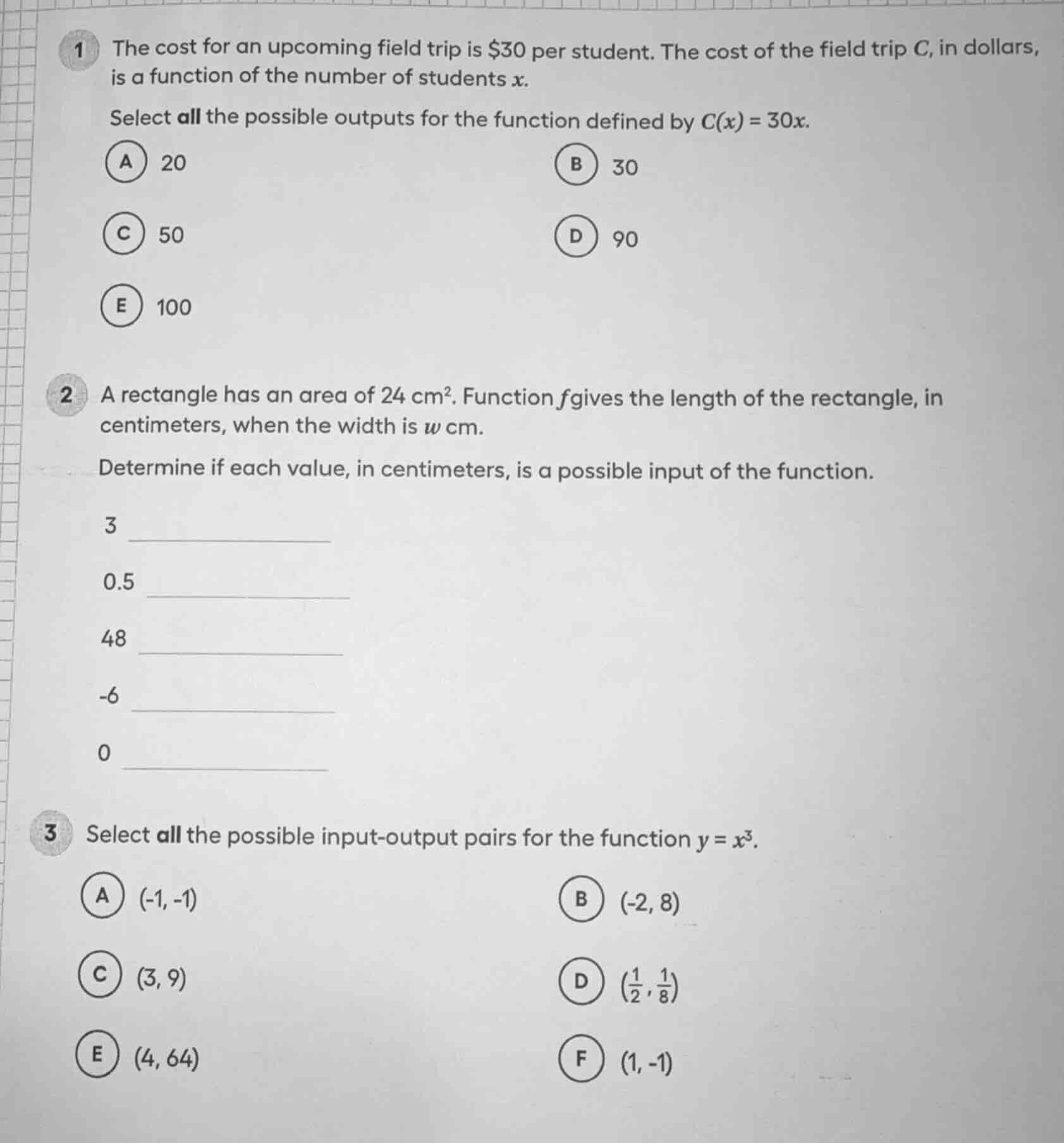
1 the cost for an upcoming field trip is $30 per student. the cost of the field trip c, in dollars, is a function of the number of students x. select all the possible outputs for the function defined by c(x) = 30x. a 20 b 30 c 50 d 90 e 100 2 a rectangle has an area of 24 cm². function f gives the length of the rectangle, in centimeters, when the width is w cm. determine if each value, in centimeters, is a possible input of the function. 3 ____ 0.5 __ 48 __ -6 __ 0 ____ 3 select all the possible input - output pairs for the function y = x³. a (-1, -1) b (-2, 8) c (3, 9) d (1/2, 1/8) e (4, 64) f (1, -1)
Question 1
Step1: Analyze the function \( C(x) = 30x \)
The number of students \( x \) must be a non - negative integer (since you can't have a fraction or negative number of students in a practical sense for a field trip). So we need to check which of the given numbers can be written as \( 30x \) where \( x \) is a non - negative integer.
Step2: Check option A
For \( C(x)=20 \), we solve \( 30x = 20\), then \( x=\frac{20}{30}=\frac{2}{3}\), which is not an integer. So 20 is not a possible output.
Step3: Check option B
For \( C(x) = 30\), we solve \( 30x=30\), then \( x = 1\) (an integer). So 30 is a possible output.
Step4: Check option C
For \( C(x)=50 \), we solve \( 30x = 50\), then \( x=\frac{50}{30}=\frac{5}{3}\), which is not an integer. So 50 is not a possible output.
Step5: Check option D
For \( C(x)=90 \), we solve \( 30x=90\), then \( x = 3\) (an integer). So 90 is a possible output.
Step6: Check option E
For \( C(x)=100 \), we solve \( 30x = 100\), then \( x=\frac{100}{30}=\frac{10}{3}\), which is not an integer. So 100 is not a possible output.
- For \( w = 3\): Valid (width > 0, length exists).
- For \( w = 0.5\): Valid (width > 0, length exists).
- For \( w = 48\): Valid (width > 0, length exists).
- For \( w=-6\): Invalid (width can't be negative).
- For \( w = 0\): Invalid (width can't be zero).
We need to check if for each pair \((x,y)\), \( y=x^{3}\)
Step1: Check option A
For \( x=-1\), \( y=(-1)^{3}=-1\). So \((-1,-1)\) is a valid pair.
Step2: Check option B
For \( x = - 2\), \( y=(-2)^{3}=-8
eq8\). So \((-2,8)\) is not a valid pair.
Step3: Check option C
For \( x = 3\), \( y=3^{3}=27
eq9\). So \((3,9)\) is not a valid pair.
Step4: Check option D
For \( x=\frac{1}{2}\), \( y = (\frac{1}{2})^{3}=\frac{1}{8}\). So \((\frac{1}{2},\frac{1}{8})\) is a valid pair.
Step5: Check option E
For \( x = 4\), \( y=4^{3}=64\). So \((4,64)\) is a valid pair.
Step6: Check option F
For \( x = 1\), \( y=1^{3}=1
eq - 1\). So \((1,-1)\) is not a valid pair.

Snap & solve any problem in the app
Get step-by-step solutions on Sovi AI
Photo-based solutions with guided steps
Explore more problems and detailed explanations
B. 30, D. 90
Question 2
The area of a rectangle \( A=l\times w \), given \( A = 24\space cm^{2}\), so the length \( l=\frac{24}{w}\), and the width \( w>0\) (since width of a rectangle can't be zero or negative).
- For \( w = 3\): \( l=\frac{24}{3}=8\) (valid, since \( 3>0\))
- For \( w=0.5\): \( l=\frac{24}{0.5} = 48\) (valid, since \( 0.5>0\))
- For \( w = 48\): \( l=\frac{24}{48}=0.5\) (valid, since \( 48>0\))
- For \( w=-6\): Width can't be negative, so invalid.
- For \( w = 0\): If \( w = 0\), the rectangle doesn't exist (area would be 0), so invalid.