QUESTION IMAGE
Question
cphs : advanced algebra: concepts and connections - block (27.0831030)
adding and subtracting rational expressions
subtracting rational expressions
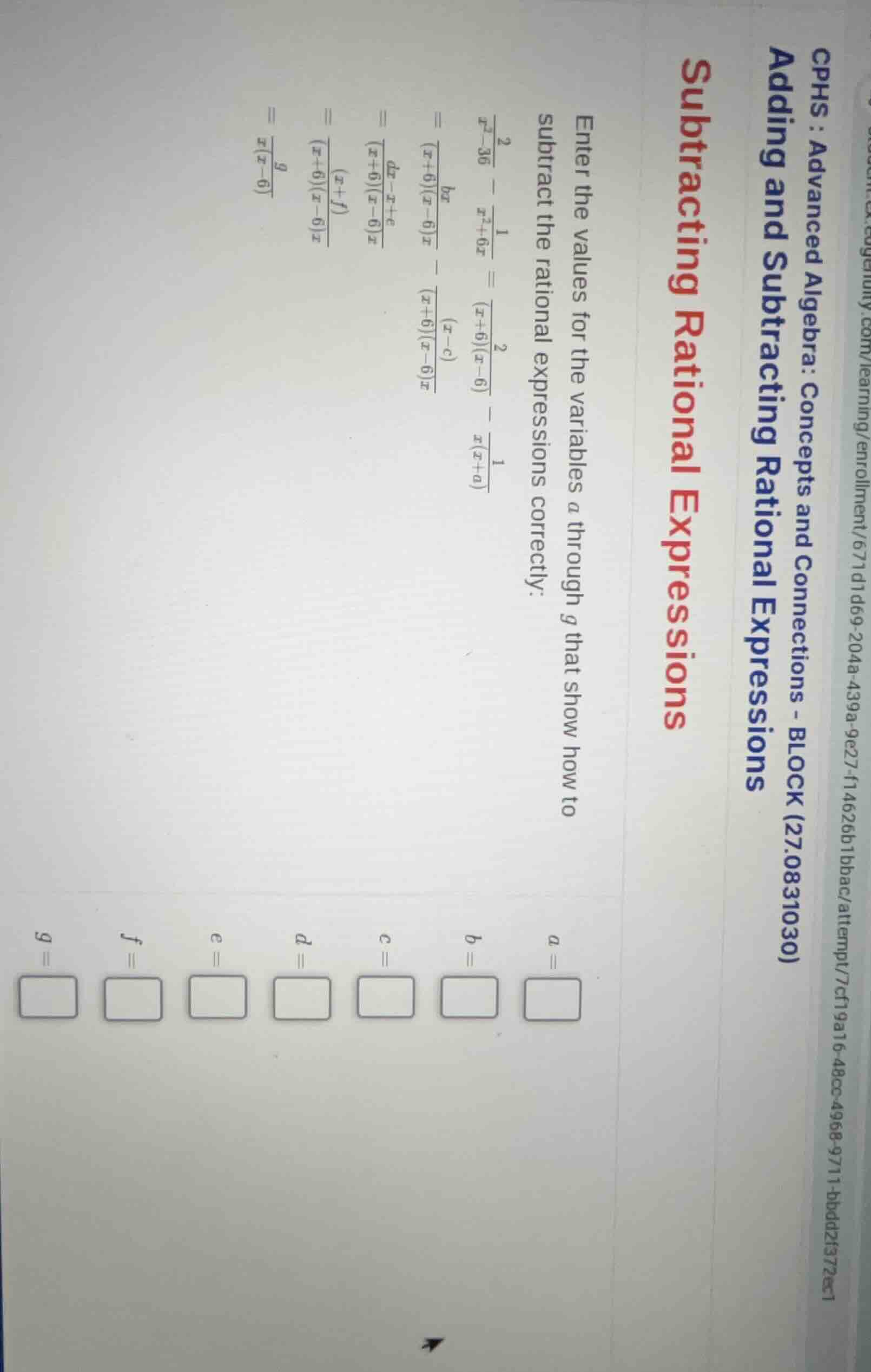
enter the values for the variables a through g that show how to
subtract the rational expressions correctly:
$\frac{2}{x^2 - 36} - \frac{1}{x^2 + 6x} = \frac{2}{(x + 6)(x - 6)} - \frac{1}{x(x + a)}$
$= \frac{bx}{(x + 6)(x - 6)x} - \frac{(x - c)}{(x + 6)(x - 6)x}$
$= \frac{dx - x + e}{(x + 6)(x - 6)x}$
$= \frac{(x + f)}{(x + 6)(x - 6)x}$
$= \frac{g}{x(x - 6)}$
$a = \square$
$b = \square$
$c = \square$
$d = \square$
$e = \square$
$f = \square$
$g = \square$
Step1: Factor denominators
First, factor the denominators of the rational expressions. We know that \(x^{2}-36=(x + 6)(x - 6)\) (by the difference of squares formula \(a^{2}-b^{2}=(a + b)(a - b)\) where \(a=x\) and \(b = 6\)) and \(x^{2}+6x=x(x + 6)\).
Step2: Find common denominator
The common denominator for \(\frac{2}{x^{2}-36}\) and \(\frac{1}{x^{2}+6x}\) is \(x(x + 6)(x - 6)\) (since \(x^{2}-36=(x + 6)(x - 6)\) and \(x^{2}+6x=x(x + 6)\)).
Step3: Rewrite fractions with common denominator
Rewrite \(\frac{2}{x^{2}-36}\) as \(\frac{2x}{x(x + 6)(x - 6)}\) (multiply numerator and denominator by \(x\)) and \(\frac{1}{x^{2}+6x}\) as \(\frac{x - 6}{x(x + 6)(x - 6)}\) (multiply numerator and denominator by \((x - 6)\)).
Step4: Subtract the fractions
Now, subtract the two fractions: \(\frac{2x}{x(x + 6)(x - 6)}-\frac{x - 6}{x(x + 6)(x - 6)}=\frac{2x-(x - 6)}{x(x + 6)(x - 6)}\).
Step5: Simplify the numerator
Simplify the numerator: \(2x-(x - 6)=2x-x + 6=x + 6\).
Step6: Simplify the fraction
So the fraction becomes \(\frac{x + 6}{x(x + 6)(x - 6)}\), and we can cancel out the \((x + 6)\) terms (assuming \(x
eq - 6\)) to get \(\frac{1}{x(x - 6)}\). Wait, no, wait, let's check again. Wait, original problem is \(\frac{2}{x^{2}-36}-\frac{1}{x^{2}+6x}\). Let's do it step by step with the given steps in the image.
Looking at the image steps:
First, \(\frac{2}{x^{2}-36}=\frac{2}{(x + 6)(x - 6)}=\frac{2x}{x(x + 6)(x - 6)}\) (so \(b = 2\), because in the step \(\frac{bx}{(x + 6)(x - 6)x}\), so \(b = 2\)).
Then, \(\frac{1}{x^{2}+6x}=\frac{1}{x(x + 6)}=\frac{x - 6}{x(x + 6)(x - 6)}\) (so the numerator here is \(x - 6\), so in the step \(\frac{(x - c)}{(x + 6)(x - 6)x}\), so \(c = 6\) because \(x - c=x - 6\) implies \(c = 6\)).
Then, subtracting: \(\frac{2x}{x(x + 6)(x - 6)}-\frac{x - 6}{x(x + 6)(x - 6)}=\frac{2x-(x - 6)}{x(x + 6)(x - 6)}=\frac{2x-x + 6}{x(x + 6)(x - 6)}=\frac{x + 6}{x(x + 6)(x - 6)}\) (so \(d = 1\) (coefficient of \(x\) in numerator? Wait, no, looking at the steps:
First step: \(\frac{2}{x^{2}-36}=\frac{2}{(x + 6)(x - 6)}=\frac{bx}{(x + 6)(x - 6)x}\) ⇒ \(b = 2\) (since numerator 2 times x is \(2x\), so \(bx = 2x\) ⇒ \(b = 2\)).
Second step: \(\frac{1}{x^{2}+6x}=\frac{1}{x(x + 6)}=\frac{(x - c)}{(x + 6)(x - 6)x}\) ⇒ \(x - c\) is the numerator when we multiply 1 by \((x - 6)\), so \(x - c=x - 6\) ⇒ \(c = 6\).
Third step: \(\frac{2x}{x(x + 6)(x - 6)}-\frac{x - 6}{x(x + 6)(x - 6)}=\frac{2x-(x - 6)}{x(x + 6)(x - 6)}=\frac{2x-x + 6}{x(x + 6)(x - 6)}=\frac{x + 6}{x(x + 6)(x - 6)}\) (so the numerator after subtraction is \(x + 6\), which is \(dx - x+e\)? Wait, the step shows \(\frac{dx - x+e}{(x + 6)(x - 6)x}\). So \(dx - x+e=(d - 1)x+e\). And we have \(2x-(x - 6)=x + 6\), so \((d - 1)x+e=x + 6\). Therefore, \(d - 1 = 1\) ⇒ \(d = 2\)? No, wait, no, \(2x-(x - 6)=x + 6\), so \(dx - x+e=x + 6\) ⇒ \(d = 1\)? Wait, maybe I misread the step. The step is \(\frac{dx - x+e}{(x + 6)(x - 6)x}\). So \(dx - x+e=(d - 1)x+e\). And \(2x-(x - 6)=x + 6\), so \((d - 1)x+e=x + 6\). Therefore, \(d - 1 = 1\) ⇒ \(d = 2\)? No, \(2x - x= x\), so \(d = 2\)? Wait, no, original numerator of first fraction is 2, multiplied by x is 2x. Second fraction numerator is 1, multiplied by (x - 6) is (x - 6). So subtraction: 2x - (x - 6)=2x - x + 6=x + 6. So \(dx - x+e=x + 6\) ⇒ \(d = 1\) (coefficient of x is 1), so \(d - 1 = 1\) ⇒ \(d = 2\)? No, \(dx - x=(d - 1)x\). So (d - 1)x+e=x + 6. Therefore, \(d - 1 = 1\) ⇒ \(d = 2\)? No, 1x + 6, so \(d - 1 = 1\) ⇒ \(d = 2\), and \(e = 6\).
Then next step: \(\frac{(x + f)}{(x + 6)(x - 6)x}\). Since we have \(\fr…

Snap & solve any problem in the app
Get step-by-step solutions on Sovi AI
Photo-based solutions with guided steps
Explore more problems and detailed explanations
\(a = 6\)
\(b = 2\)
\(c = 6\)
\(d = 2\)
\(e = 6\)
\(f = 6\)
\(g = 1\)