QUESTION IMAGE
Question
cphs : advanced algebra: concepts and connections - block (27.0831030)
function inverses
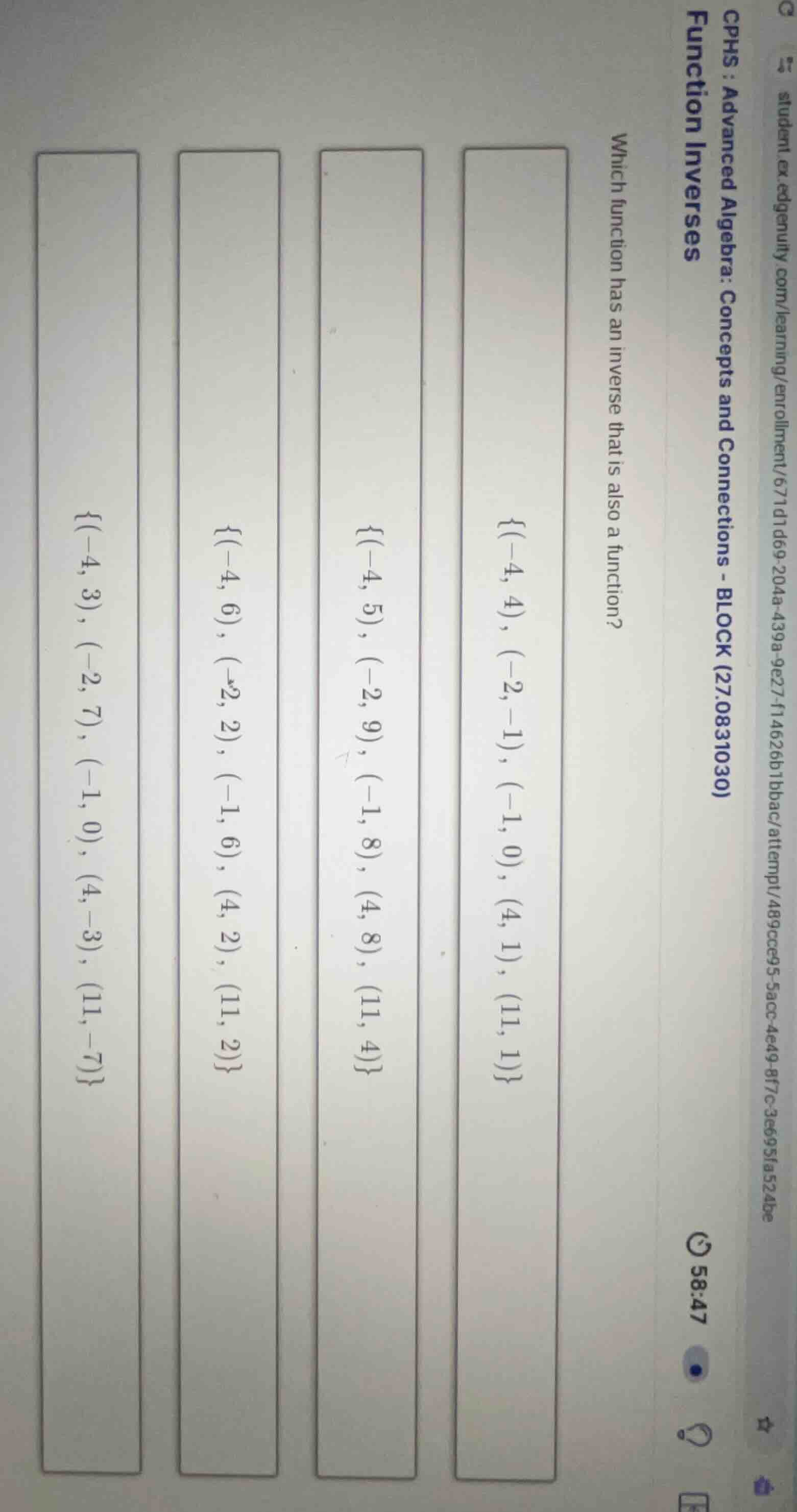
which function has an inverse that is also a function?
{(-4, 4), (-2, -1), (-1, 0), (4, 1), (11, 1)}
{(-4, 5), (-2, 9), (-1, 8), (4, 8), (11, 4)}
{(-4, 6), (-2, 2), (-1, 6), (4, 2), (11, 2)}
{(-4, 3), (-2, 7), (-1, 0), (4, -3), (11, -7)}
Step1: Recall the definition of a function and its inverse
A function has a unique output for each input (passes the vertical line test). The inverse of a function will also be a function if the original function is one - to - one (passes the horizontal line test), meaning each output corresponds to exactly one input.
Step2: Analyze the first set of ordered pairs \(\{(-4,4),(-2, - 1),(-1,0),(4,1),(11,1)\}\)
- For the original function: Check for repeated \(x\) - values (inputs). The \(x\) - values are \(-4,-2,-1,4,11\), all unique, so it is a function.
- For the inverse: The inverse of a function \((x,y)\) is \((y,x)\). So the inverse ordered pairs would be \(\{(4,-4),(-1,-2),(0,-1),(1,4),(1,11)\}\). Here, the \(x\) - value \(1\) is repeated (corresponds to \(y = 4\) and \(y=11\) in the original function), so the inverse is not a function.
Step3: Analyze the second set of ordered pairs \(\{(-4,5),(-2,9),(-1,8),(4,8),(11,4)\}\)
- For the original function: \(x\) - values \(-4,-2,-1,4,11\) are unique, so it is a function.
- For the inverse: The inverse ordered pairs are \(\{(5,-4),(9,-2),(8,-1),(8,4),(4,11)\}\). The \(x\) - value \(8\) is repeated (corresponds to \(y=-1\) and \(y = 4\) in the original function), so the inverse is not a function.
Step4: Analyze the third set of ordered pairs \(\{(-4,6),(-2,2),(-1,6),(4,2),(11,2)\}\)
- For the original function: \(x\) - values \(-4,-2,-1,4,11\) are unique, so it is a function.
- For the inverse: The inverse ordered pairs are \(\{(6,-4),(2,-2),(6,-1),(2,4),(2,11)\}\). The \(x\) - values \(6\) and \(2\) are repeated, so the inverse is not a function.
Step5: Analyze the fourth set of ordered pairs \(\{(-4,3),(-2,7),(-1,0),(4,-3),(11,-7)\}\)
- For the original function: \(x\) - values \(-4,-2,-1,4,11\) are unique, so it is a function.
- For the inverse: The inverse ordered pairs are \(\{(3,-4),(7,-2),(0,-1),(-3,4),(-7,11)\}\). The \(x\) - values \(3,7,0,-3,-7\) are all unique, so the inverse is also a function.

Snap & solve any problem in the app
Get step-by-step solutions on Sovi AI
Photo-based solutions with guided steps
Explore more problems and detailed explanations
The function with ordered pairs \(\{(-4,3),(-2,7),(-1,0),(4,-3),(11,-7)\}\) has an inverse that is also a function.