QUESTION IMAGE
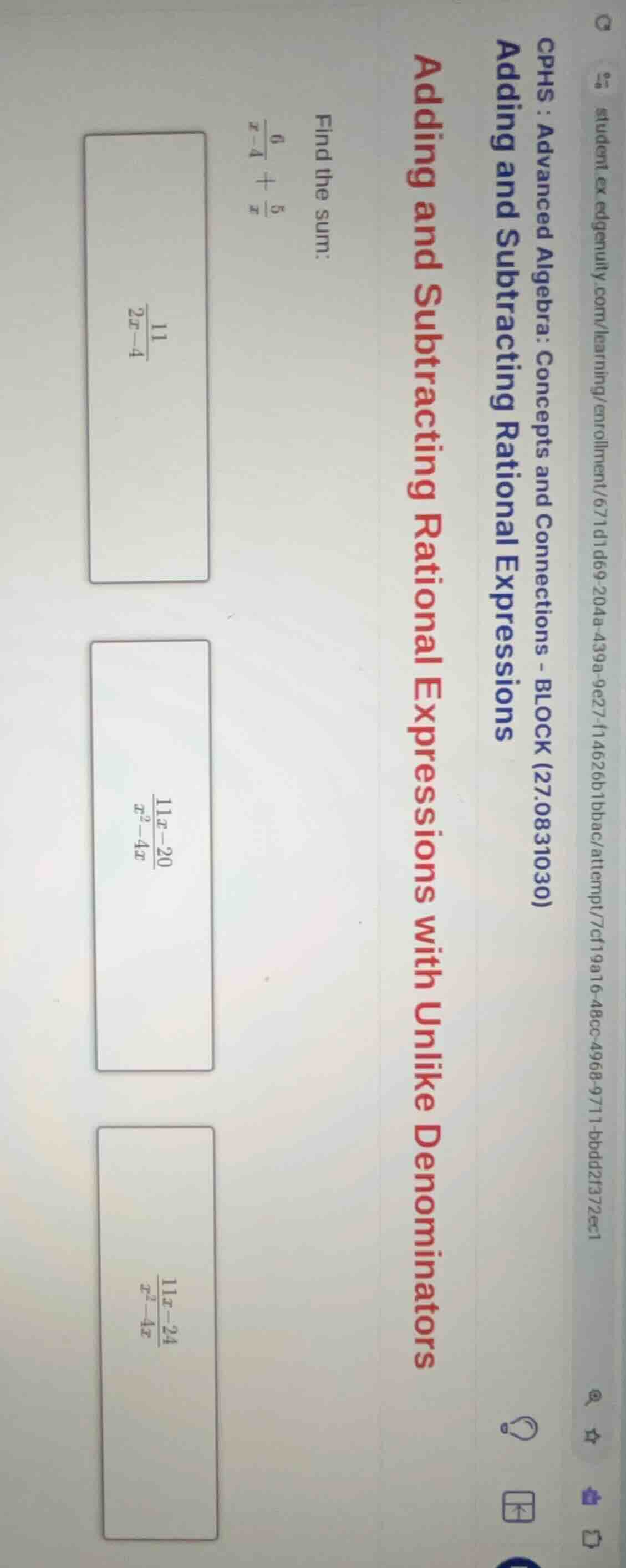
Question
cphs : advanced algebra: concepts and connections - block (27.0831030)
adding and subtracting rational expressions
adding and subtracting rational expressions with unlike denominators
find the sum:
$\frac{6}{x - 4} + \frac{5}{x}$
options:
$\frac{11}{2x - 4}$
$\frac{11x - 20}{x^2 - 4x}$
$\frac{11x - 24}{x^2 - 4x}$
Step1: Find a common denominator
The denominators are \(x - 4\) and \(x\). The common denominator is \(x(x - 4)=x^{2}-4x\).
Rewrite each fraction with the common denominator:
\(\frac{6}{x - 4}=\frac{6x}{x(x - 4)}\) (multiply numerator and denominator by \(x\))
\(\frac{5}{x}=\frac{5(x - 4)}{x(x - 4)}\) (multiply numerator and denominator by \(x - 4\))
Step2: Add the fractions
Now that the fractions have the same denominator, we add the numerators:
\(\frac{6x}{x^{2}-4x}+\frac{5(x - 4)}{x^{2}-4x}=\frac{6x + 5(x - 4)}{x^{2}-4x}\)
Step3: Simplify the numerator
Expand and combine like terms in the numerator:
\(6x+5(x - 4)=6x + 5x-20 = 11x-20\)
Step4: Write the final fraction
So the sum is \(\frac{11x - 20}{x^{2}-4x}\)

Snap & solve any problem in the app
Get step-by-step solutions on Sovi AI
Photo-based solutions with guided steps
Explore more problems and detailed explanations
\(\frac{11x - 20}{x^{2}-4x}\) (corresponding to the middle option)