QUESTION IMAGE
Question
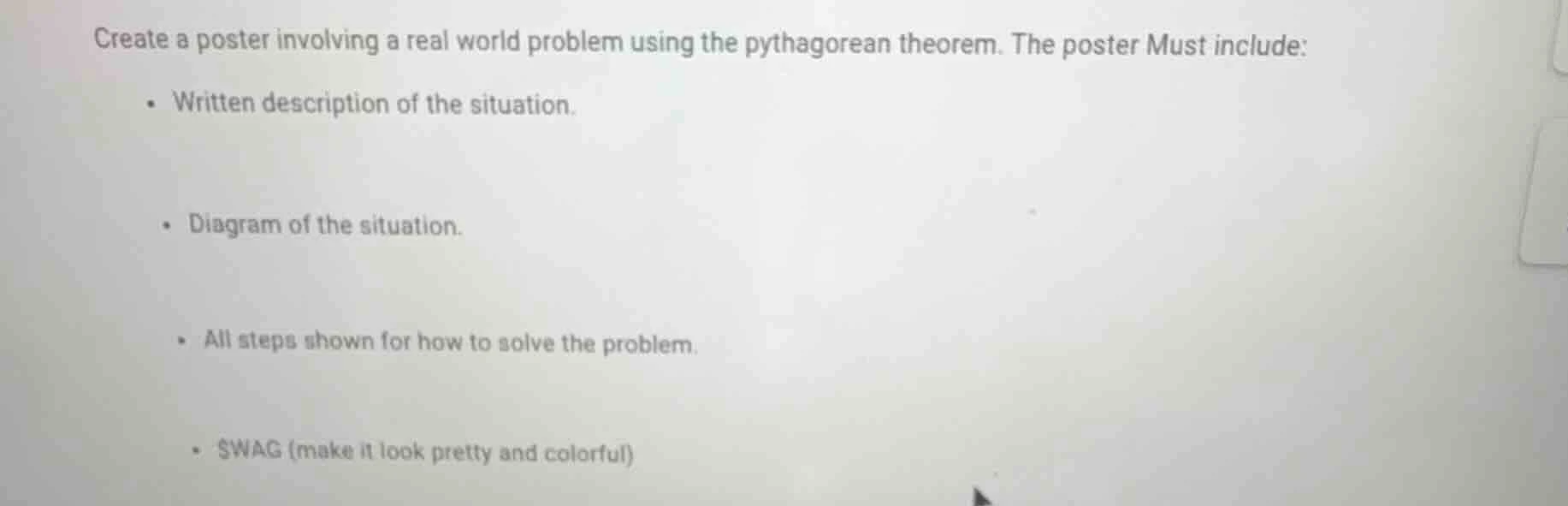
create a poster involving a real world problem using the pythagorean theorem. the poster must include: - written description of the situation. - diagram of the situation. - all steps shown for how to solve the problem. - swag (make it look pretty and colorful)
Poster: Using Pythagorean Theorem to Find the Length of a Ladder Against a Wall
1. Written Description of the Situation
A painter needs to lean a ladder against a vertical wall to reach the top of the wall to paint. The base of the ladder is 6 feet away from the bottom of the wall (horizontal distance), and the wall is 8 feet tall (vertical height). We need to find the length of the ladder required to reach the top of the wall.
2. Diagram of the Situation
(You can draw a right - angled triangle where:
- The vertical side (height of the wall) is labeled as \( a = 8 \) feet.
- The horizontal side (distance from the base of the ladder to the wall) is labeled as \( b = 6 \) feet.
- The hypotenuse (length of the ladder) is labeled as \( c \), which we need to find.
- Color the wall (vertical side) blue, the ground (horizontal side) brown, and the ladder (hypotenuse) green. Add some decorative elements like a small paint bucket at the top of the ladder and some paint splatters around to make it look “SWAG” - y!)
3. Steps to Solve the Problem
The Pythagorean Theorem states that for a right - angled triangle, \( a^{2}+b^{2}=c^{2} \), where \( a \) and \( b \) are the lengths of the two legs (the sides forming the right angle) and \( c \) is the length of the hypotenuse (the side opposite the right angle).
Step 1: Identify the values of \( a \), \( b \)
We know that \( a = 8 \) feet (height of the wall) and \( b = 6 \) feet (distance from the base of the ladder to the wall).
Step 2: Substitute the values into the Pythagorean Theorem
Substitute \( a = 8 \) and \( b = 6 \) into the formula \( a^{2}+b^{2}=c^{2} \).
\( 8^{2}+6^{2}=c^{2} \)
Step 3: Calculate the squares
\( 8^{2}=64 \) and \( 6^{2}=36 \). So the equation becomes:
\( 64 + 36=c^{2} \)
Step 4: Add the numbers on the left - hand side
\( 64+36 = 100 \), so \( c^{2}=100 \)
Step 5: Solve for \( c \)
Take the square root of both sides. Since length cannot be negative, we take the positive square root.
\( c=\sqrt{100}=10 \)
4. SWAG (Make it Look Pretty and Colorful)
- Use bright colors for the triangle (e.g., red for the right angle symbol, different shades for the sides).
- Add a border around the poster with a pattern of paintbrushes and paint cans.
- Write the title “Pythagorean Theorem in Action: Ladder and Wall Problem” in a fancy, colorful font at the top.

Snap & solve any problem in the app
Get step-by-step solutions on Sovi AI
Photo-based solutions with guided steps
Explore more problems and detailed explanations
The length of the ladder required is 10 feet.