QUESTION IMAGE
Question
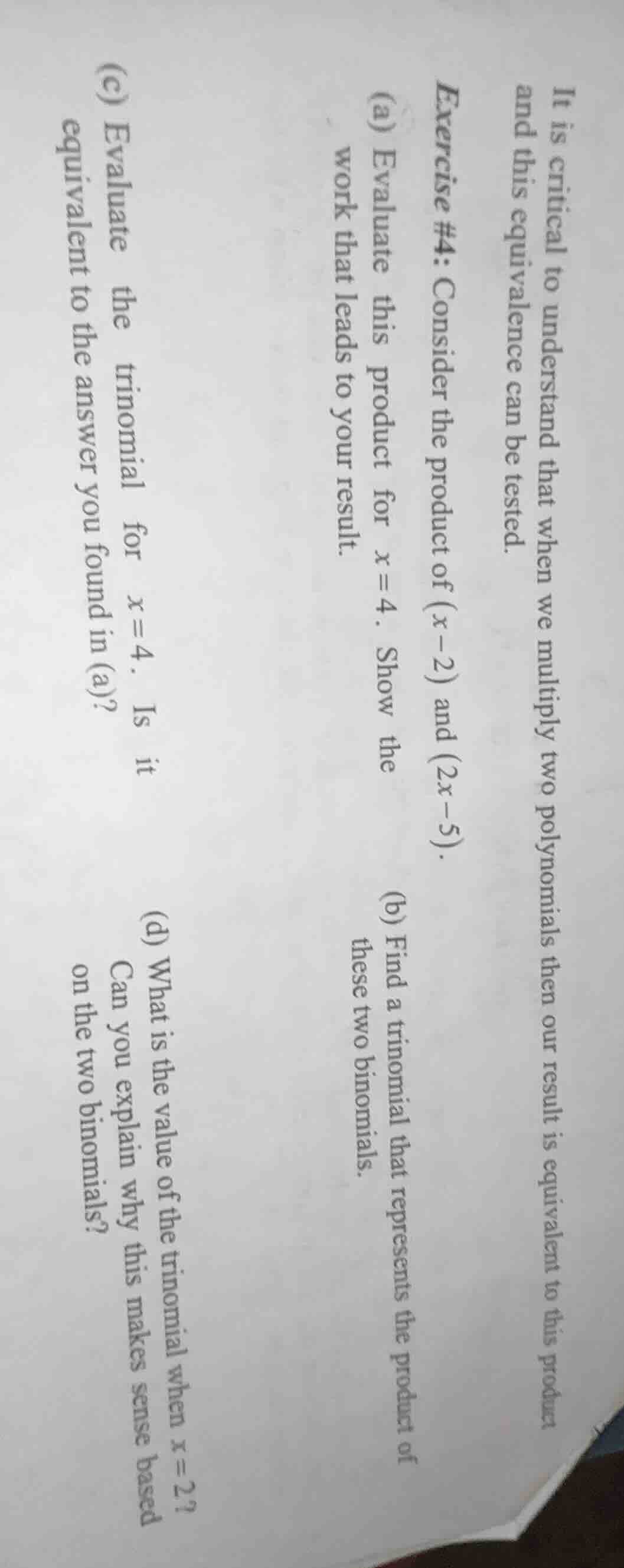
it is critical to understand that when we multiply two polynomials then our result is equivalent to this product and this equivalence can be tested. exercise #4: consider the product of ((x - 2)) and ((2x - 5)). (a) evaluate this product for (x = 4). show the work that leads to your result. (b) find a trinomial that represents the product of these two binomials. (c) evaluate the trinomial for (x = 4). is it equivalent to the answer you found in (a)? (d) what is the value of the trinomial when (x = 2)? can you explain why this makes sense based on the two binomials?
Part (a)
Step 1: Substitute \( x = 4 \) into the binomials
First, find the values of \( (x - 2) \) and \( (2x - 5) \) when \( x = 4 \).
For \( (x - 2) \): \( 4 - 2 = 2 \)
For \( (2x - 5) \): \( 2(4) - 5 = 8 - 5 = 3 \)
Step 2: Multiply the results
Now, multiply these two values: \( 2\times3 = 6 \)
Step 1: Use the distributive property (FOIL method)
Multiply \( (x - 2)(2x - 5) \).
First terms: \( x\times2x = 2x^2 \)
Outer terms: \( x\times(-5) = -5x \)
Inner terms: \( -2\times2x = -4x \)
Last terms: \( -2\times(-5) = 10 \)
Step 2: Combine like terms
Combine the middle terms: \( -5x - 4x = -9x \)
So the trinomial is \( 2x^2 - 9x + 10 \)
Step 1: Substitute \( x = 4 \) into the trinomial
Substitute \( x = 4 \) into \( 2x^2 - 9x + 10 \).
Calculate each term:
\( 2(4)^2 = 2\times16 = 32 \)
\( -9(4) = -36 \)
\( 10 = 10 \)
Step 2: Combine the terms
Add them together: \( 32 - 36 + 10 = (32 + 10) - 36 = 42 - 36 = 6 \)
Step 3: Compare with part (a)
The result from part (a) is \( 6 \), and the result from evaluating the trinomial at \( x = 4 \) is also \( 6 \), so they are equivalent.

Snap & solve any problem in the app
Get step-by-step solutions on Sovi AI
Photo-based solutions with guided steps
Explore more problems and detailed explanations
The product when \( x = 4 \) is \( 6 \).