QUESTION IMAGE
Question
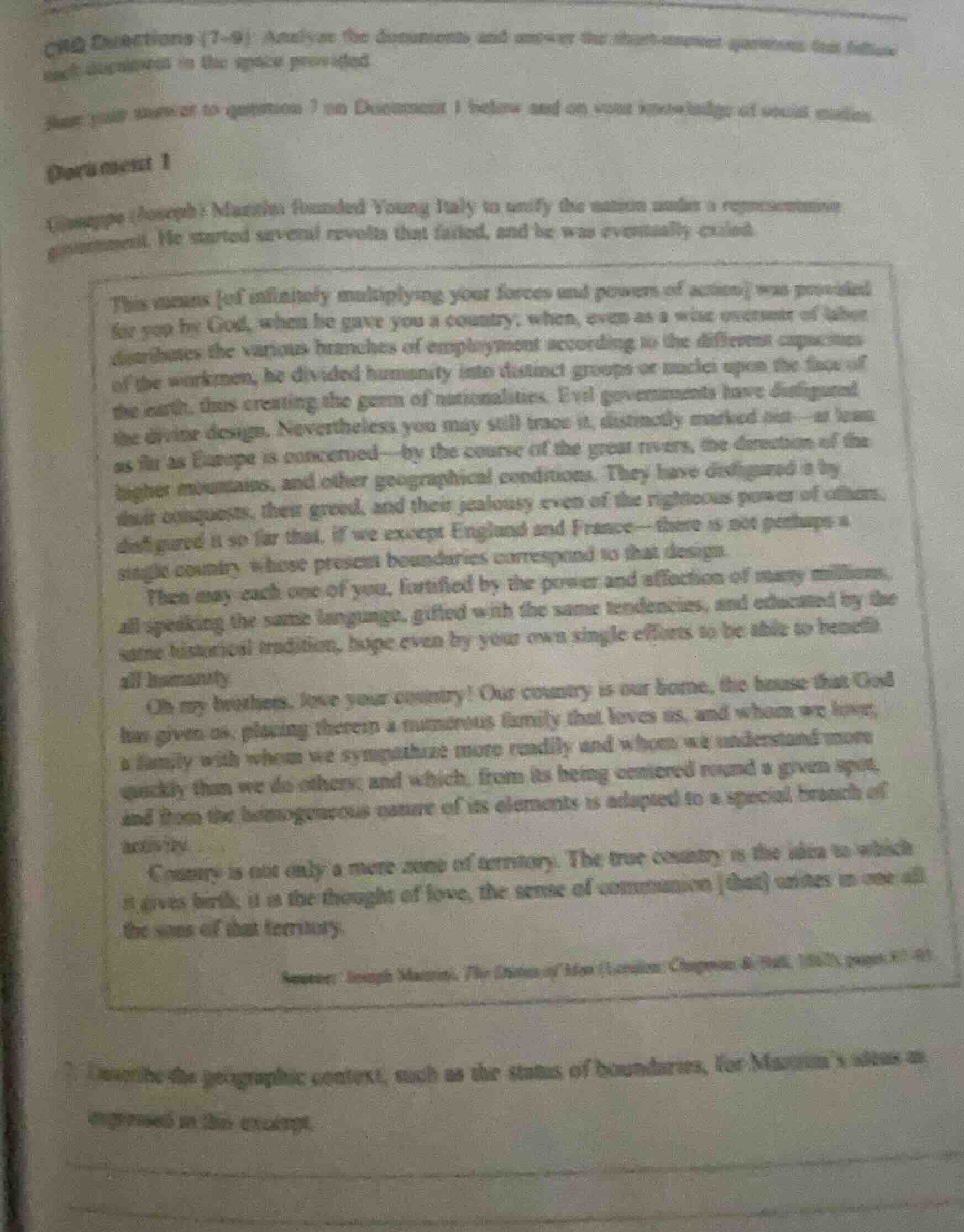
crq directions (7-9): analyze the documents and answer the short - answer questions that follow. each response in the space provided. base your answer to question 7 on document 1 below and on your knowledge of social studies. document 1 giuseppe (joseph) mazzini founded young italy to unify the nation under a representative government. he started several revolts that failed, and he was eventually exiled. this means of infinitely multiplying your forces and powers of action was provided for you by god, when he gave you a country; when, even as a wise overseer of labor distributes the various branches of employment according to the different capacities of the workmen, he divided humanity into distinct groups or races upon the face of the earth, thus creating the germ of nationalities. evil governments have disfigured the divine design. nevertheless you may still trace it, distinctly marked out — at least as far as europe is concerned — by the course of the great rivers, the direction of the higher mountains, and other geographical conditions. they have disfigured it by their conquests, their greed, and their jealousy even of the righteous power of others, disfigured it so far that, if we except england and france — there is not perhaps a single country whose present boundaries correspond to that design. then may each one of you, fortified by the power and affection of many millions, all speaking the same language, gifted with the same tendencies, and educated by the same historical tradition, hope even by your own simple efforts to be able to benefit all humanity. oh my brothers, love your country! our country is our home, the house that god has given us, placing therein a numerous family that loves us, and whom we love; a family with whom we sympathize more readily and whom we understand more quickly than we do others; and which, from its being centered round a given spot, and from the homogeneous nature of its elements is adapted to a special branch of activity. country is not only a mere name of territory. the true country is the idea to which it gives birth; it is the thought of love, the sense of communion that unites in one all the sons of that territory. source: joseph mazzini, the duties of man (london: chapman & hall, 1867), pages 87 - 90. 7. identify the geographic context, such as the status of boundaries, for mazzini’s ideas as expressed in this excerpt.
To identify the geographic context for Mazzini’s ideas:
- Document Analysis: The excerpt mentions Europe’s geography (rivers, mountains) as part of a “divine design” for national boundaries, but “evil governments” distorted these. Most European countries (except England/France) had boundaries not matching this design.
- Historical Context: Mazzini (founder of Young Italy) advocated Italian unification. In 19th - century Europe, Italy was fragmented into states (e.g., Kingdom of Sardinia, Papal States, Austrian - controlled regions), and national boundaries were shaped by imperialism, dynastic rule, and lack of ethnic/national alignment.
- Key Points:
- Natural geography (rivers, mountains) was seen as a basis for national boundaries.
- Political boundaries (imposed by empires/selfish rulers) ignored ethnic/national unity (e.g., Italy’s fragmentation, German states, multi - ethnic empires like Austria - Hungary).

Snap & solve any problem in the app
Get step-by-step solutions on Sovi AI
Photo-based solutions with guided steps
Explore more problems and detailed explanations
The geographic context for Mazzini’s ideas includes:
- Natural Geography: Europe’s physical features (rivers, mountains) were viewed as a “divine design” for national boundaries, defining ethnic/national groups.
- Political Boundaries: Most European countries (except England/France) had boundaries distorted by “evil governments” (imperialism, dynastic rule), ignoring national unity. For Italy specifically, it was fragmented into multiple states (e.g., under Austrian rule, papal control, independent kingdoms), with boundaries unaligned with ethnic/national identity, fueling Mazzini’s call for Italian unification.