QUESTION IMAGE
Question
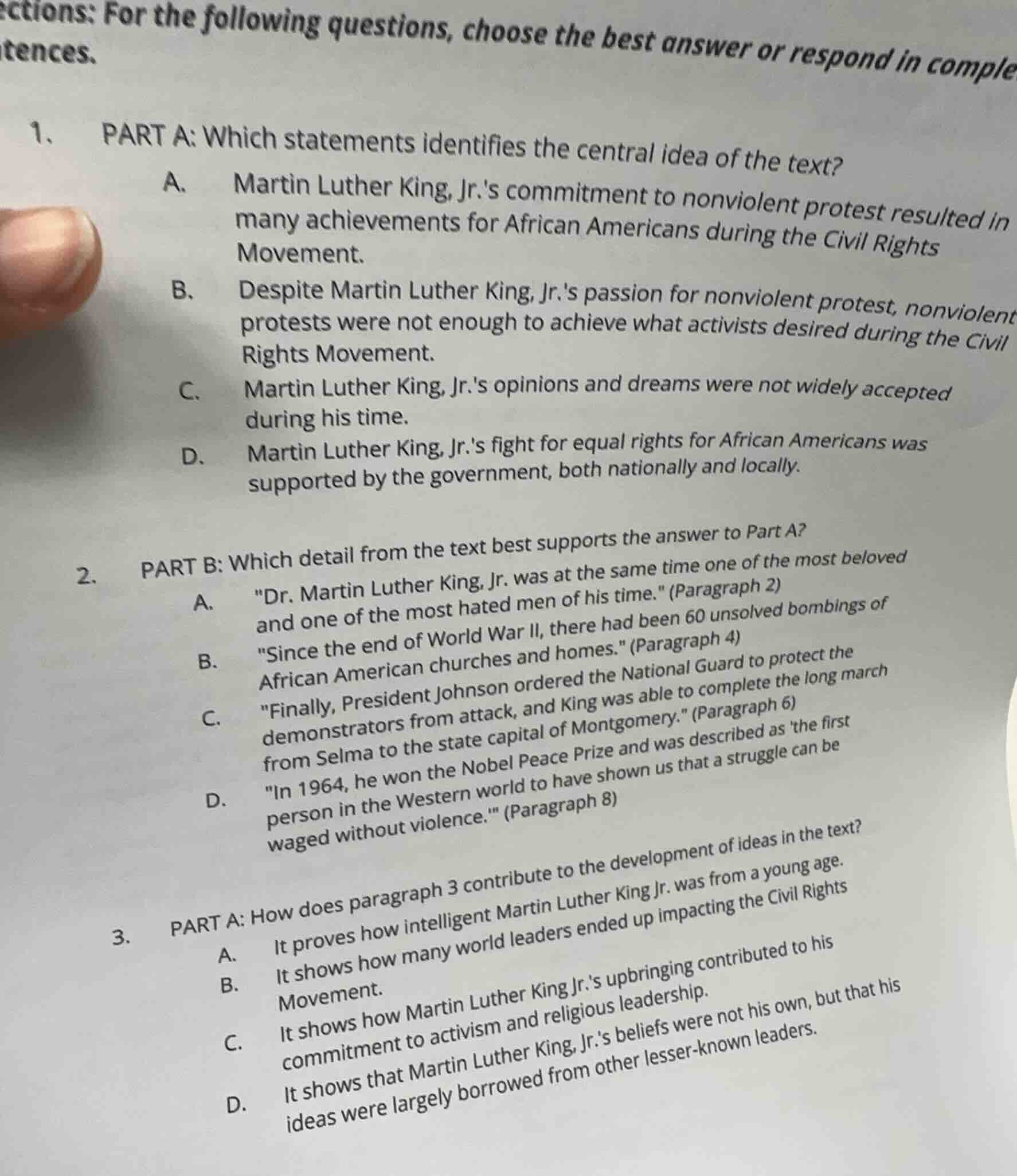
ctions: for the following questions, choose the best answer or respond in comple tences. 1. part a: which statements identifies the central idea of the text? a. martin luther king, jr.s commitment to nonviolent protest resulted in many achievements for african americans during the civil rights movement. b. despite martin luther king, jr.s passion for nonviolent protest, nonviolent protests were not enough to achieve what activists desired during the civil rights movement. c. martin luther king, jr.s opinions and dreams were not widely accepted during his time. d. martin luther king, jr.s fight for equal rights for african americans was supported by the government, both nationally and locally. 2. part b: which detail from the text best supports the answer to part a? a. \dr. martin luther king, jr. was at the same time one of the most beloved and one of the most hated men of his time.\ (paragraph 2) b. \since the end of world war ii, there had been 60 unsolved bombings of african american churches and homes.\ (paragraph 4) c. \finally, president johnson ordered the national guard to protect the demonstrators from attack, and king was able to complete the long march from selma to the state capital of montgomery.\ (paragraph 6) d. \in 1964, he won the nobel peace prize and was described as the first person in the western world to have shown us that a struggle can be waged without violence.\ (paragraph 8) 3. part a: how does paragraph 3 contribute to the development of ideas in the text? a. it proves how intelligent martin luther king jr. was from a young age. b. it shows how many world leaders ended up impacting the civil rights movement. c. it shows how martin luther king jr.s upbringing contributed to his commitment to activism and religious leadership. d. it shows that martin luther king, jr.s beliefs were not his own, but that his ideas were largely borrowed from other lesser - known leaders.
Question 1 - Part A
To determine the central idea, we analyze each option:
- Option A: MLK's nonviolent protest led to African American achievements in Civil Rights. This aligns with his known impact.
- Option B: Claims nonviolent protests were insufficient, which contradicts historical outcomes.
- Option C: States his opinions were not widely accepted, but his ideas (like "I Have a Dream") were influential.
- Option D: His fight was not always government - supported (e.g., faced opposition from some officials). So A is correct.
We need a detail supporting Part A's answer (MLK's nonviolent protest led to achievements).
- Option A: Talks about being loved and hated, not achievements from nonviolent protest.
- Option B: Discusses unsolved bombings, not achievements.
- Option C: Shows government protection for a march, but not directly about nonviolent protest achievements.
- Option D: His Nobel Peace Prize and being recognized for nonviolent struggle supports that his nonviolent approach led to achievements. So D is correct.
We analyze how paragraph 3 (assuming it's about his upbringing) contributes:
- Option A: Not about proving intelligence.
- Option B: Not about world leaders impacting Civil Rights.
- Option C: If paragraph 3 is about his upbringing (e.g., religious background), it would show how it contributed to his activism and religious leadership. This makes sense.
- Option D: His beliefs were his own (e.g., nonviolent philosophy from his own understanding), not borrowed from lesser - known leaders. So C is correct.

Snap & solve any problem in the app
Get step-by-step solutions on Sovi AI
Photo-based solutions with guided steps
Explore more problems and detailed explanations
A. Martin Luther King, Jr.'s commitment to nonviolent protest resulted in many achievements for African Americans during the Civil Rights Movement.