QUESTION IMAGE
Question
current attempt in progress
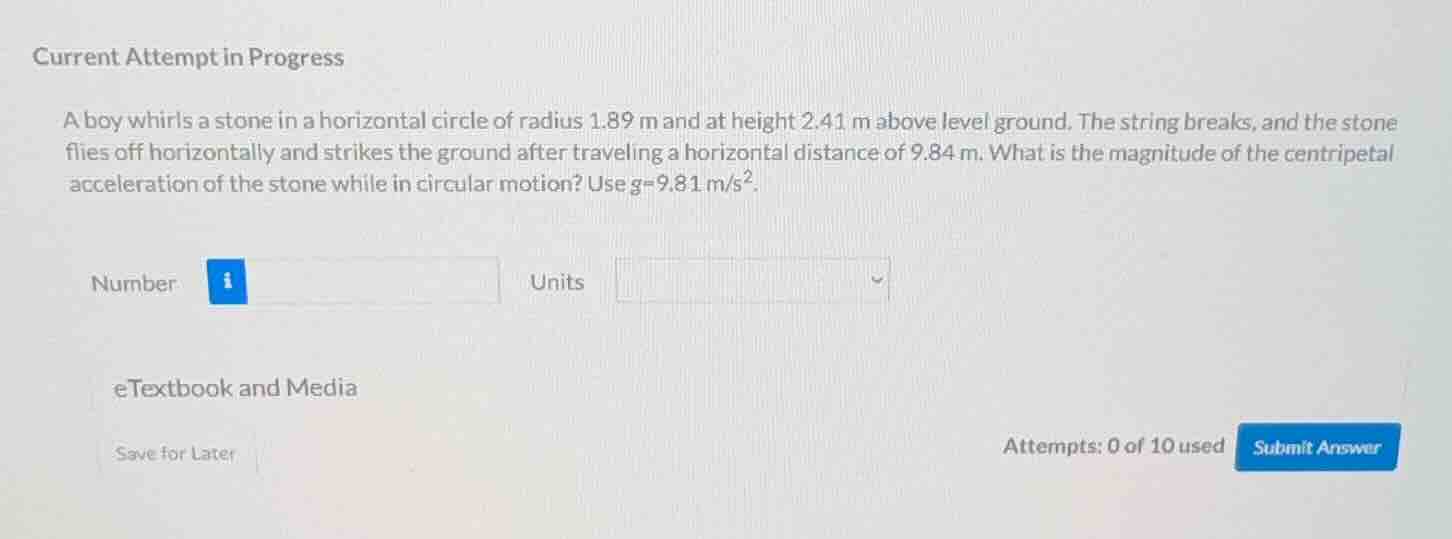
a boy whirls a stone in a horizontal circle of radius 1.89 m and at height 2.41 m above level ground. the string breaks, and the stone flies off horizontally and strikes the ground after traveling a horizontal distance of 9.84 m. what is the magnitude of the centripetal acceleration of the stone while in circular motion? use $g=9.81\text{m/s}^2$.
number
units
etextbook and media
save for later
attempts: 0 of 10 used submit answer
Step1: Find fall time of stone
First, use vertical free-fall motion to find the time the stone takes to hit the ground. The vertical displacement formula is $h = \frac{1}{2}gt^2$, solving for $t$:
$$t = \sqrt{\frac{2h}{g}} = \sqrt{\frac{2\times2.41}{9.81}} \approx \sqrt{0.4903} \approx 0.7002\ \text{s}$$
Step2: Find horizontal velocity
Use horizontal distance to find the constant horizontal velocity $v$ (this equals the tangential velocity of the circular motion):
$$v = \frac{d}{t} = \frac{9.84}{0.7002} \approx 14.05\ \text{m/s}$$
Step3: Calculate centripetal acceleration
Use centripetal acceleration formula $a_c = \frac{v^2}{r}$:
$$a_c = \frac{(14.05)^2}{1.89} = \frac{197.40}{1.89} \approx 104.4\ \text{m/s}^2$$

Snap & solve any problem in the app
Get step-by-step solutions on Sovi AI
Photo-based solutions with guided steps
Explore more problems and detailed explanations
104.4
Units: $\text{m/s}^2$