QUESTION IMAGE
Question
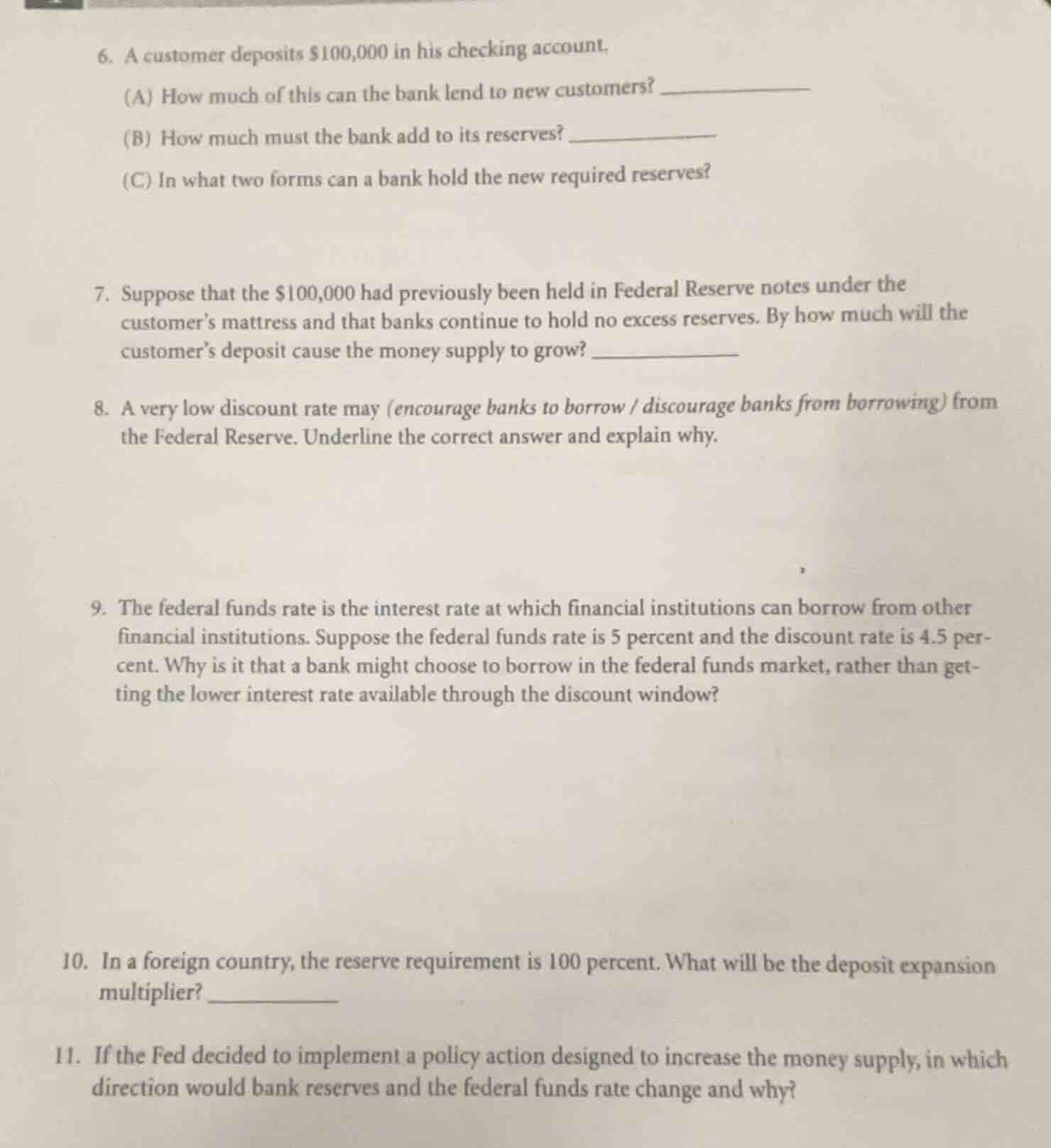
- a customer deposits $100,000 in his checking account.
(a) how much of this can the bank lend to new customers? _______________
(b) how much must the bank add to its reserves? _______________
(c) in what two forms can a bank hold the new required reserves?
- suppose that the $100,000 had previously been held in federal reserve notes under the customers mattress and that banks continue to hold no excess reserves. by how much will the customers deposit cause the money supply to grow? _______________
- a very low discount rate may (encourage banks to borrow / discourage banks from borrowing) from the federal reserve. underline the correct answer and explain why.
- the federal funds rate is the interest rate at which financial institutions can borrow from other financial institutions. suppose the federal funds rate is 5 percent and the discount rate is 4.5 percent. why is it that a bank might choose to borrow in the federal funds market, rather than getting the lower interest rate available through the discount window?
- in a foreign country, the reserve requirement is 100 percent. what will be the deposit expansion multiplier? _______________
- if the fed decided to implement a policy action designed to increase the money supply, in which direction would bank reserves and the federal funds rate change and why?
For Question 6:
Note: We assume a standard 10% reserve requirement ratio, as it is not provided.
Step1: Define reserve requirement
Let required reserve ratio $r = 0.10$
Step2: Calculate required reserves (Q6B)
Required Reserves = Deposit $\times r$
$\$100,000 \times 0.10 = \$10,000$
Step3: Calculate lendable funds (Q6A)
Lendable Funds = Deposit - Required Reserves
$\$100,000 - \$10,000 = \$90,000$
Step1: Calculate money multiplier
Money Multiplier $m = \frac{1}{r}$, where $r=0.10$
$m = \frac{1}{0.10} = 10$
Step2: Calculate money supply growth
Growth = (Deposit - Currency removed) $\times (m-1)$
Since the currency was previously out of the banking system, the new injectable base is $\$100,000$.
Growth = $\$100,000 \times (10-1) = \$900,000$
The discount rate is the interest rate the Fed charges banks for direct loans. A low rate reduces the cost of borrowing from the Fed, making this a cheaper source of reserves for banks.

Snap & solve any problem in the app
Get step-by-step solutions on Sovi AI
Photo-based solutions with guided steps
Explore more problems and detailed explanations
(A) $\$90,000$
(B) $\$10,000$
(C) Banks can hold required reserves as vault cash (physical currency on hand) and deposits held at the Federal Reserve Bank.
---