QUESTION IMAGE
Question
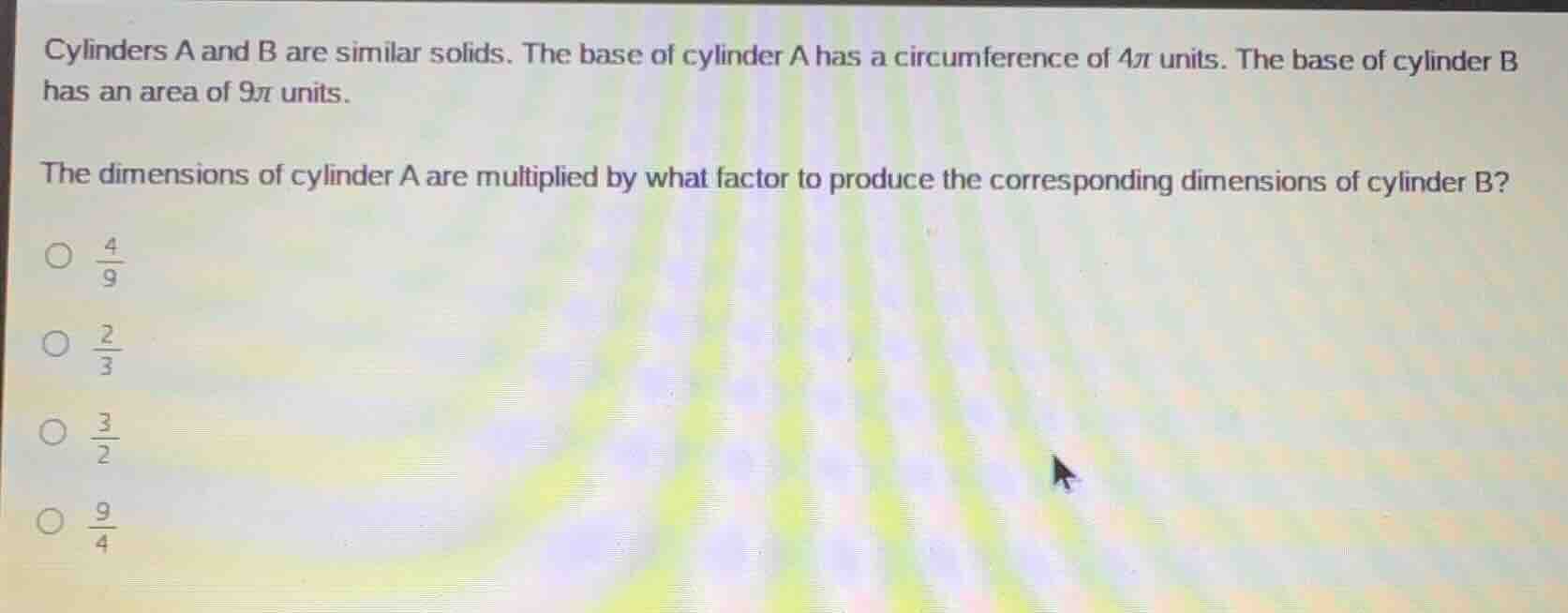
cylinders a and b are similar solids. the base of cylinder a has a circumference of 4π units. the base of cylinder b has an area of 9π units. the dimensions of cylinder a are multiplied by what factor to produce the corresponding dimensions of cylinder b? \\(\frac{4}{9}\\) \\(\frac{2}{3}\\) \\(\frac{3}{2}\\) \\(\frac{9}{4}\\)
Step1: Find radius of cylinder A's base
The circumference of a circle is given by \( C = 2\pi r \). For cylinder A, \( C = 4\pi \), so:
\( 4\pi = 2\pi r_A \)
Divide both sides by \( 2\pi \): \( r_A=\frac{4\pi}{2\pi}=2 \)
Step2: Find radius of cylinder B's base
The area of a circle is \( A=\pi r^2 \). For cylinder B, \( A = 9\pi \), so:
\( 9\pi=\pi r_B^2 \)
Divide both sides by \( \pi \): \( r_B^2 = 9 \)
Take square root: \( r_B = 3 \) (radius is positive)
Step3: Find the scale factor
The scale factor from A to B is \( \frac{r_B}{r_A}=\frac{3}{2} \)

Snap & solve any problem in the app
Get step-by-step solutions on Sovi AI
Photo-based solutions with guided steps
Explore more problems and detailed explanations
\(\frac{3}{2}\) (corresponding to the option \(\boldsymbol{\frac{3}{2}}\))