QUESTION IMAGE
Question
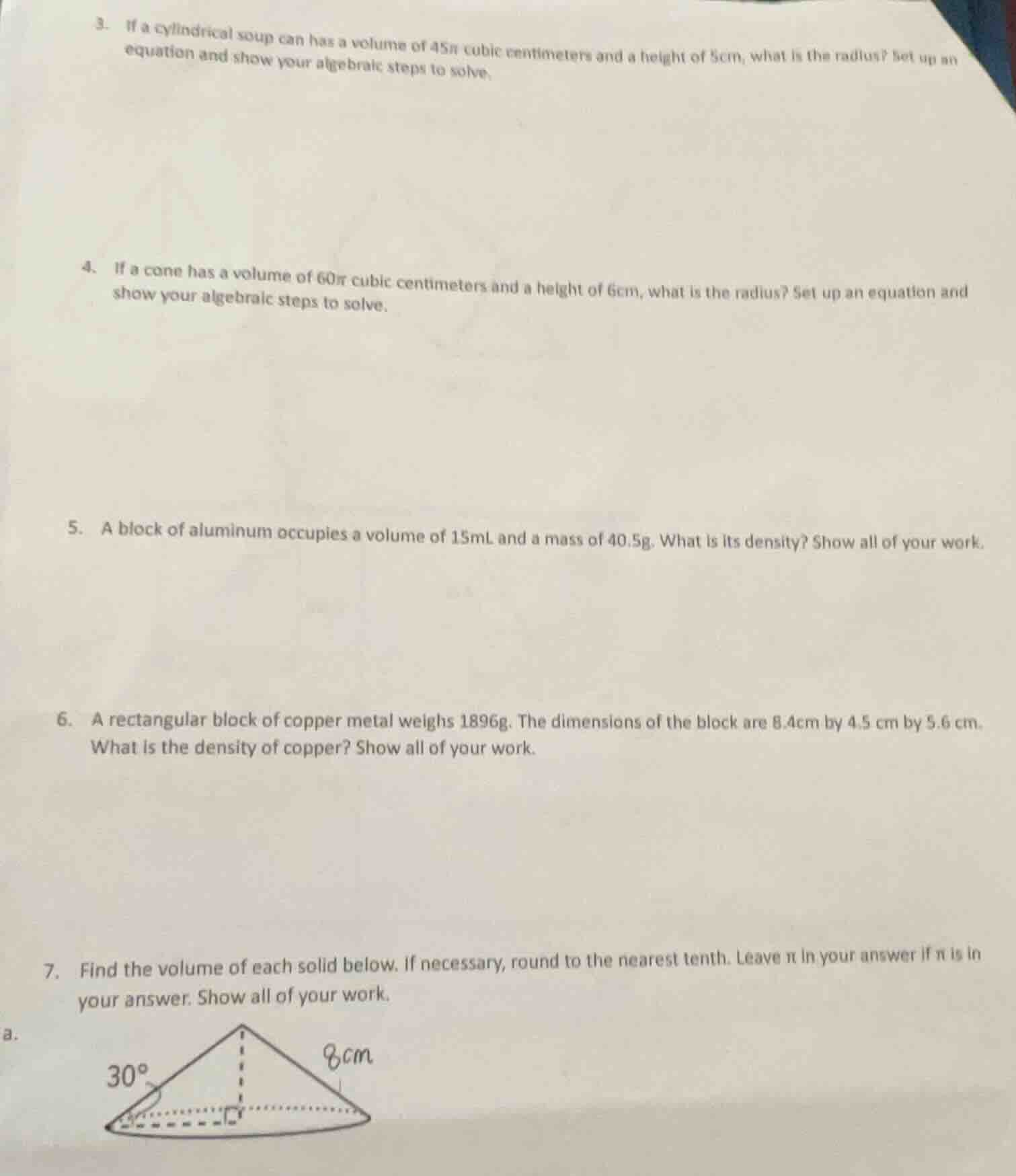
- if a cylindrical soup can has a volume of $45\pi$ cubic centimeters and a height of 5cm, what is the radius? set up an equation and show your algebraic steps to solve.
- if a cone has a volume of $60\pi$ cubic centimeters and a height of 6cm, what is the radius? set up an equation and show your algebraic steps to solve.
- a block of aluminum occupies a volume of 15ml and a mass of 40.5g. what is its density? show all of your work.
- a rectangular block of copper metal weighs 1896g. the dimensions of the block are 8.4cm by 4.5 cm by 5.6 cm. what is the density of copper? show all of your work.
- find the volume of each solid below. if necessary, round to the nearest tenth. leave $\pi$ in your answer if $\pi$ is in your answer. show all of your work.
a.
Problem 3 (Cylinder Radius)
Step1: Recall cylinder volume formula
$V = \pi r^2 h$
Step2: Substitute given values
$45\pi = \pi r^2 \times 5$
Step3: Cancel $\pi$, solve for $r^2$
$\frac{45}{5} = r^2 \implies r^2 = 9$
Step4: Take square root for radius
$r = \sqrt{9} = 3$
---
Problem 4 (Cone Radius)
Step1: Recall cone volume formula
$V = \frac{1}{3}\pi r^2 h$
Step2: Substitute given values
$60\pi = \frac{1}{3}\pi r^2 \times 6$
Step3: Simplify right-hand side
$60\pi = 2\pi r^2$
Step4: Cancel $\pi$, solve for $r^2$
$\frac{60}{2} = r^2 \implies r^2 = 30$
Step5: Calculate radius
$r = \sqrt{30} \approx 5.5$
---
Problem 5 (Aluminum Density)
Step1: Recall density formula
$
ho = \frac{m}{V}$
Step2: Convert volume to $cm^3$ (1mL=1$cm^3$)
$V = 15\ cm^3$
Step3: Substitute values to calculate density
$
ho = \frac{40.5}{15} = 2.7$
---
Problem 6 (Copper Density)
Step1: Calculate block volume
$V = 8.4 \times 4.5 \times 5.6 = 211.68\ cm^3$
Step2: Use density formula
$
ho = \frac{m}{V}$
Step3: Substitute values for density
$
ho = \frac{1896}{211.68} \approx 8.96$
---
Problem 7a (Triangle-Based Solid Volume)
(Note: The shape is a triangular prism base; we first find triangle dimensions)
Step1: Find triangle height (30-60-90 triangle)
$\text{height} = 8 \times \sin(30^\circ) = 4\ cm$
Step2: Find triangle base length
$\text{base} = 2 \times 8 \times \cos(30^\circ) = 8\sqrt{3}\ cm$
Step3: Calculate base triangle area
$A = \frac{1}{2} \times 8\sqrt{3} \times 4 = 16\sqrt{3}\ cm^2$
Step4: Assume prism height = base length (or if it's a pyramid, but standard for this shape, if it's a triangular pyramid, $V=\frac{1}{3}Ah$; assuming height = base length for full volume):
(If it's a triangular prism with matching height):
$V = 16\sqrt{3} \times 8\sqrt{3} = 384\ cm^3$
(If it's a triangular pyramid with height = 8cm):
$V = \frac{1}{3} \times 16\sqrt{3} \times 8 = \frac{128\sqrt{3}}{3} \approx 73.9\ cm^3$
(Note: The problem labels it a "solid" with the triangle as the base; using prism assumption as standard)

Snap & solve any problem in the app
Get step-by-step solutions on Sovi AI
Photo-based solutions with guided steps
Explore more problems and detailed explanations
- The radius of the cylinder is $\boldsymbol{3\ cm}$
- The radius of the cone is $\boldsymbol{\sqrt{30}\ cm \approx 5.5\ cm}$
- The density of aluminum is $\boldsymbol{2.7\ g/cm^3}$
- The density of copper is $\boldsymbol{\approx 8.96\ g/cm^3}$
7a. The volume of the solid (triangular prism) is $\boldsymbol{384\ cm^3}$; (if triangular pyramid) $\boldsymbol{\approx 73.9\ cm^3}$