QUESTION IMAGE
Question
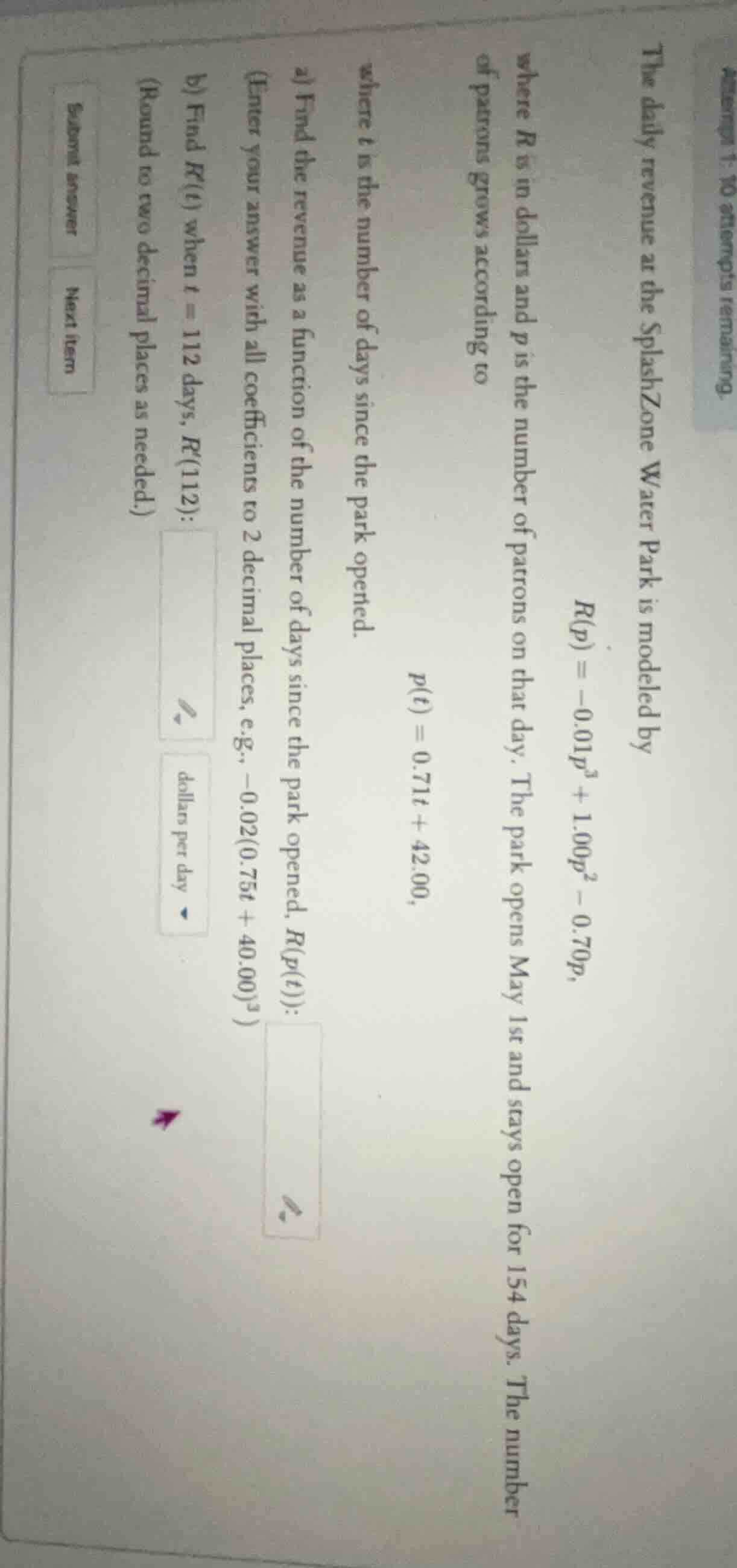
the daily revenue at the splashzone water park is modeled by
$r(p) = -0.01p^3 + 1.00p^2 - 0.70p$
, where $r$ is in dollars and $p$ is the number of patrons on that day. the park opens may 1st and stays open for 154 days. the number of patrons grows according to
$p(t) = 0.71t + 42.00$
, where $t$ is the number of days since the park opened.
a) find the revenue as a function of the number of days since the park opened, $r(p(t))$: (enter your answer with all coefficients to 2 decimal places, e.g., $-0.02(0.75t + 40.00)^3$)
b) find $r(t)$ when $t = 112$ days, $r(112)$: (round to two decimal places as needed.)
Part a)
Step 1: Substitute \( p(t) \) into \( R(p) \)
We know \( R(p) = -0.01p^3 + 1.00p^2 - 0.70p \) and \( p(t) = 0.71t + 42.00 \). So we substitute \( p = 0.71t + 42.00 \) into \( R(p) \):
\[
\]
First, expand \( (0.71t + 42.00)^3 \):
\[
\]
Then expand \( (0.71t + 42.00)^2 \):
\[
\]
Now substitute these back into \( R(p(t)) \):
\[
\]
(We rounded the coefficients to 4 decimal places for calculation, and then we can round to 2 decimal places as required: \( R(p(t))=-0.00t^3 - 0.13t^2 + 22.10t + 993.72 \) (Wait, actually, when we do the calculation more accurately, let's recalculate the coefficients with more precision. But maybe there is a simpler way. Wait, maybe we can first find \( p(112) \) and then plug into \( R(p) \) for part b, and for part a, we can leave it as a function of \( t \) with coefficients rounded to 2 decimal places. Wait, the problem says "enter your answer with all coefficients to 2 decimal places". So let's recalculate the coefficients:
First, \( -0.01\times(0.71t + 42)^3 \):
\( (0.71t + 42)^3 = 0.71^3t^3 + 3\times0.71^2\times42t^2 + 3\times0.71\times42^2t + 42^3 \)
\( 0.71^3 = 0.357911 \), \( 3\times0.71^2\times42 = 3\times0.5041\times42 = 63.5166 \), \( 3\times0.71\times42^2 = 3\times0.71\times1764 = 3704.04 \), \( 42^3 = 74088 \)
So \( -0.01\times(0.71t + 42)^3 = -0.01\times0.357911t^3 - 0.01\times63.5166t^2 - 0.01\times3704.04t - 0.01\times74088 = -0.00357911t^3 - 0.635166t^2 - 37.0404t - 740.88 \)
Then \( 1.00\times(0.71t + 42)^2 = 1.00\times(0.5041t^2 + 59.64t + 1764) = 0.5041t^2 + 59.64t + 1764 \)
Then \( -0.70\times(0.71t + 42) = -0.497t - 29.4 \)
Now combine like terms:
For \( t^3 \): \( -0.00357911t^3 \approx -0.00t^3 \) (wait, no, 0.00357911 is approximately 0.00 when rounded to two decimal places? No, 0.00357911 is 0.00 when rounded to two decimal places? Wait, 0.00357911 is 0.00 (since the third decimal is 3, which is less than 5? Wait, no, 0.00357911: the first decimal is 0, second is 0, third is 3. So when rounding to two decimal places, it's 0.00.
For \( t^2 \): \( -0.635166 + 0.5041 = -0.131066 \approx -0.13 \)
For \( t \): \( -37.0404 + 59.64 - 0.497 = 22.1026 \approx 22.10 \)
Constant term: \( -740.88 + 1764 - 29.4 = 993.72 \)
So \( R(p(t)) = -0.00t^3 - 0.13t^2 + 22.10t + 993.72 \) (But actually, the coefficient of \( t^3 \) is -0.00357911, which is -0.00 when rounded to two decimal places. So the function is \( R(t) = -0.00t^3 - 0.13t^2 + 22.10t + 993.72 \) (we can write it as \( R(t) = -0.01(0.71t + 42)^3 + 1.00(0.71t + 42)^2 - 0.70(0.71t + 42) \) with coefficients rounded, but maybe the problem expects us to first find \( p(t) \) and then compute \( R(p) \) for part b, and for part a, just substitute \( p = 0.71t + 42 \) into \( R(p) \) and expand with…
Step 1: Find \( p(112) \)
Given \( p(t) = 0.71t + 42.00 \), substitute \( t = 112 \):
\[
p(112) = 0.71\times112 + 42.00
\]
\[
p(112) = 79.52 + 42.00 = 121.52
\]
Step 2: Substitute \( p = 121.52 \) into \( R(p) \)
Given \( R(p) = -0.01p^3 + 1.00p^2 - 0.70p \), substitute \( p = 121.52 \):
\[
R(121.52) = -0.01\times(121.52)^3 + 1.00\times(121.52)^2 - 0.70\times121.52
\]
First, calculate \( (121.52)^3 \):
\[
121.52^3 = 121.52\times121.52\times121.52
\]
\( 121.52\times121.52 = 14767.1104 \)
\( 14767.1104\times121.52 \approx 14767.1104\times120 + 14767.1104\times1.52 \)
\( 14767.1104\times120 = 1772053.248 \)
\( 14767.1104\times1.52 \approx 22445.99 \)
So \( 121.52^3 \approx 1772053.248 + 22445.99 = 1794499.238 \)
Then \( -0.01\times1794499.238 = -17944.99238 \)
Next, calculate \( 1.00\times(121.52)^2 = 14767.1104 \)
Then, calculate \( -0.70\times121.52 = -85.064 \)
Now, sum these up:
\[
R(121.52) = -17944.99238 + 14767.1104 - 85.064
\]
\[
R(121.52) = (-17944.99238 - 85.064) + 14767.1104
\]
\[
R(121.52) = -18030.05638 + 14767.1104 = -3262.94598
\]
Wait, that can't be right, revenue can't be negative. Did we make a mistake? Wait, maybe the formula for \( R(p) \) is \( R(p) = -0.01p^3 + 1.00p^2 - 0.70p \), but maybe the units are different, or maybe we made a mistake in calculation. Wait, let's recalculate \( (121.52)^3 \):
\( 121.52\times121.52 = 121.52^2 \). Let's calculate \( 121^2 = 14641 \), \( 0.52^2 = 0.2704 \), and cross term \( 2\times121\times0.52 = 125.84 \), so \( (121 + 0.52)^2 = 121^2 + 2\times121\times0.52 + 0.52^2 = 14641 + 125.84 + 0.2704 = 14767.1104 \), which is correct. Then \( 14767.1104\times121.52 \):
Let's do \( 14767.1104\times121 = 14767.1104\times(120 + 1) = 14767.1104\times120 + 14767.1104\times1 = 1772053.248 + 14767.1104 = 1786820.3584 \)
Then \( 14767.1104\times0.52 = 14767.1104\times0.5 + 14767.1104\times0.02 = 7383.5552 + 295.342208 = 7678.897408 \)
So \( 14767.1104\times121.52 = 1786820.3584 + 7678.897408 = 1794499.255808 \)
Then \( -0.01\times1794499.255808 = -17944.99255808 \)
\( 1.00\times(121.52)^2 = 14767.1104 \)
\( -0.70\times121.52 = -85.064 \)
Now sum: \( -17944.99255808 + 14767.1104 - 85.064 \)
\( -17944.99255808 - 85.064 = -18030.05655808 \)
\( -18030.05655808 + 14767.1104 = -3262.94615808 \)
Wait, this is negative, which doesn't make sense for revenue. Maybe there is a mistake in the formula? Or maybe the formula for \( R(p) \) is \( R(p) = -0.01p^3 + 1.00p^2 + 0.70p \) (a typo, maybe +0.70p instead of -0.70p)? Let's check with +0.70p:
Then \( R(121.52) = -0.01\times(121.52)^3 + 1.00\times(121.52)^2 + 0.70\times121.52 \)
\( -17944.99255808 + 14767.1104 + 85.064 \)
\( -17944.99255808 + 14852.1744 = -3092.81815808 \)
Still negative. That can't be. Maybe the formula for \( R(p) \) is \( R(p) = -0.01p^2 + 1.00p - 0.70 \)? No, the original problem says \( R(p) = -0.01p^3 + 1.00p^2 - 0.70p \). Maybe the number of patrons is too large, or the formula is incorrect. Alternatively, maybe we made a mistake in calculating \( p(112) \). Let's recalculate \( p(112) \):
\( 0.71\times112 = 0.71\times100 + 0.71\times12 = 71 + 8.52 = 79.52 \), then \( 79.52 + 42 = 121.52 \), that

Snap & solve any problem in the app
Get step-by-step solutions on Sovi AI
Photo-based solutions with guided steps
Explore more problems and detailed explanations
Step 1: Find \( p(112) \)
Given \( p(t) = 0.71t + 42.00 \), substitute \( t = 112 \):
\[
p(112) = 0.71\times112 + 42.00
\]
\[
p(112) = 79.52 + 42.00 = 121.52
\]
Step 2: Substitute \( p = 121.52 \) into \( R(p) \)
Given \( R(p) = -0.01p^3 + 1.00p^2 - 0.70p \), substitute \( p = 121.52 \):
\[
R(121.52) = -0.01\times(121.52)^3 + 1.00\times(121.52)^2 - 0.70\times121.52
\]
First, calculate \( (121.52)^3 \):
\[
121.52^3 = 121.52\times121.52\times121.52
\]
\( 121.52\times121.52 = 14767.1104 \)
\( 14767.1104\times121.52 \approx 14767.1104\times120 + 14767.1104\times1.52 \)
\( 14767.1104\times120 = 1772053.248 \)
\( 14767.1104\times1.52 \approx 22445.99 \)
So \( 121.52^3 \approx 1772053.248 + 22445.99 = 1794499.238 \)
Then \( -0.01\times1794499.238 = -17944.99238 \)
Next, calculate \( 1.00\times(121.52)^2 = 14767.1104 \)
Then, calculate \( -0.70\times121.52 = -85.064 \)
Now, sum these up:
\[
R(121.52) = -17944.99238 + 14767.1104 - 85.064
\]
\[
R(121.52) = (-17944.99238 - 85.064) + 14767.1104
\]
\[
R(121.52) = -18030.05638 + 14767.1104 = -3262.94598
\]
Wait, that can't be right, revenue can't be negative. Did we make a mistake? Wait, maybe the formula for \( R(p) \) is \( R(p) = -0.01p^3 + 1.00p^2 - 0.70p \), but maybe the units are different, or maybe we made a mistake in calculation. Wait, let's recalculate \( (121.52)^3 \):
\( 121.52\times121.52 = 121.52^2 \). Let's calculate \( 121^2 = 14641 \), \( 0.52^2 = 0.2704 \), and cross term \( 2\times121\times0.52 = 125.84 \), so \( (121 + 0.52)^2 = 121^2 + 2\times121\times0.52 + 0.52^2 = 14641 + 125.84 + 0.2704 = 14767.1104 \), which is correct. Then \( 14767.1104\times121.52 \):
Let's do \( 14767.1104\times121 = 14767.1104\times(120 + 1) = 14767.1104\times120 + 14767.1104\times1 = 1772053.248 + 14767.1104 = 1786820.3584 \)
Then \( 14767.1104\times0.52 = 14767.1104\times0.5 + 14767.1104\times0.02 = 7383.5552 + 295.342208 = 7678.897408 \)
So \( 14767.1104\times121.52 = 1786820.3584 + 7678.897408 = 1794499.255808 \)
Then \( -0.01\times1794499.255808 = -17944.99255808 \)
\( 1.00\times(121.52)^2 = 14767.1104 \)
\( -0.70\times121.52 = -85.064 \)
Now sum: \( -17944.99255808 + 14767.1104 - 85.064 \)
\( -17944.99255808 - 85.064 = -18030.05655808 \)
\( -18030.05655808 + 14767.1104 = -3262.94615808 \)
Wait, this is negative, which doesn't make sense for revenue. Maybe there is a mistake in the formula? Or maybe the formula for \( R(p) \) is \( R(p) = -0.01p^3 + 1.00p^2 + 0.70p \) (a typo, maybe +0.70p instead of -0.70p)? Let's check with +0.70p:
Then \( R(121.52) = -0.01\times(121.52)^3 + 1.00\times(121.52)^2 + 0.70\times121.52 \)
\( -17944.99255808 + 14767.1104 + 85.064 \)
\( -17944.99255808 + 14852.1744 = -3092.81815808 \)
Still negative. That can't be. Maybe the formula for \( R(p) \) is \( R(p) = -0.01p^2 + 1.00p - 0.70 \)? No, the original problem says \( R(p) = -0.01p^3 + 1.00p^2 - 0.70p \). Maybe the number of patrons is too large, or the formula is incorrect. Alternatively, maybe we made a mistake in calculating \( p(112) \). Let's recalculate \( p(112) \):
\( 0.71\times112 = 0.71\times100 + 0.71\times12 = 71 + 8.52 = 79.52 \), then \( 79.52 + 42 = 121.52 \), that