QUESTION IMAGE
Question
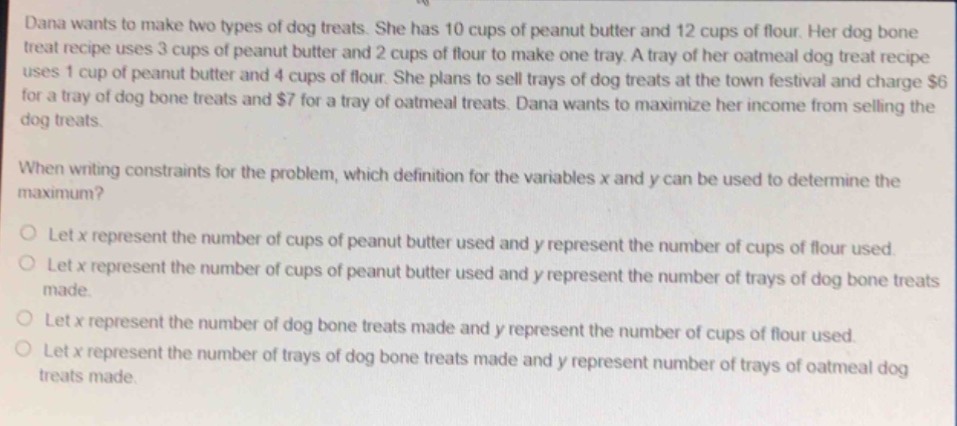
dana wants to make two types of dog treats. she has 10 cups of peanut butter and 12 cups of flour. her dog bone treat recipe uses 3 cups of peanut butter and 2 cups of flour to make one tray. a tray of her oatmeal dog treat recipe uses 1 cup of peanut butter and 4 cups of flour. she plans to sell trays of dog treats at the town festival and charge $6 for a tray of dog bone treats and $7 for a tray of oatmeal treats. dana wants to maximize her income from selling the dog treats. when writing constraints for the problem, which definition for the variables x and y can be used to determine the maximum? \bigcirc let x represent the number of cups of peanut butter used and y represent the number of cups of flour used. \bigcirc let x represent the number of cups of peanut butter used and y represent the number of trays of dog bone treats made. \bigcirc let x represent the number of dog bone treats made and y represent the number of cups of flour used. \bigcirc let x represent the number of trays of dog bone treats made and y represent number of trays of oatmeal dog treats made.
To set up constraints for maximizing income from selling treat trays, variables should represent the quantities we can control (number of each treat tray made), since resources (peanut butter, flour) depend on these quantities and income is calculated per tray. The other options use resource amounts as variables, which do not directly model the decision of how many trays to make for maximum profit.

Snap & solve any problem in the app
Get step-by-step solutions on Sovi AI
Photo-based solutions with guided steps
Explore more problems and detailed explanations
Let x represent the number of trays of dog bone treats made and y represent number of trays of oatmeal dog treats made.