QUESTION IMAGE
Question
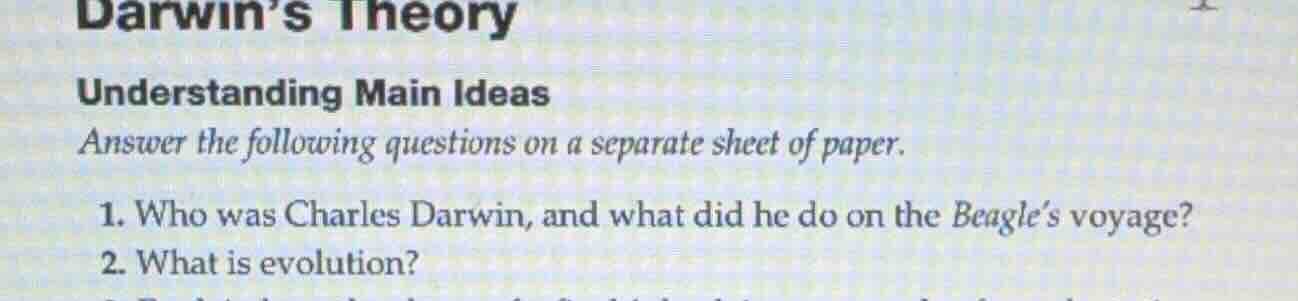
darwin’s theory
understanding main ideas
answer the following questions on a separate sheet of paper.
- who was charles darwin, and what did he do on the beagle’s voyage?
- what is evolution?
Brief Explanations
- Charles Darwin was a 19th-century British naturalist. During the HMS Beagle's 5-year global voyage (1831-1836), he collected and studied a vast array of plant, animal, and fossil specimens, especially noting unique species (like Galápagos finches) and geological formations, which laid the groundwork for his evolutionary theories.
- Evolution is the process of heritable genetic changes in populations of organisms across successive generations, driven by mechanisms like natural selection, leading to the development of new traits, species, and biodiversity over time.

Snap & solve any problem in the app
Get step-by-step solutions on Sovi AI
Photo-based solutions with guided steps
Explore more problems and detailed explanations
- Charles Darwin was a foundational British naturalist. On the Beagle's voyage (1831-1836), he traveled globally, collecting and analyzing diverse biological specimens, geological samples, and observing unique species (e.g., Galápagos Island organisms), gathering data that informed his evolutionary framework.
- Evolution is the gradual, heritable change in the genetic makeup of biological populations over multiple generations, driven by forces such as natural selection, resulting in the emergence of new species, traits, and biodiversity.