QUESTION IMAGE
Question
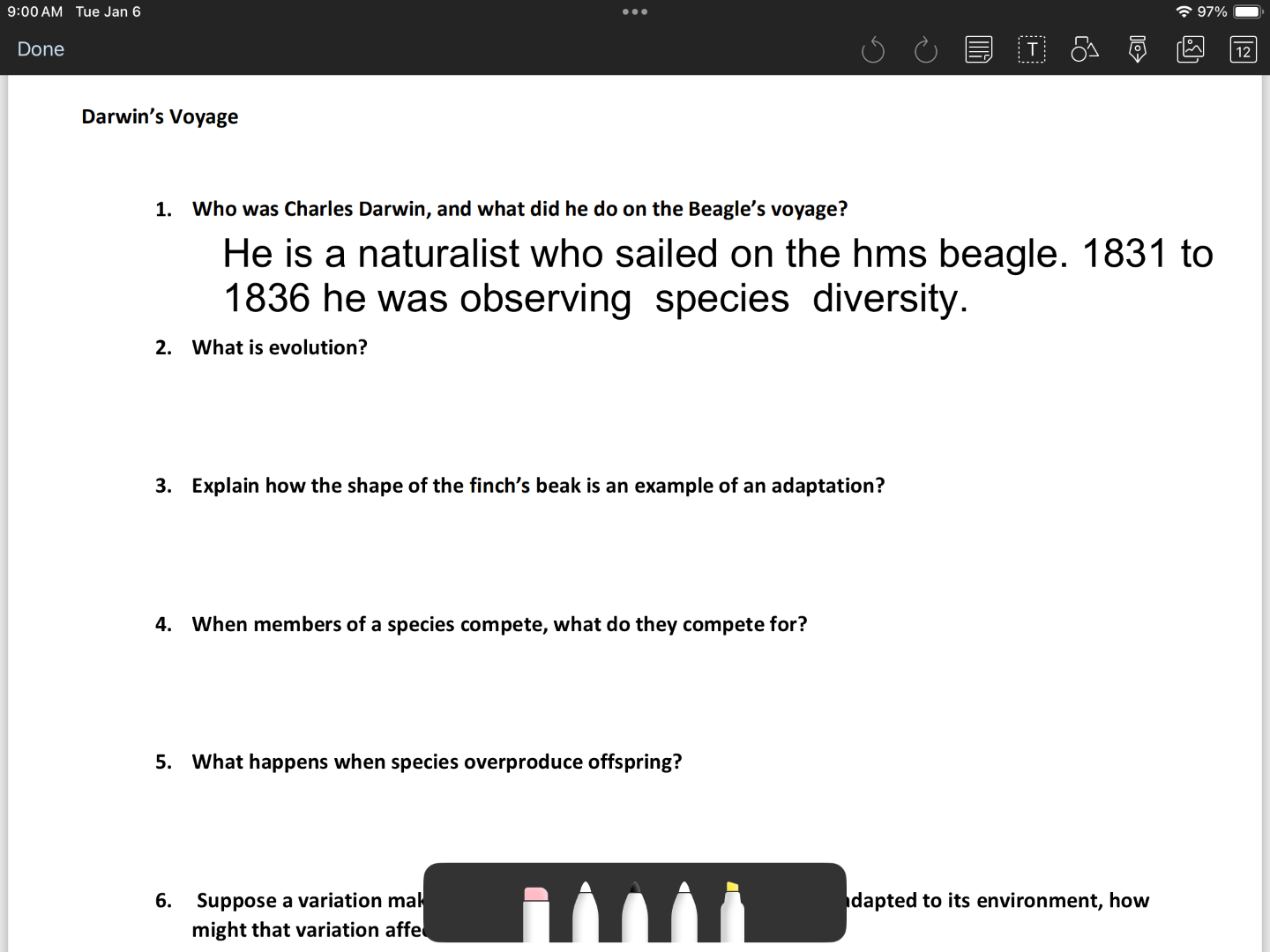
darwin’s voyage
- who was charles darwin, and what did he do on the beagle’s voyage?
he is a naturalist who sailed on the hms beagle. 1831 to 1836 he was observing species diversity.
- what is evolution?
- explain how the shape of the finch’s beak is an example of an adaptation?
- when members of a species compete, what do they compete for?
- what happens when species overproduce offspring?
- suppose a variation makobscuredadapted to its environment, how might that variation affeobscured
Question 1
Charles Darwin was a British naturalist. During the HMS Beagle's voyage (1831 - 1836), he collected specimens, observed diverse species, and studied geological formations, which contributed to his later theory of evolution.
Evolution is the process of change in living organisms over generations. It involves the descent with modification of species, driven by mechanisms like natural selection, where traits that enhance survival and reproduction become more common in a population over time.
Finch beak shape is an adaptation because different shapes (e.g., long, thin for probing insects; thick, strong for cracking seeds) match the finches’ food sources in their environments. This trait helps them survive and reproduce, as those with beaks suited to available food are more likely to get enough nutrition.

Snap & solve any problem in the app
Get step-by-step solutions on Sovi AI
Photo-based solutions with guided steps
Explore more problems and detailed explanations
Charles Darwin was a naturalist. On the Beagle’s voyage (1831–1836), he observed species diversity, collected specimens, and studied geology, laying groundwork for his evolution theory.