QUESTION IMAGE
Question
data analysis: photosynthesis in the oceans
discussion questions:
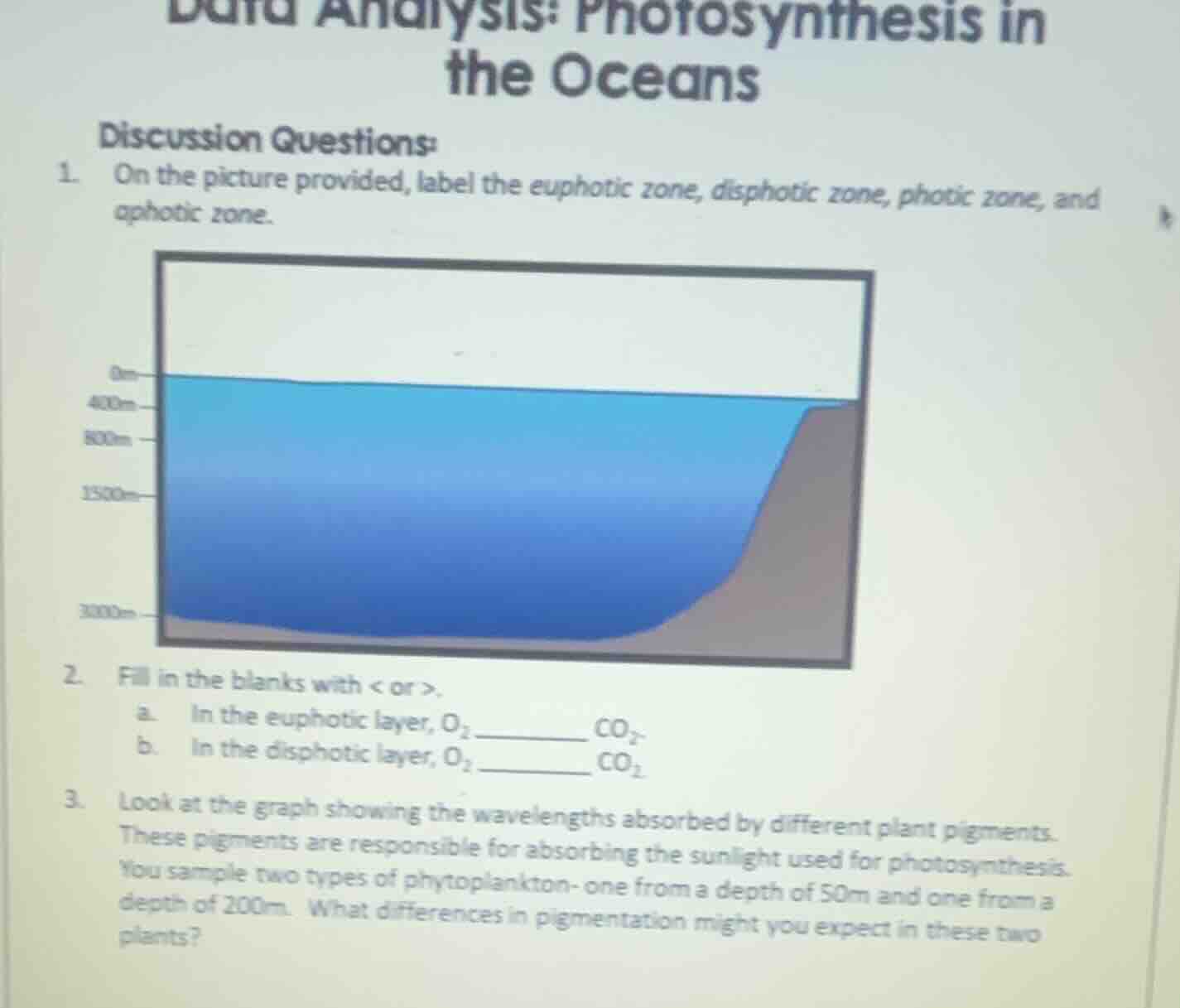
- on the picture provided, label the euphotic zone, disphotic zone, photic zone, and aphotic zone.
- fill in the blanks with < or >.
a. in the euphotic layer, $o_2$ ______ $co_2$.
b. in the disphotic layer, $o_2$ ______ $co_2$.
- look at the graph showing the wavelengths absorbed by different plant pigments. these pigments are responsible for absorbing the sunlight used for photosynthesis. you sample two types of phytoplankton- one from a depth of 50m and one from a depth of 200m. what differences in pigmentation might you expect in these two plants?
Step1: Label ocean light zones
- Euphotic zone: 0m to ~200m (upper bright blue region, enough light for full photosynthesis)
- Disphotic zone: ~200m to 1000m (darker blue region, low light, limited photosynthesis)
- Photic zone: Combined euphotic + disphotic zones (0m to 1000m, all regions with any sunlight)
- Aphotic zone: 1000m to 3000m (deep dark region, no sunlight for photosynthesis)
Step2: Compare gas levels (euphotic)
Photosynthesis dominates: $\text{O}_2$ produced > $\text{CO}_2$ consumed.
Expression: $\text{O}_2 > \text{CO}_2$
Step3: Compare gas levels (disphotic)
Respiration dominates over weak photosynthesis: $\text{O}_2$ used < $\text{CO}_2$ produced.
Expression: $\text{O}_2 < \text{CO}_2$
Step4: Predict pigment differences
50m (euphotic): Full sunlight, so standard chlorophyll a/b (absorbs red/blue light) is dominant.
200m (disphotic): Only blue-green light penetrates, so accessory pigments (e.g., phycobilins, fucoxanthin) that absorb blue-green wavelengths are more abundant, with reduced standard chlorophyll.

Snap & solve any problem in the app
Get step-by-step solutions on Sovi AI
Photo-based solutions with guided steps
Explore more problems and detailed explanations
- Zone labels (matching the diagram):
- Euphotic zone: 0m to ~200m (upper light blue section)
- Disphotic zone: ~200m to 1000m (darker blue middle section)
- Photic zone: 0m to 1000m (entire sunlit blue region, euphotic + disphotic)
- Aphotic zone: 1000m to 3000m (deep dark bottom section)
- a. $\text{O}_2 > \text{CO}_2$
b. $\text{O}_2 < \text{CO}_2$
- The 50m phytoplankton will have high levels of standard chlorophyll a and b (to absorb full-spectrum sunlight). The 200m phytoplankton will have more accessory pigments (like phycobilins or fucoxanthin) that absorb the blue-green light that penetrates to deeper depths, with lower amounts of standard chlorophyll.