QUESTION IMAGE
Question
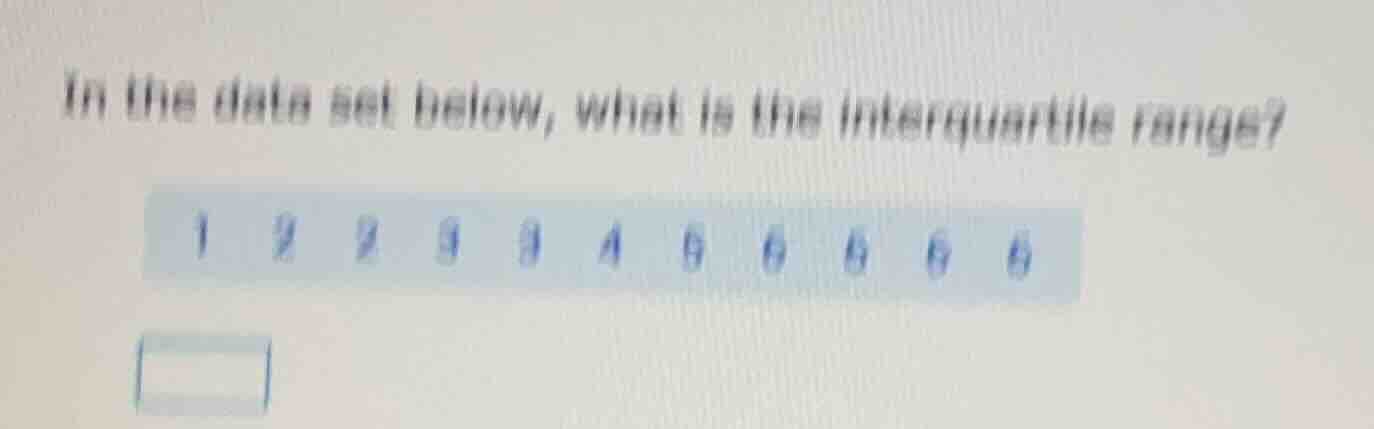
in the data set below, what is the interquartile range?
1 2 2 3 3 4 6 6 6 6 6
Step1: Order the data set (already ordered)
The data set is \(1, 2, 2, 3, 3, 4, 6, 6, 6, 6, 6\). The number of data points \(n = 11\).
Step2: Find the median (Q2)
The median is the middle value. For \(n = 11\) (odd), the median is the \(\frac{11 + 1}{2}=6\)-th term. The 6th term is \(4\), so \(Q2 = 4\).
Step3: Find Q1 (median of lower half)
The lower half of the data (values below Q2) is \(1, 2, 2, 3, 3\) (5 values). The median of this set (n = 5, odd) is the \(\frac{5 + 1}{2}=3\)-rd term. The 3rd term is \(2\), so \(Q1 = 2\).
Step4: Find Q3 (median of upper half)
The upper half of the data (values above Q2) is \(6, 6, 6, 6, 6\) (5 values). The median of this set (n = 5, odd) is the \(\frac{5 + 1}{2}=3\)-rd term. The 3rd term is \(6\), so \(Q3 = 6\).
Step5: Calculate Interquartile Range (IQR)
The interquartile range is \(IQR=Q3 - Q1\). Substituting the values, we get \(IQR = 6 - 2=4\).

Snap & solve any problem in the app
Get step-by-step solutions on Sovi AI
Photo-based solutions with guided steps
Explore more problems and detailed explanations
\(4\)