QUESTION IMAGE
Question
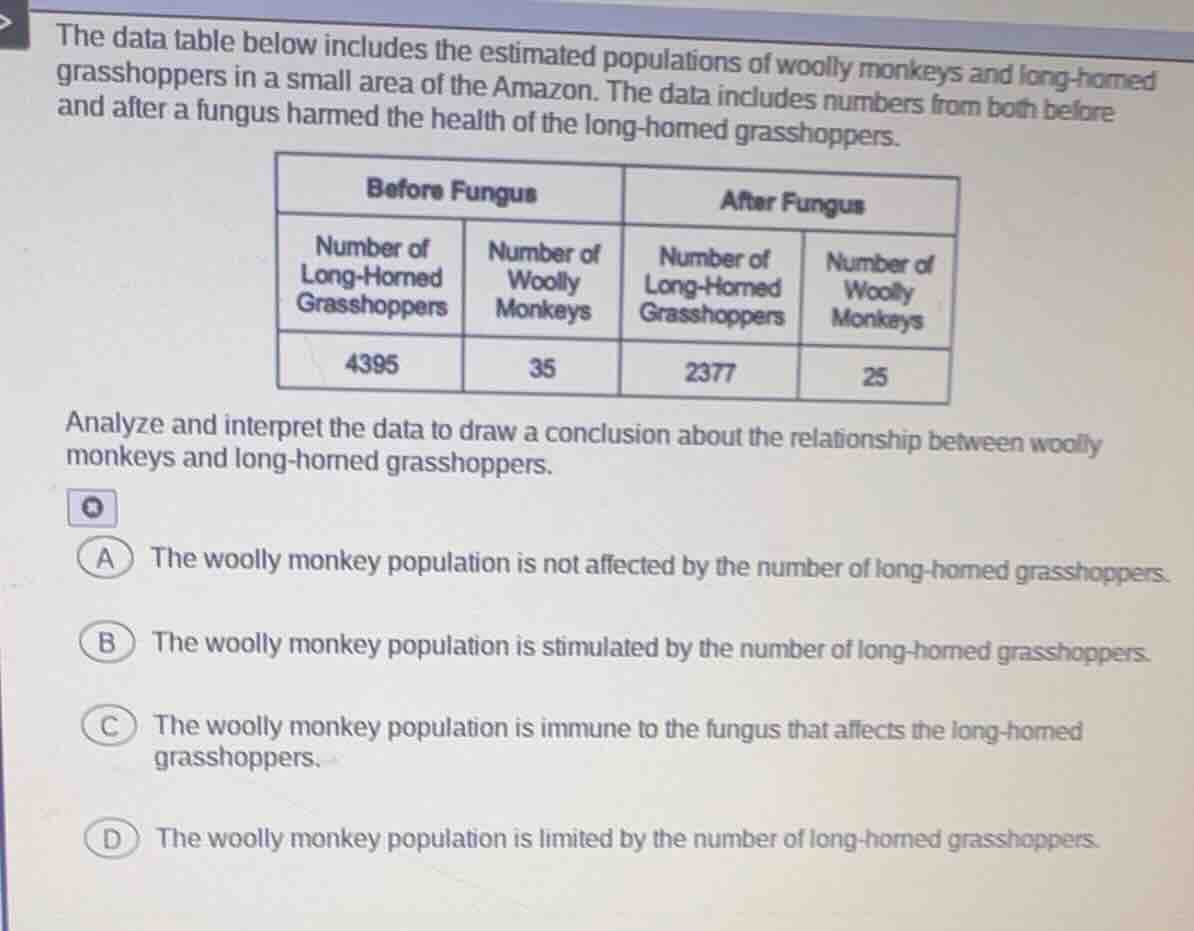
the data table below includes the estimated populations of woolly monkeys and long - horned grasshoppers in a small area of the amazon. the data includes numbers from both before and after a fungus harmed the health of the long - horned grasshoppers.
| before fungus | after fungus | ||
|---|---|---|---|
| 4395 | 35 | 2377 | 25 |
analyze and interpret the data to draw a conclusion about the relationship between woolly monkeys and long - horned grasshoppers.
a the woolly monkey population is not affected by the number of long - horned grasshoppers.
b the woolly monkey population is stimulated by the number of long - horned grasshoppers.
c the woolly monkey population is immune to the fungus that affects the long - horned grasshoppers.
d the woolly monkey population is limited by the number of long - horned grasshoppers.
- Analyze the data: Before the fungus, long - horned grasshoppers were 4395 and woolly monkeys were 35. After the fungus, long - horned grasshoppers decreased to 2377 and woolly monkeys decreased to 25.
- Evaluate Option A: Since the number of woolly monkeys changed when the number of long - horned grasshoppers changed, the woolly monkey population is affected by the number of long - horned grasshoppers. So A is incorrect.
- Evaluate Option B: When the number of long - horned grasshoppers decreased, the number of woolly monkeys also decreased. This suggests that the woolly monkey population is positively related (stimulated) by the number of long - horned grasshoppers. As the grasshopper population drops, the monkey population drops too, implying that the grasshoppers provide a resource (like food) that supports the monkey population.
- Evaluate Option C: The question is about the relationship between the two species, not about the monkey's immunity to the fungus. The data does not give any information about the monkey's immunity. So C is incorrect.
- Evaluate Option D: "Limited" might imply a negative limiting factor, but the data shows a positive relationship (more grasshoppers, more monkeys; fewer grasshoppers, fewer monkeys). So D is incorrect.

Snap & solve any problem in the app
Get step-by-step solutions on Sovi AI
Photo-based solutions with guided steps
Explore more problems and detailed explanations
B. The woolly monkey population is stimulated by the number of long - horned grasshoppers.