QUESTION IMAGE
Question
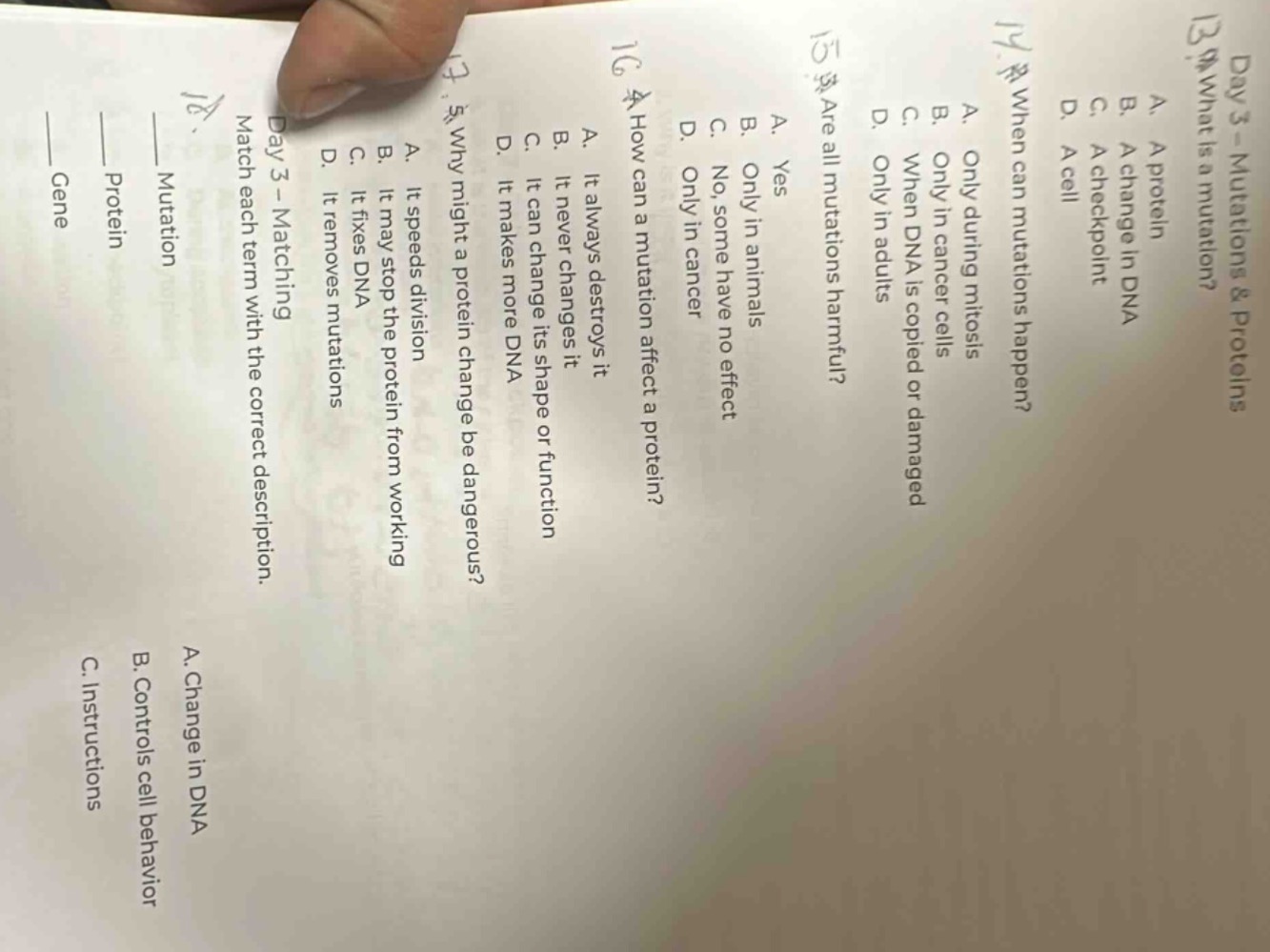
day 3 – mutations & proteins
- what is a mutation?
a. a protein
b. a change in dna
c. a checkpoint
d. a cell
- when can mutations happen?
a. only during mitosis
b. only in cancer cells
c. when dna is copied or damaged
d. only in adults
- are all mutations harmful?
a. yes
b. only in animals
c. no, some have no effect
d. only in cancer
- how can a mutation affect a protein?
a. it always destroys it
b. it never changes it
c. it can change its shape or function
d. it makes more dna
- why might a protein change be dangerous?
a. it speeds division
b. it may stop the protein from working
c. it fixes dna
d. it removes mutations
day 3 – matching
match each term with the correct description.
18.
____ mutation
____ protein
____ gene
a. change in dna
b. controls cell behavior
c. instructions
- A mutation is defined as a change in the DNA sequence.
- Mutations occur when DNA is replicated (copied) or damaged, as errors can arise during replication or from damage that is not repaired correctly.
- Not all mutations are harmful; some are neutral (have no effect) or even beneficial.
- Mutations can alter the shape or function of a protein by changing the DNA code that dictates the protein's structure.
- A protein change can be dangerous if it stops the protein from performing its essential cellular function.
18.
- Mutation: A change in the DNA sequence.
- Protein: Proteins carry out cellular processes and control cell behavior.
- Gene: A gene contains the instructions (DNA sequence) for making a protein.

Snap & solve any problem in the app
Get step-by-step solutions on Sovi AI
Photo-based solutions with guided steps
Explore more problems and detailed explanations
- B. A change in DNA
- C. When DNA is copied or damaged
- C. No, some have no effect
- C. It can change its shape or function
- B. It may stop the protein from working
18.
- Mutation: A. Change in DNA
- Protein: B. Controls cell behavior
- Gene: C. Instructions