QUESTION IMAGE
Question
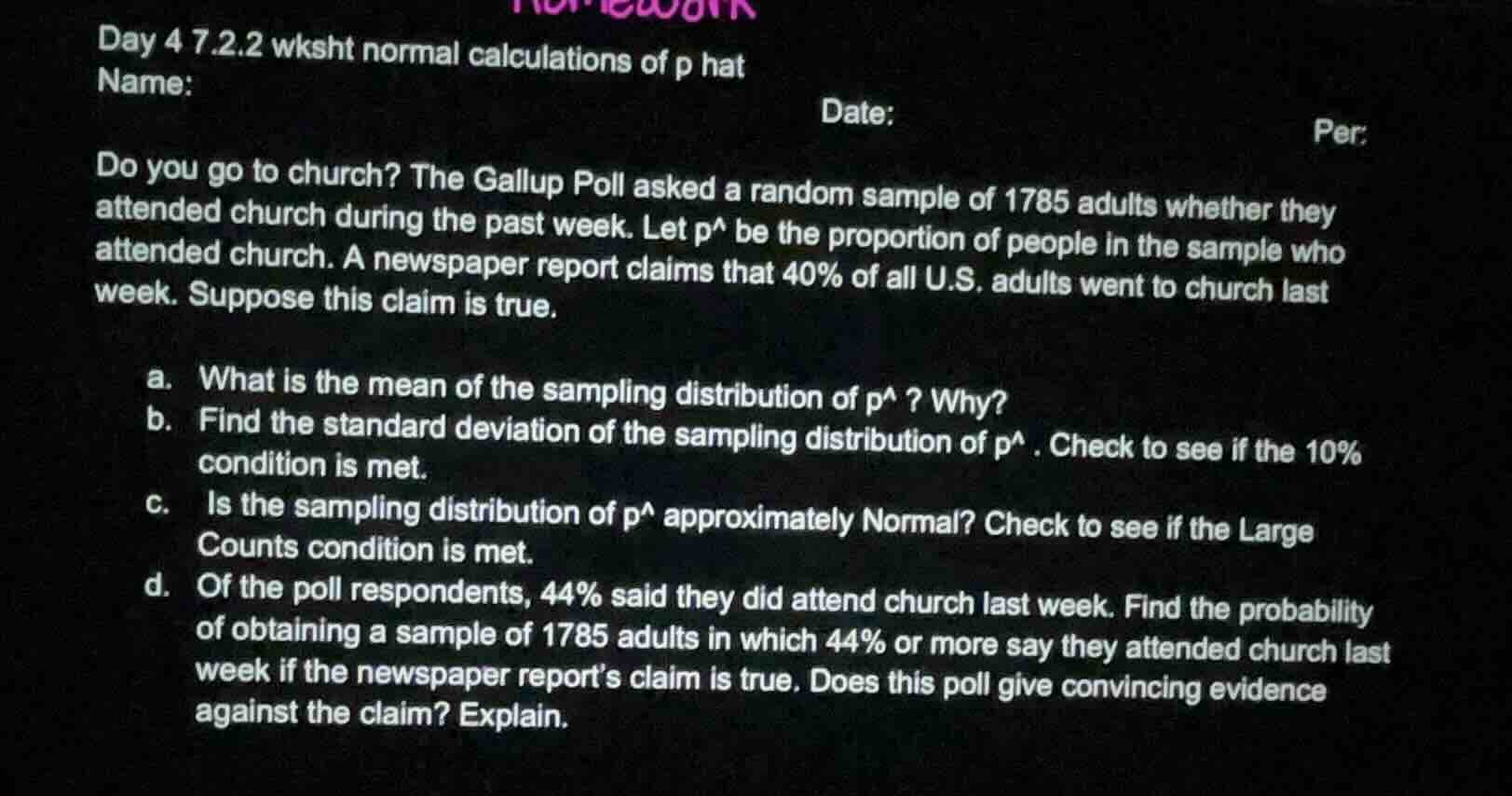
day 4 7.2.2 wksht normal calculations of p hat
name:
date:
per:
do you go to church? the gallup poll asked a random sample of 1785 adults whether they attended church during the past week. let $\hat{p}$ be the proportion of people in the sample who attended church. a newspaper report claims that 40% of all u.s. adults went to church last week. suppose this claim is true.
a. what is the mean of the sampling distribution of $\hat{p}$? why?
b. find the standard deviation of the sampling distribution of $\hat{p}$. check to see if the 10% condition is met.
c. is the sampling distribution of $\hat{p}$ approximately normal? check to see if the large counts condition is met.
d. of the poll respondents, 44% said they did attend church last week. find the probability of obtaining a sample of 1785 adults in which 44% or more say they attended church last week if the newspaper report’s claim is true. does this poll give convincing evidence against the claim? explain.
Part (a)
Step1: Recall sampling distribution mean for proportion
For a sampling distribution of a sample proportion \(\hat{p}\), the mean (expected value) is equal to the population proportion \(p\). Here, the population proportion \(p\) is given as \(0.40\) (since 40% of all U.S. adults went to church last week).
Step2: Apply the formula
The formula for the mean of the sampling distribution of \(\hat{p}\) is \(\mu_{\hat{p}} = p\). Substituting \(p = 0.40\), we get \(\mu_{\hat{p}} = 0.40\). This is because the sampling distribution of the sample proportion is centered at the true population proportion when the sample is random and the conditions for sampling (like independence) are met (which we can assume here as the sample is random and from a large population).
Step1: Recall standard deviation formula for \(\hat{p}\)
The formula for the standard deviation of the sampling distribution of \(\hat{p}\) is \(\sigma_{\hat{p}}=\sqrt{\frac{p(1 - p)}{n}}\), where \(p\) is the population proportion and \(n\) is the sample size.
Step2: Substitute values
We know \(p = 0.40\), \(1-p=1 - 0.40 = 0.60\), and \(n = 1785\). Plugging these into the formula: \(\sigma_{\hat{p}}=\sqrt{\frac{0.40\times0.60}{1785}}\). First, calculate the numerator: \(0.40\times0.60 = 0.24\). Then, divide by \(n\): \(\frac{0.24}{1785}\approx0.0001344\). Then take the square root: \(\sqrt{0.0001344}\approx0.0116\).
Step3: Check 10% condition
The 10% condition states that the sample size \(n\) should be less than or equal to 10% of the population size \(N\). Since the population of U.S. adults is very large (well over \(1785\times10 = 17850\)), \(n = 1785\) is less than 10% of the population, so the 10% condition is met. This allows us to use the formula for the standard deviation as if the samples are independent (which is a reasonable approximation when the 10% condition is met).
Step1: Recall Large Counts condition
The Large Counts condition for the sampling distribution of \(\hat{p}\) to be approximately normal is that \(np\geq10\) and \(n(1 - p)\geq10\).
Step2: Calculate \(np\) and \(n(1 - p)\)
We have \(n = 1785\), \(p = 0.40\), so \(np=1785\times0.40 = 714\) and \(n(1 - p)=1785\times0.60 = 1071\).
Step3: Check the condition
Since \(714\geq10\) and \(1071\geq10\), both conditions are satisfied. Therefore, the sampling distribution of \(\hat{p}\) is approximately Normal.

Snap & solve any problem in the app
Get step-by-step solutions on Sovi AI
Photo-based solutions with guided steps
Explore more problems and detailed explanations
The mean of the sampling distribution of \(\hat{p}\) is \(0.40\) because the mean of the sampling distribution of a sample proportion \(\hat{p}\) is equal to the population proportion \(p\), and here \(p = 0.40\).