QUESTION IMAGE
Question
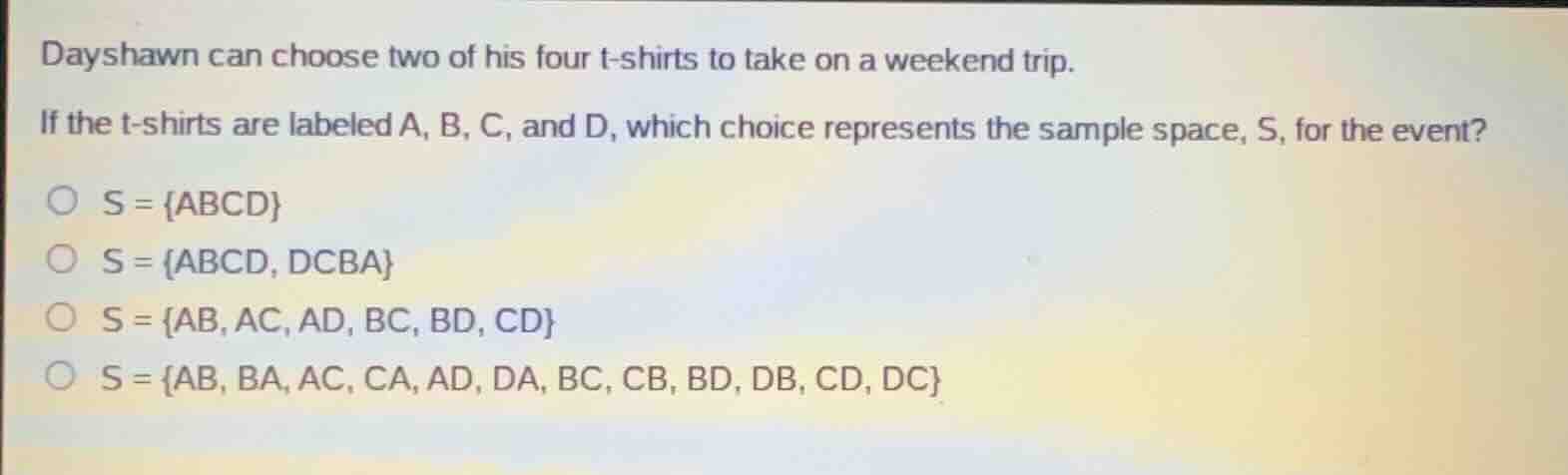
dayshawn can choose two of his four t - shirts to take on a weekend trip. if the t - shirts are labeled a, b, c, and d, which choice represents the sample space, s, for the event? \\(\bigcirc\\) \\(s = \\{abcd\\}\\) \\(\bigcirc\\) \\(s = \\{abcd, dcba\\}\\) \\(\bigcirc\\) \\(s = \\{ab, ac, ad, bc, bd, cd\\}\\) \\(\bigcirc\\) \\(s = \\{ab, ba, ac, ca, ad, da, bc, cb, bd, db, cd, dc\\}\\)
Step1: Understand Sample Space for Combinations
When choosing 2 t - shirts out of 4 (A, B, C, D) without considering order (since choosing AB is the same as choosing BA for taking t - shirts), we use combinations. The formula for combinations of \(n\) items taken \(r\) at a time is \(C(n,r)=\frac{n!}{r!(n - r)!}\), here \(n = 4\), \(r=2\), so \(C(4,2)=\frac{4!}{2!(4 - 2)!}=\frac{4\times3\times2!}{2!\times2!}=\frac{4\times3}{2\times1}=6\) possible pairs.
Step2: Analyze Each Option
- Option 1: \(S=\{ABCD\}\) represents choosing all 4 t - shirts, not 2. So this is wrong.
- Option 2: \(S = \{ABCD, DCBA\}\) also represents choosing all 4 t - shirts (just reversed order), not 2. Wrong.
- Option 3: \(S=\{AB, AC, AD, BC, BD, CD\}\). Let's count the number of pairs. For t - shirt A, it can pair with B, C, D (3 pairs: AB, AC, AD). For t - shirt B (excluding the pair with A which we already counted), it can pair with C, D (2 pairs: BC, BD). For t - shirt C (excluding pairs with A and B), it can pair with D (1 pair: CD). Total \(3 + 2+1=6\) pairs, which matches the combination result and these are unordered pairs (AB is same as BA in terms of the set of t - shirts chosen).
- Option 4: \(S=\{AB, BA, AC, CA, AD, DA, BC, CB, BD, DB, CD, DC\}\) represents permutations (where order matters), but when choosing t - shirts to take, the order of selection doesn't matter. So this is for permutations of 4 items taken 2 at a time (\(P(4,2)=\frac{4!}{(4 - 2)!}=\frac{4!}{2!}=12\)), which is not what we want here.

Snap & solve any problem in the app
Get step-by-step solutions on Sovi AI
Photo-based solutions with guided steps
Explore more problems and detailed explanations
\(S=\{AB, AC, AD, BC, BD, CD\}\) (the third option)