QUESTION IMAGE
Question
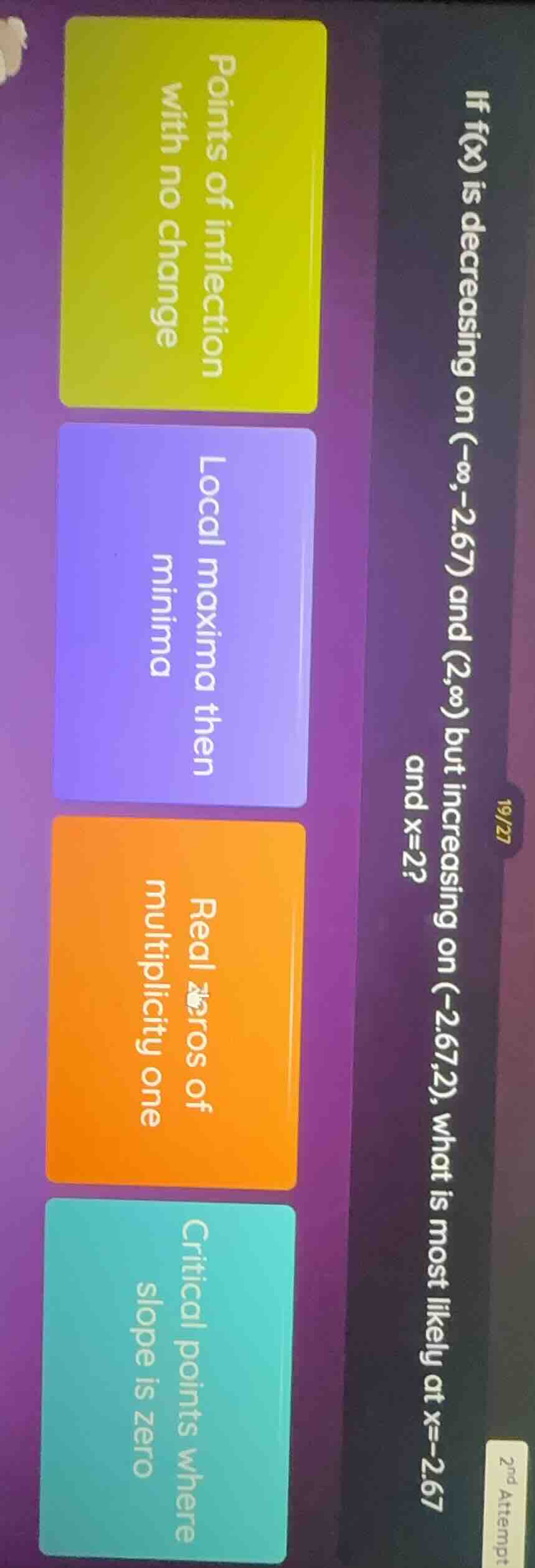
if f(x) is decreasing on (-∞,-2.67) and (2,∞) but increasing on (-2.67,2), what is most likely at x=-2.67 and x=2?
points of inflection with no change
local maxima then minima
real zeros of multiplicity one
critical points where slope is zero
Step1: Recall critical points and monotonicity
A function \( f(x) \) changes from decreasing to increasing or vice - versa at critical points. The critical points are the points where the derivative \( f^{\prime}(x) = 0 \) or \( f^{\prime}(x) \) is undefined. When a function changes from decreasing to increasing, it has a local minimum at that critical point, and when it changes from increasing to decreasing, it has a local maximum at that critical point. Also, at critical points, the slope of the tangent line (which is given by the derivative) is zero (for differentiable functions).
Given that \( f(x) \) is decreasing on \( (-\infty, - 2.67) \) and increasing on \( (-2.67,2) \), and then decreasing on \( (2,\infty) \).
Step2: Analyze the point \( x=-2.67 \)
At \( x = - 2.67 \), the function changes from decreasing (on \( (-\infty, - 2.67) \)) to increasing (on \( (-2.67,2) \)). For a differentiable function (assuming differentiable as we are dealing with critical points related to slope), at the point where the function changes from decreasing to increasing, the derivative \( f^{\prime}(x)=0 \) (slope is zero) and it is a local minimum? Wait, no. Wait, when the function changes from decreasing to increasing, it's a local minimum, but when it changes from increasing to decreasing, it's a local maximum. Wait, the question is about \( x=-2.67 \). The function is decreasing before \( x = - 2.67 \) and increasing after \( x=-2.67 \). So at \( x=-2.67 \), the function has a critical point where the slope (derivative) is zero (since it's a point where the function changes its monotonicity and we assume the function is differentiable here). Also, let's analyze the options:
- "Points of inflection with no change": Points of inflection are related to the second derivative (concavity change), not monotonicity change. So this is incorrect.
- "Local maxima then minima": At \( x=-2.67 \), the function changes from decreasing to increasing, so it's a local minimum, not a local maximum followed by minimum.
- "Real zeros of multiplicity one": The information given is about the monotonicity of the function, not about the zeros of the function. So this is incorrect.
- "Critical points where slope is zero": Since the function changes its monotonicity at \( x = - 2.67 \) (from decreasing to increasing), and for a differentiable function, at such a point the derivative (slope of the tangent) is zero. So \( x=-2.67 \) is a critical point where the slope is zero.

Snap & solve any problem in the app
Get step-by-step solutions on Sovi AI
Photo-based solutions with guided steps
Explore more problems and detailed explanations
Critical points where slope is zero