QUESTION IMAGE
Question
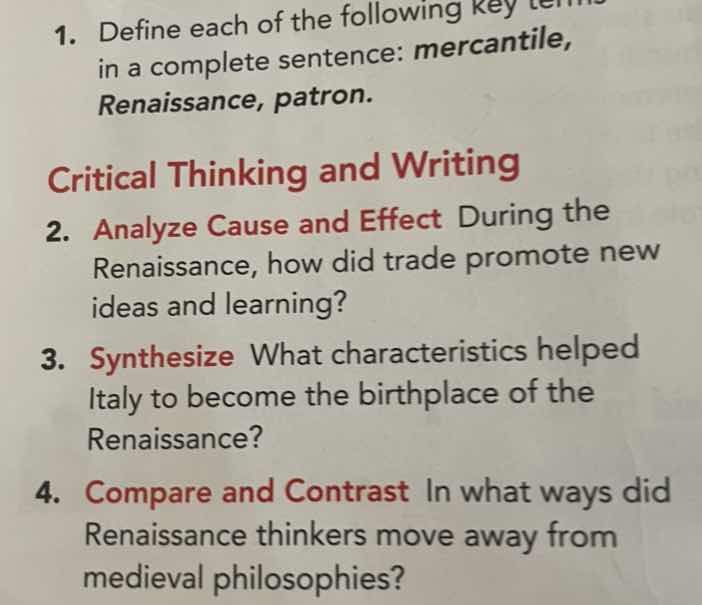
- define each of the following key terms in a complete sentence: mercantile, renaissance, patron.
critical thinking and writing
- analyze cause and effect during the renaissance, how did trade promote new ideas and learning?
- synthesize what characteristics helped italy to become the birthplace of the renaissance?
- compare and contrast in what ways did renaissance thinkers move away from medieval philosophies?
Brief Explanations
- For the key terms:
- "Mercantile" refers to systems or activities focused on trade and commerce, especially the historical mercantilist economic policies.
- "Renaissance" is a period of European history from the 14th to 17th centuries marked by a revival of interest in classical art, literature, and learning.
- A "patron" is a person who financially supports artists, scholars, or creators, common during the Renaissance.
- Trade during the Renaissance connected European cities to global markets, bringing new goods, cultural practices, and texts from other regions; merchants and travelers shared ideas, and the wealth from trade funded artists and scholars, enabling the spread of new learning.
- Italy's strategic location for Mediterranean trade created wealthy city-states with merchant classes that could fund art and learning; it was the center of the former Roman Empire, so classical ruins and texts were readily available to inspire revival; political fragmentation allowed city-states to compete culturally, fostering innovation.
- Renaissance thinkers shifted from medieval philosophy's focus on religious dogma and the afterlife to humanism, emphasizing human potential, secular subjects, individual achievement, and the study of classical Greek and Roman texts rather than just religious scriptures.

Snap & solve any problem in the app
Get step-by-step solutions on Sovi AI
Photo-based solutions with guided steps
Explore more problems and detailed explanations
1.
- Mercantile: Relating to trade, commerce, or the mercantilist economic system focused on accumulating wealth through trade.
- Renaissance: A 14th–17th century European cultural movement marked by a revival of classical learning and human-centered thought.
- Patron: An individual, often wealthy, who financially supports artists, writers, or scholars, particularly prominent during the Renaissance.
- Trade generated wealth for merchant classes who funded scholars and artists; it also connected Europe to other cultures, bringing new texts, ideas, and perspectives that challenged old ways of thinking and spread learning across regions.
- Italy's Mediterranean trade routes created wealthy city-states with funds for cultural patronage; its proximity to Roman ruins and classical texts provided direct access to ancient knowledge; political competition between city-states drove cultural innovation.
- Renaissance thinkers embraced humanism, focusing on human potential and secular life instead of medieval philosophy's primary focus on religious doctrine and the afterlife; they prioritized classical Greek and Roman texts alongside religious works, and emphasized individual achievement over collective religious identity.