QUESTION IMAGE
Question
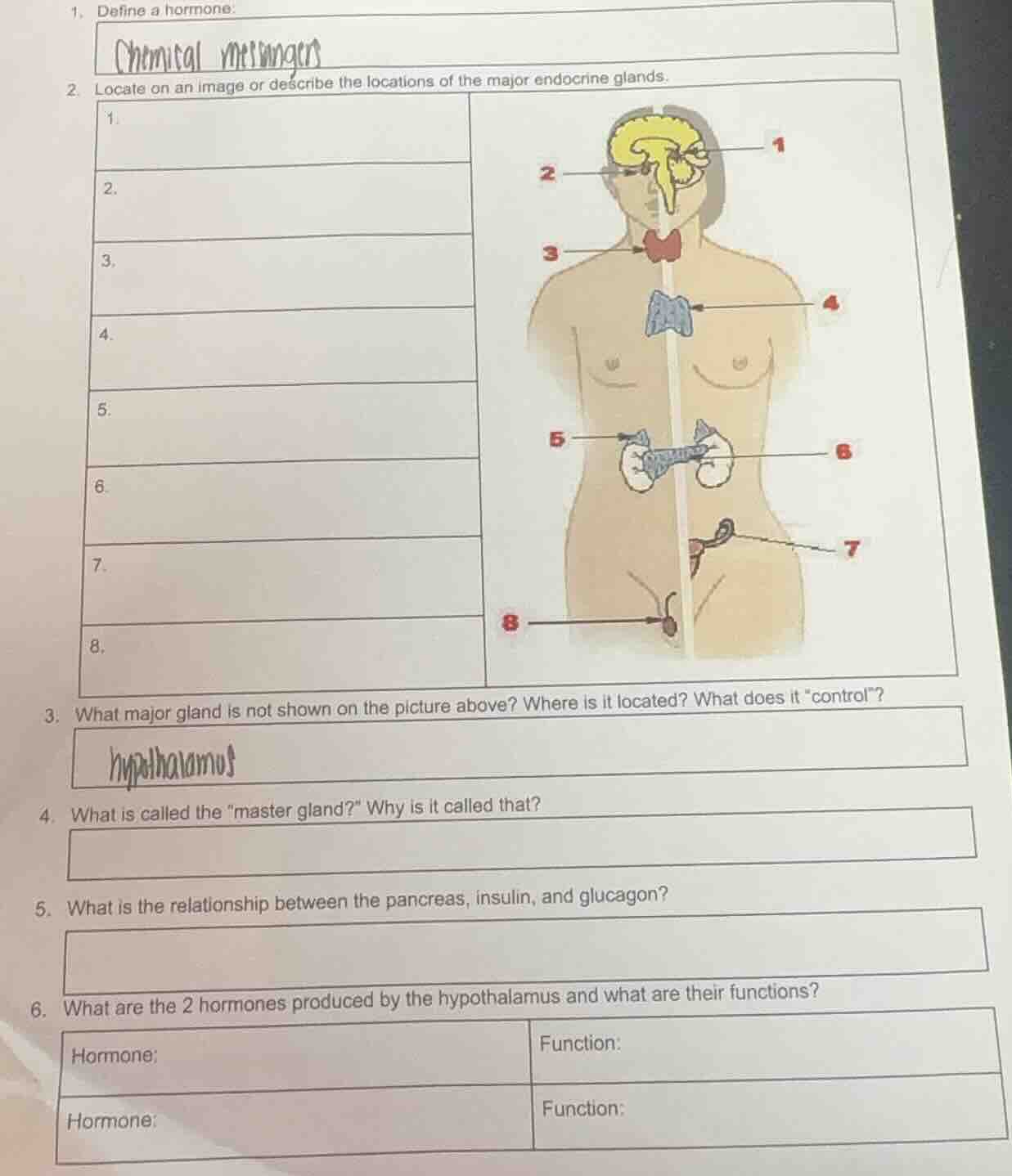
- define a hormone:2. locate on an image or describe the locations of the major endocrine glands.1.2.3.4.5.6.7.8.3. what major gland is not shown on the picture above? where is it located? what does it \control\?4. what is called the \master gland?\ why is it called that?5. what is the relationship between the pancreas, insulin, and glucagon?6. what are the 2 hormones produced by the hypothalamus and what are their functions?hormone: function:hormone: function:
Brief Explanations
- For question 1: Hormones are signaling molecules that regulate physiology.
- For question 2: Match each numbered gland to its location/name.
- For question 3: Identify the missing gland, its location, and role.
- For question 4: Name the master gland and its regulatory role.
- For question 5: Explain pancreas as the source of the two hormones and their opposing blood sugar roles.
- For question 6: List two hypothalamic hormones and their core functions.

Snap & solve any problem in the app
Get step-by-step solutions on Sovi AI
Photo-based solutions with guided steps
Explore more problems and detailed explanations
- A hormone is a chemical messenger produced by endocrine glands, released into the bloodstream to regulate distant target organs' physiological functions, growth, and development.
2.
- Pituitary gland: Base of the brain, below the hypothalamus
- Pineal gland: Deep in the brain, near the center
- Thyroid gland: Front of the neck, below the larynx
- Thymus gland: Upper chest, behind the sternum
- Adrenal glands: Top of each kidney
- Pancreas: Abdomen, behind the stomach
- Ovaries (female): Pelvic cavity, on either side of the uterus
- Testes (male): Scrotum, outside the pelvic cavity
- The major gland not shown is the hypothalamus. It is located at the base of the brain, above the pituitary gland. It controls the release of hormones from the pituitary gland, regulates body temperature, hunger, thirst, circadian rhythms, and autonomic nervous system functions.
- The pituitary gland is called the "master gland". It is named this because it produces and releases a variety of hormones that control the functions of most other endocrine glands in the body, regulating growth, reproduction, metabolism, and more.
- The pancreas is an endocrine gland that produces both insulin and glucagon. Insulin lowers blood glucose levels by promoting glucose uptake into cells and storage as glycogen. Glucagon raises blood glucose levels by stimulating the breakdown of glycogen into glucose in the liver. The two hormones work together to maintain stable blood glucose concentrations.
6.
| Hormone: | Function: |
|---|---|
| Oxytocin | Triggers uterine contractions during childbirth and stimulates milk ejection during breastfeeding; also plays a role in social bonding. |