QUESTION IMAGE
Question
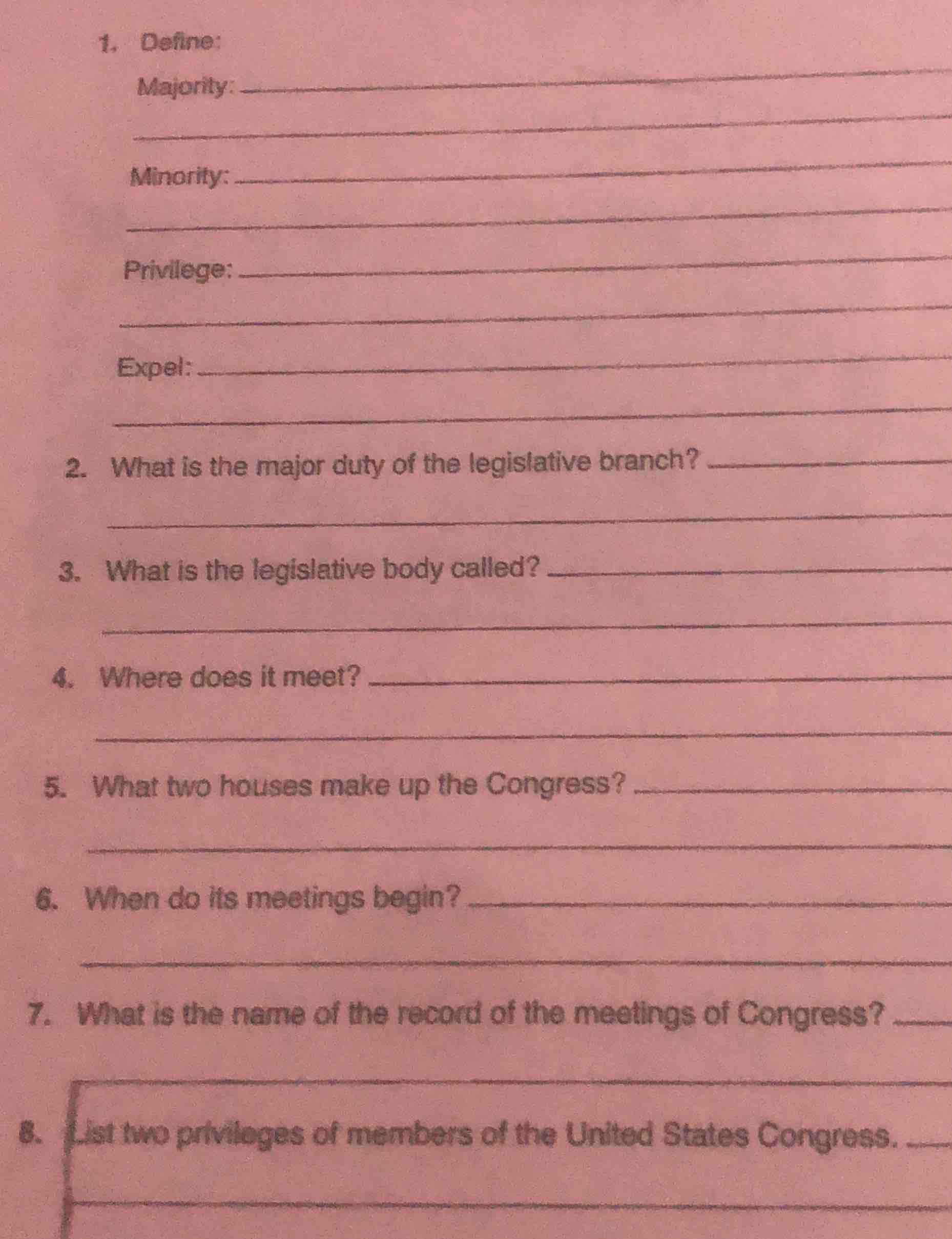
- define:
majority:
minority:
privilege:
expel:
- what is the major duty of the legislative branch?
- what is the legislative body called?
- where does it meet?
- what two houses make up the congress?
- when do its meetings begin?
- what is the name of the record of the meetings of congress?
- list two privileges of members of the united states congress.
Brief Explanations
- Defines key legislative terms, answers core U.S. legislative branch questions based on U.S. government structure.
- Addresses each question with standard, accepted definitions and facts about the U.S. Congress.

Snap & solve any problem in the app
Get step-by-step solutions on Sovi AI
Photo-based solutions with guided steps
Explore more problems and detailed explanations
1.
- Majority: The larger number or part of a group, typically more than half of the total members in a legislative body.
- Minority: The smaller number or part of a group, typically less than half of the total members in a legislative body.
- Privilege: A special right, advantage, or immunity granted to a specific group, such as members of Congress.
- Expel: To formally force a member out of a legislative body for misconduct.
- The major duty is to create, debate, and pass federal laws.
- The legislative body is called the United States Congress.
- It meets in the United States Capitol building in Washington, D.C.
- The two houses are the Senate and the House of Representatives.
- Its regular meetings begin on January 3rd of each odd-numbered year, as set by federal law.
- The record of meetings is called the Congressional Record.
- Two privileges are:
- Immunity from arrest while attending congressional sessions and traveling to/from them (for most non-felony offenses).
- Freedom of speech and debate on the floor of Congress, meaning members cannot be sued for comments made during official proceedings.