QUESTION IMAGE
Question
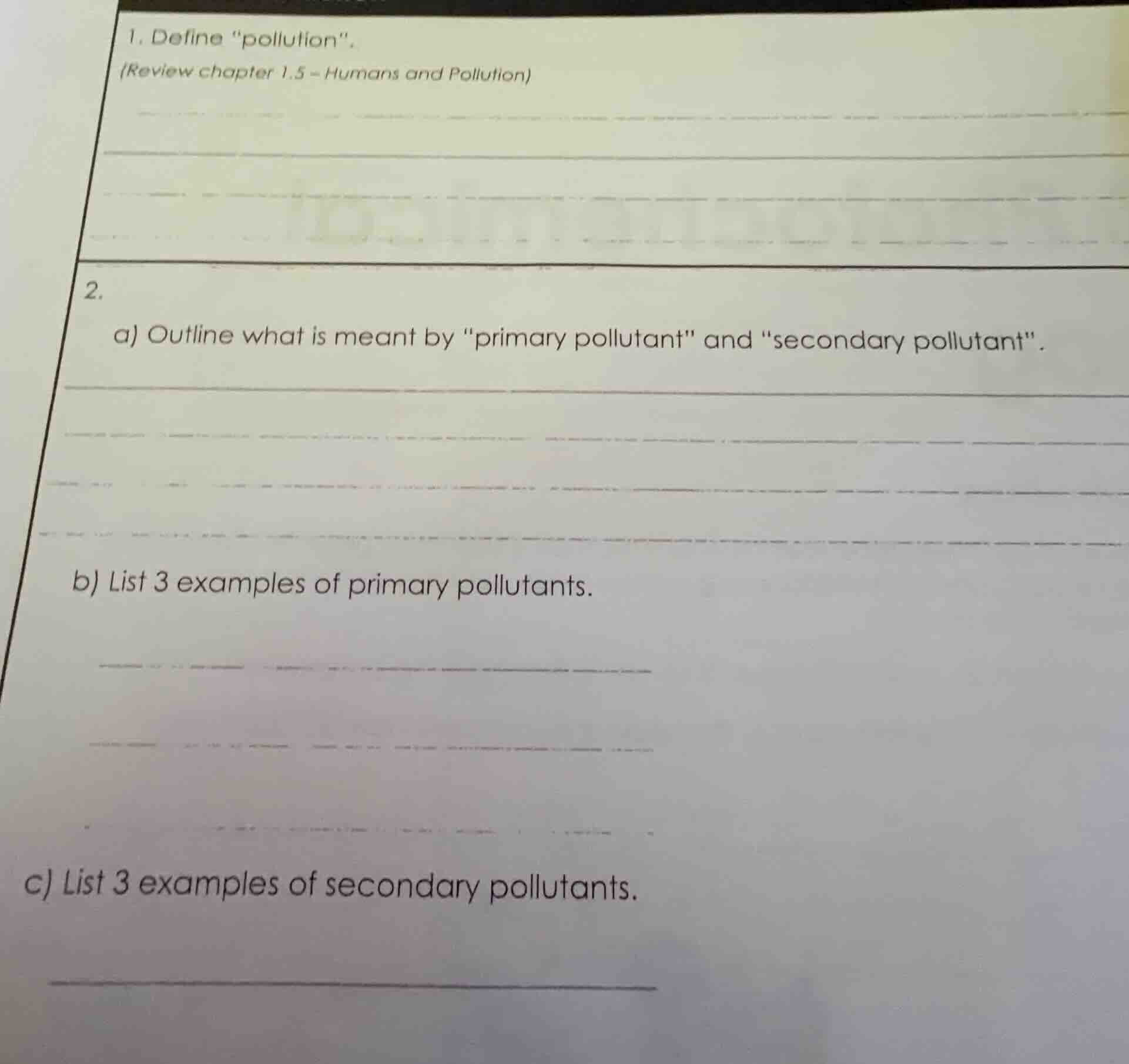
- define \pollution\.
(review chapter 1.5 – humans and pollution)
2.
a) outline what is meant by \primary pollutant\ and \secondary pollutant\.
b) list 3 examples of primary pollutants.
c) list 3 examples of secondary pollutants.
Brief Explanations
- For the definition of pollution: It refers to the introduction of harmful or toxic substances, energy, or materials into the natural environment (air, water, land) that cause harm to ecosystems, living organisms, or human health, and disrupt the normal functioning of the environment.
- a) Primary pollutants are released directly from a source into the environment in a harmful form. Secondary pollutants form when primary pollutants react with other substances in the environment (like air, water, or sunlight) to create new harmful compounds.
- b) Common primary pollutants are direct emissions from human or natural sources.
- c) Secondary pollutants form via chemical reactions in the environment from primary pollutants.

Snap & solve any problem in the app
Get step-by-step solutions on Sovi AI
Photo-based solutions with guided steps
Explore more problems and detailed explanations
- Pollution is the introduction of harmful substances, energy, or contaminants into the natural environment (air, water, soil) that cause adverse changes, harming ecosystems, wildlife, and human health, and degrading environmental quality.
- a) Primary pollutant: A harmful substance released directly from a source (natural or human-made) into the environment in its toxic form.
Secondary pollutant: A harmful substance formed when primary pollutants react with other environmental components (e.g., sunlight, water, other chemicals) rather than being emitted directly.
- b) 1. Carbon monoxide (CO) from vehicle exhaust
- Sulfur dioxide (SO₂) from fossil fuel combustion
- Volatile organic compounds (VOCs) from paint and gasoline
- c) 1. Ozone (O₃) formed from VOCs and nitrogen oxides reacting in sunlight
- Acid rain (sulfuric acid/nitric acid) formed from sulfur dioxide and nitrogen oxides reacting with atmospheric water
- Particulate matter (secondary PM₂.₅) formed from reactions of primary pollutants like nitrogen oxides and VOCs