QUESTION IMAGE
Question
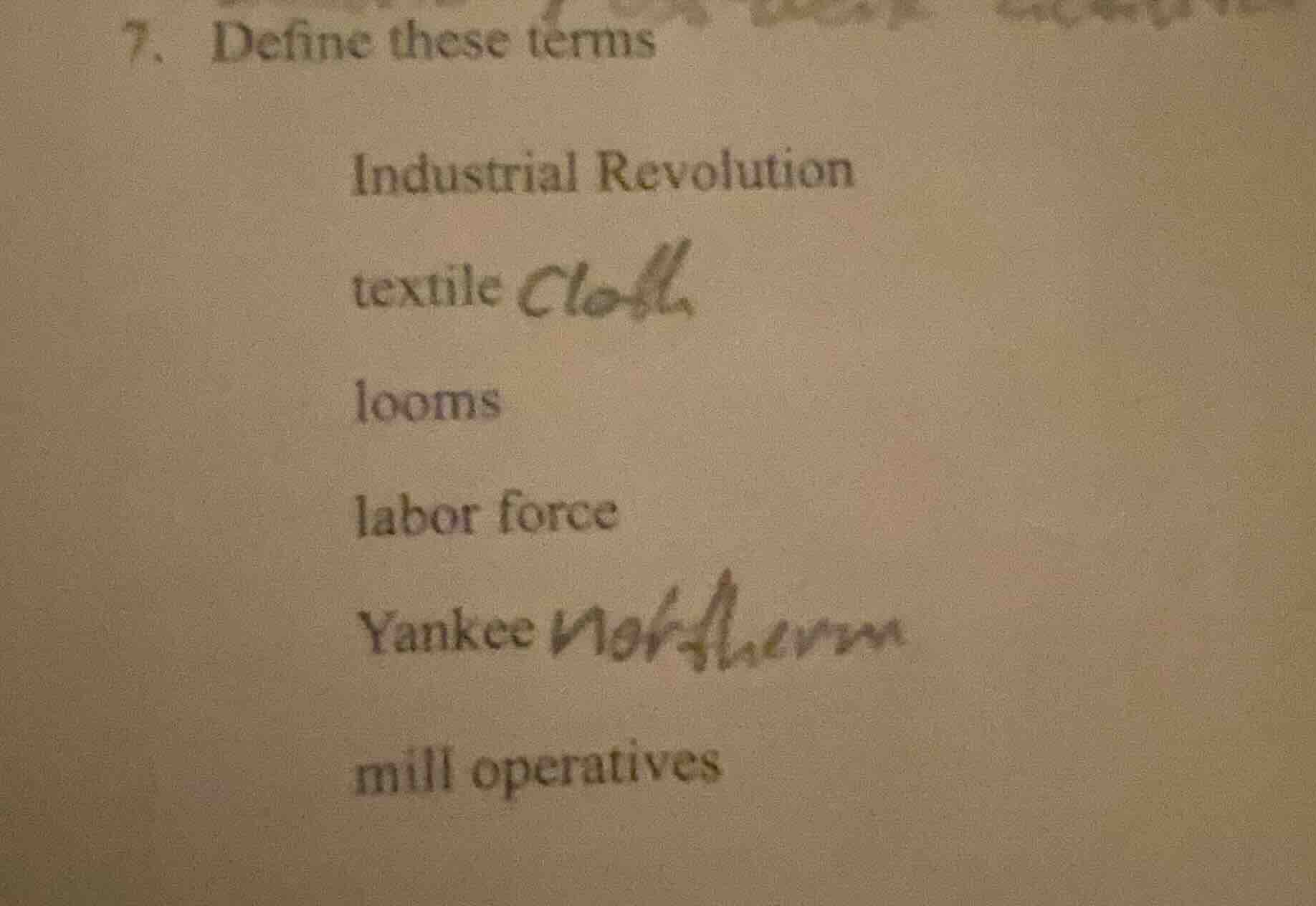
- define these terms
industrial revolution
textile
looms
labor force
yankee
mill operatives
Brief Explanations
- Industrial Revolution: A period of major technological, economic, and social shift from agrarian, handcraft-based economies to industrial, machine-driven production, starting in late 18th-century Britain.
- textile: Fibers, yarns, or woven/knitted fabrics used to make clothing, household goods, and industrial products.
- looms: Machines used to interlace threads (warp and weft) to produce woven textiles.
- labor force: All people who are either employed or actively seeking employment, available to work in an economy.
- Yankee: A term historically referring to people from the New England region of the U.S., often associated with 19th-century industrial and commercial activity there.
- mill operatives: Workers employed in a mill (typically a textile mill) who operate machinery and perform production tasks.

Snap & solve any problem in the app
Get step-by-step solutions on Sovi AI
Photo-based solutions with guided steps
Explore more problems and detailed explanations
- Industrial Revolution: A period of 18th-19th century global shift from agrarian, hand-based production to industrial, machine-driven manufacturing, marked by new technologies, urbanization, and economic restructuring.
- textile: A flexible material made by interlacing natural or synthetic fibers, used for clothing, upholstery, and industrial products.
- looms: Mechanical or electronic devices designed to weave threads into woven textiles by interlacing vertical (warp) and horizontal (weft) threads.
- labor force: The total number of people within an economy who are employed or actively looking for paid work.
- Yankee: A term originating to describe residents of the U.S. New England region, later broadly used for U.S. citizens; in 19th-century industrial contexts, it referred to New England's mill-owning and working class populations.
- mill operatives: Workers employed in a factory (especially textile mills) who operate production machinery and carry out day-to-day manufacturing tasks.