QUESTION IMAGE
Question
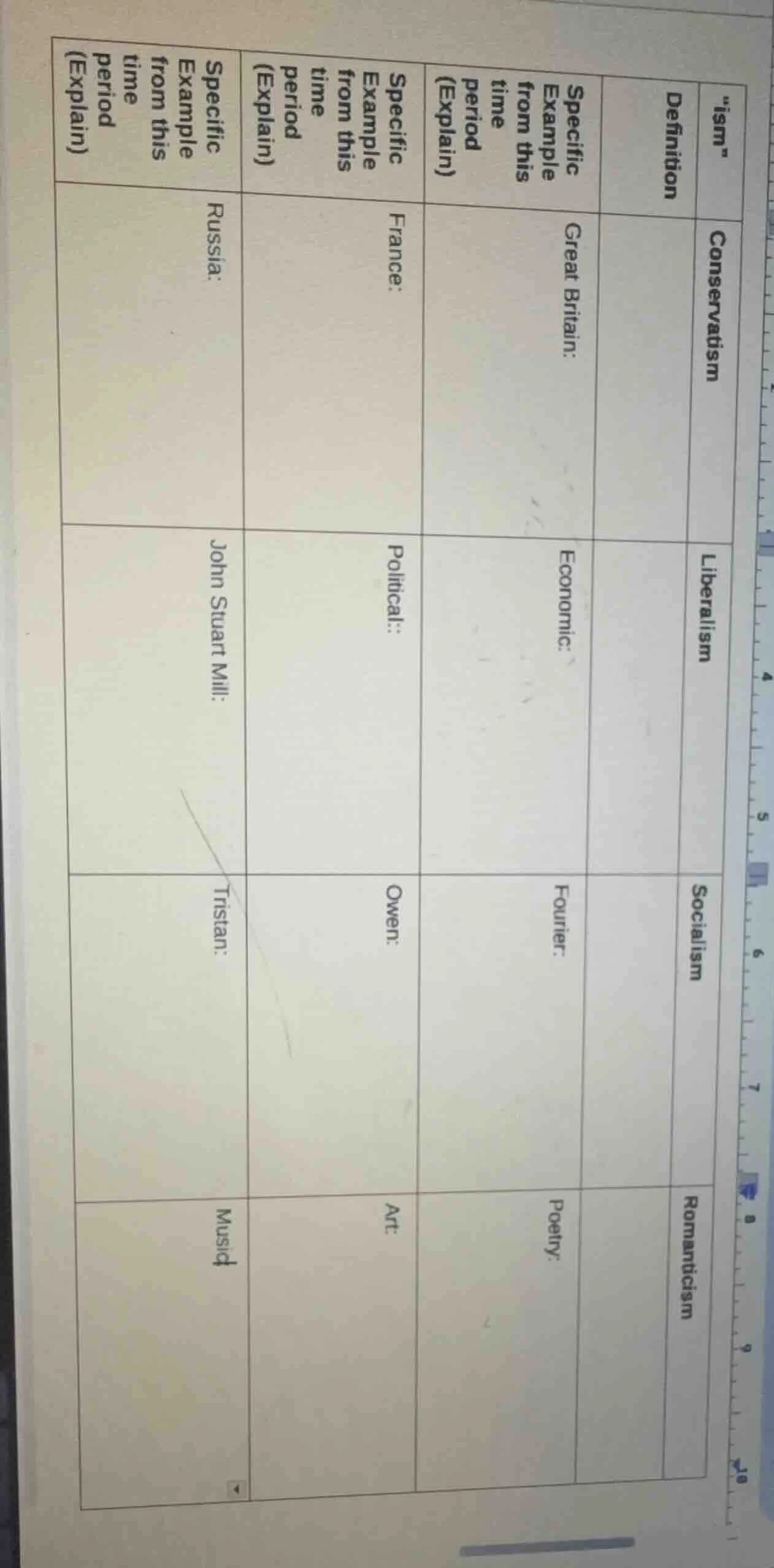
| \ism\ | definition | specific example from this time period (explain) | specific example from this time period (explain) | specific example from this time period (explain) |
|---|---|---|---|---|
| liberalism | economic: | political:: | john stuart mill: | |
| socialism | fourier: | owen: | tristan: | |
| romanticism | poetry: | art: | music |
Brief Explanations
This table is completed with core definitions and context-specific examples/explainers for each ideological and cultural movement, aligned with their key regional, disciplinary, or figure-based categories:
- Conservatism: Defined as an ideology prioritizing tradition, social stability, and gradual change over radical reform, often emphasizing established institutions.
- Liberalism: Defined as an ideology centered on individual rights, free markets, limited government, and political equality.
- Socialism: Defined as an ideology focused on collective ownership of the means of production, economic equality, and reducing class disparities.
- Romanticism: Defined as a cultural movement emphasizing emotion, individualism, nature, and rejection of Enlightenment rationality, spanning art, literature, and music.

Snap & solve any problem in the app
Get step-by-step solutions on Sovi AI
Photo-based solutions with guided steps
Explore more problems and detailed explanations
| "ism" | Definition | Specific Example from this time period (Explain) | Specific Example from this time period (Explain) | Specific Example from this time period (Explain) |
|---|---|---|---|---|
| Liberalism | Ideology centered on individual rights, free markets, limited government, and political equality | Economic: Adam Smith (1770s)<br>Smith's The Wealth of Nations laid out free-market liberalism, arguing that unregulated competition and the "invisible hand" of the market would drive prosperity, with minimal government intervention. | Political: John Locke (late 1600s)<br>Locke's Two Treatises of Government established liberal principles of natural rights (life, liberty, property), social contract theory, and the right to overthrow unjust governments. | John Stuart Mill (1850s)<br>Mill's On Liberty expanded liberal thought to defend individual freedom of speech, expression, and self-determination, arguing that state power should only limit actions that harm others. |
| Socialism | Ideology focused on collective ownership of production, economic equality, and reducing class disparities | Fourier: Charles Fourier (early 1800s)<br>A utopian socialist, he proposed cooperative "phalanxes"—shared living and working communities—where labor would be voluntary, and wealth would be distributed equitably to eliminate poverty and exploitation. | Owen: Robert Owen (early 1800s)<br>A utopian socialist, he reformed his New Lanark textile mill to provide workers with fair wages, housing, and education, advocating for collective ownership of industry to end capitalist exploitation. | Tristan: Flora Tristan (1830s-1840s)<br>A socialist and feminist, she argued that gender equality and workers' rights were interconnected, calling for working-class solidarity across genders to challenge capitalist and patriarchal systems. |
| Romanticism | Cultural movement emphasizing emotion, individualism, nature, and rejection of Enlightenment rationality | Poetry: William Wordsworth (late 1700s-early 1800s)<br>His Lyrical Ballads (with Samuel Coleridge) defined Romantic poetry, focusing on ordinary people, nature as a source of spiritual truth, and personal emotional experience. | Art: Caspar David Friedrich (early 1800s)<br>His landscape paintings (e.g., Wanderer Above the Sea of Fog) emphasized the sublime power of nature and individual introspection, core Romantic themes. | Music: Ludwig van Beethoven (early 1800s)<br>His later symphonies (e.g., Symphony No. 9) shifted from classical form to dramatic, emotional expression, reflecting Romantic individualism and passion. |