QUESTION IMAGE
Question
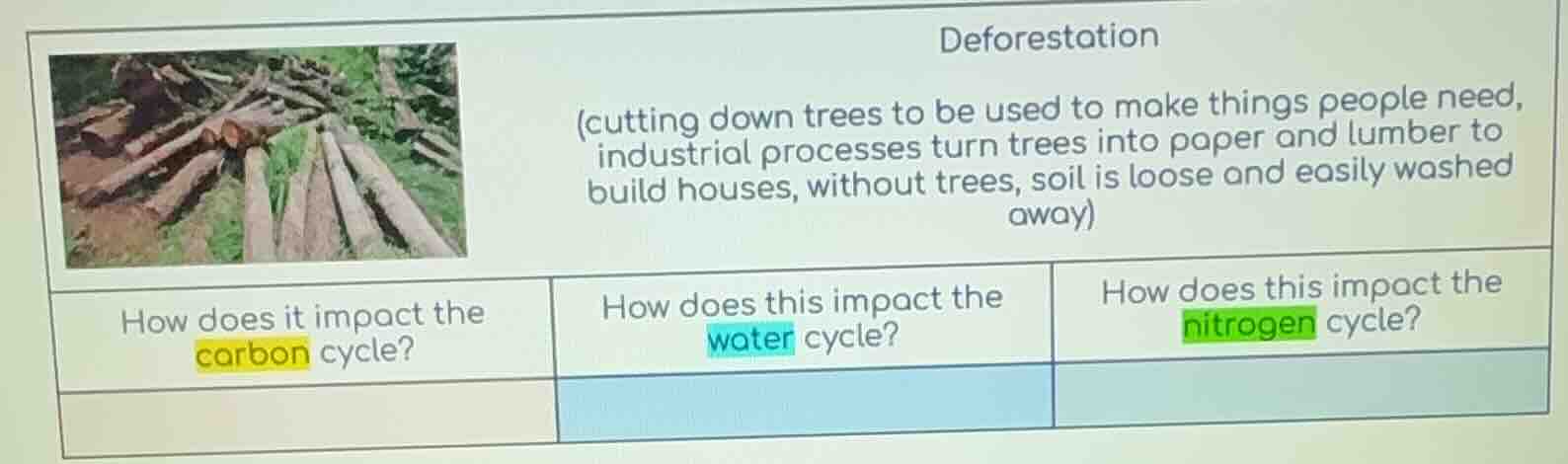
deforestation
(cutting down trees to be used to make things people need, industrial processes turn trees into paper and lumber to build houses, without trees, soil is loose and easily washed away)
how does it impact the
carbon cycle?
how does this impact the
water cycle?
how does this impact the
nitrogen cycle?
Brief Explanations
- Carbon Cycle Impact: Trees absorb atmospheric carbon dioxide via photosynthesis, storing carbon in biomass. Deforestation removes this carbon sink, releases stored carbon through burning/decomposition, increasing atmospheric CO₂.
- Water Cycle Impact: Trees take up soil water and release it via transpiration. Without trees, transpiration drops, reducing atmospheric moisture and local rainfall. Loose soil also increases runoff, reducing groundwater recharge.
- Nitrogen Cycle Impact: Trees and soil microbes in forests fix and cycle nitrogen. Deforestation removes plant uptake, leads to nitrogen leaching from unprotected soil into waterways, and reduces microbial nitrogen cycling, disrupting soil nitrogen availability.

Snap & solve any problem in the app
Get step-by-step solutions on Sovi AI
Photo-based solutions with guided steps
Explore more problems and detailed explanations
- Impact on carbon cycle: Deforestation reduces the number of trees that absorb atmospheric $\text{CO}_2$ through photosynthesis, and decomposing or burned tree biomass releases stored carbon back into the atmosphere, increasing atmospheric carbon dioxide levels and disrupting the natural carbon balance.
- Impact on water cycle: It decreases transpiration (the release of water vapor from trees into the air), reducing local precipitation. Loose, unprotected soil also increases surface runoff, which reduces groundwater infiltration and can lead to soil erosion, disrupting water storage and flow patterns.
- Impact on nitrogen cycle: Without trees to take up soil nitrogen, nitrogen is more easily leached from the soil into aquatic systems, causing nutrient pollution. The loss of forest soil microbes (which cycle nitrogen) also reduces nitrogen fixation and recycling, lowering soil nitrogen availability for remaining plants.