QUESTION IMAGE
Question
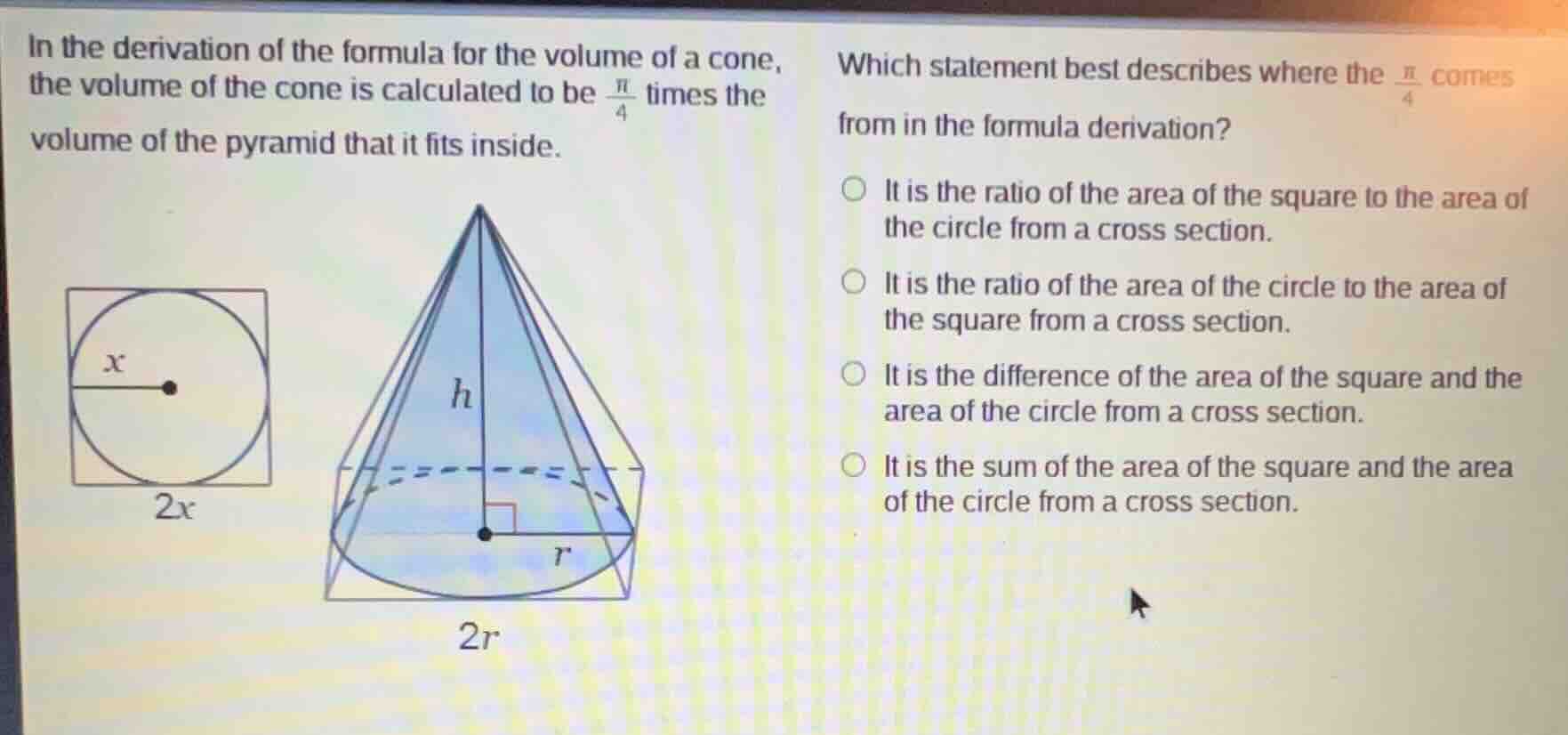
in the derivation of the formula for the volume of a cone, the volume of the cone is calculated to be \\(\frac{\pi}{4}\\) times the volume of the pyramid that it fits inside. which statement best describes where the \\(\frac{\pi}{4}\\) comes from in the formula derivation? \\(\circ\\) it is the ratio of the area of the square to the area of the circle from a cross section. \\(\circ\\) it is the ratio of the area of the circle to the area of the square from a cross section. \\(\circ\\) it is the difference of the area of the square and the area of the circle from a cross section. \\(\circ\\) it is the sum of the area of the square and the area of the circle from a cross section.
To determine where \(\frac{\pi}{4}\) comes from, we analyze the cross - section (the square with the inscribed circle).
- First, find the area of the circle: The radius of the circle is \(r\) (or \(x\) in the left - hand diagram), so the area of the circle \(A_{circle}=\pi r^{2}\).
- Then, find the area of the square: The side length of the square is equal to the diameter of the circle, which is \(2r\) (or \(2x\) in the left - hand diagram). So the area of the square \(A_{square}=(2r)^{2} = 4r^{2}\).
- Next, calculate the ratio of the area of the circle to the area of the square: \(\frac{A_{circle}}{A_{square}}=\frac{\pi r^{2}}{4r^{2}}=\frac{\pi}{4}\).
This ratio \(\frac{\pi}{4}\) is the ratio of the area of the circle to the area of the square from the cross - section. The first option is incorrect because it is the reverse ratio. The third option is incorrect as we are looking for a ratio, not a difference. The fourth option is incorrect as we are looking for a ratio, not a sum.

Snap & solve any problem in the app
Get step-by-step solutions on Sovi AI
Photo-based solutions with guided steps
Explore more problems and detailed explanations
It is the ratio of the area of the circle to the area of the square from a cross section.