QUESTION IMAGE
Question
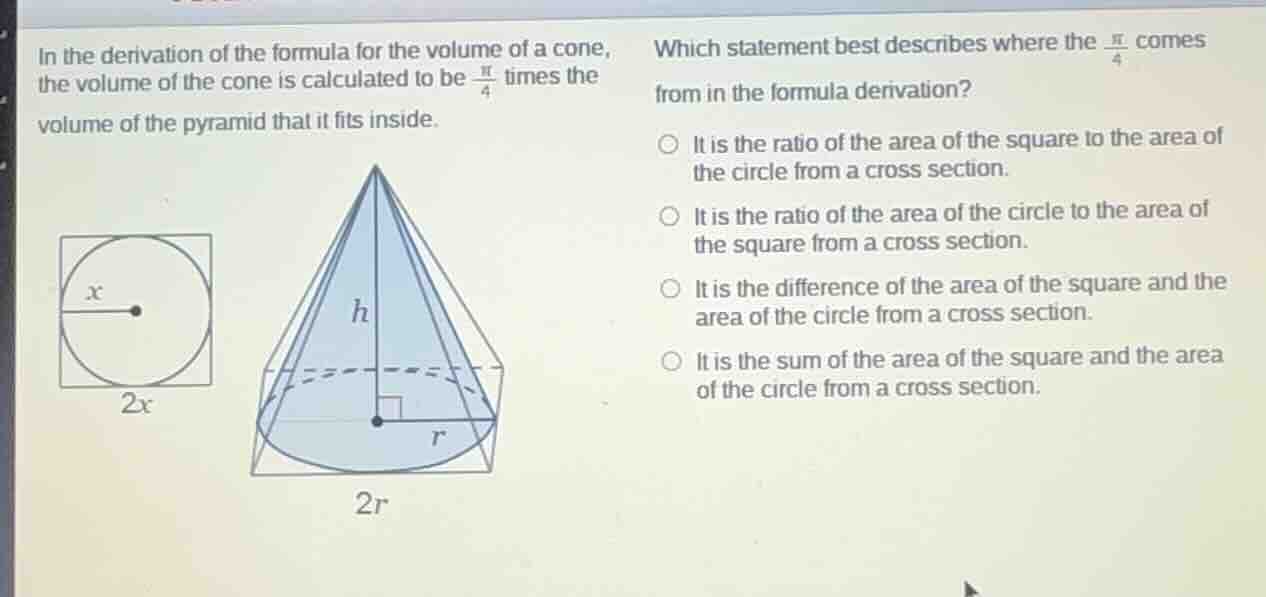
in the derivation of the formula for the volume of a cone, the volume of the cone is calculated to be \\(\frac{\pi}{4}\\) times the volume of the pyramid that it fits inside. which statement best describes where the \\(\frac{\pi}{4}\\) comes from in the formula derivation? \\(\bigcirc\\) it is the ratio of the area of the square to the area of the circle from a cross section. \\(\bigcirc\\) it is the ratio of the area of the circle to the area of the square from a cross section. \\(\bigcirc\\) it is the difference of the area of the square and the area of the circle from a cross section. \\(\bigcirc\\) it is the sum of the area of the square and the area of the circle from a cross section.
First, calculate the area of the circle with radius $x$: $A_{circle} = \pi x^2$. Then calculate the area of the square with side length $2x$: $A_{square} = (2x)^2 = 4x^2$. The ratio of the circle's area to the square's area is $\frac{\pi x^2}{4x^2} = \frac{\pi}{4}$, which matches the factor in the cone volume derivation relative to the enclosing pyramid.

Snap & solve any problem in the app
Get step-by-step solutions on Sovi AI
Photo-based solutions with guided steps
Explore more problems and detailed explanations
B. It is the ratio of the area of the circle to the area of the square from a cross section.